
The best Arena 9 decks fit the cards you have leveled. For Arena 9, start with Giant Dart Goblin Control if your card levels are comparable. Its defensive jobs are easy to follow, and Giant turns surviving defenders into pressure. Choose Goblin Barrel Dart Bait if you enjoy tracking spells, or Hog Poison Valkyrie for direct attacks with area control. A better-leveled suitable deck can be the stronger practical choice, so use the three-way comparison first and learn one list instead of upgrading all 30.
Jungle Arena begins at 2,600 trophies and runs toward Hog Mountain at 3,000. The new cards give you more ways to attack, but the question remains simple: after spending on that attack, who is left to stop the next push?
Best Arena 9 decks by defensive role
| Starting deck | Avg. elixir | Choose it when |
|---|---|---|
| Giant Dart Goblin Control | 3.5 | You want a clear tank response and patient counterpush. Avoid it if both ranged and air support are too weak to survive their jobs. |
| Goblin Barrel Dart Bait | 3.3 | You can track more than one Barrel counter. Avoid it if you tend to throw Barrel immediately after any small spell. |
| Hog Poison Valkyrie | 3.1 | You like repeated Hog attacks and can wait for valuable Poison targets. Avoid it if you need the spell to remove a defender instantly. |
Check the main air defender before the win condition. Dart Goblin is cheap and reaches far, but he is fragile. Musketeer is a steadier ranged option when her level fits your opponents. A building that pulls Balloon buys time; it does not necessarily shoot air. The deck needs both parts of that defense.
If you already have a dependable foundation from the Royal Arena guide, keep the useful levels. Change a card because it solves a repeated problem, not because the arena background changed.
What Jungle Arena changes
Dart Goblin and Goblin Gang add ranged and swarm support. Skeleton Barrel gives you a different approach to the tower, while Goblin Giant carries his own Spear Goblins. Barbarian Barrel provides ground removal with a surviving body, and Poison controls an area over time. Those cards expand your choices, but they do not all belong in one deck.
The maintained arena card listing also includes Berserker and Rune Giant here. You do not need every new unlock to build a coherent deck. These recommendations use established standard-card combinations with the roles explained below; omission is not a claim that another card is weak.
The gallery order is left to right across the top row, then the bottom row. The card list and copy link follow that same order. Each replacement below is a separate one-card alternative; applying both changes the listed average and may alter another defensive job.
Jump to the style you want to learn
Three starting choices for Jungle Arena
Choose the version whose defensive cards already work at your levels. These three lists introduce different attack timings without requiring later-arena Legendary cards.
Giant Dart Goblin Control
Safest Jungle Arena starting point when the new Dart Goblin is leveled.
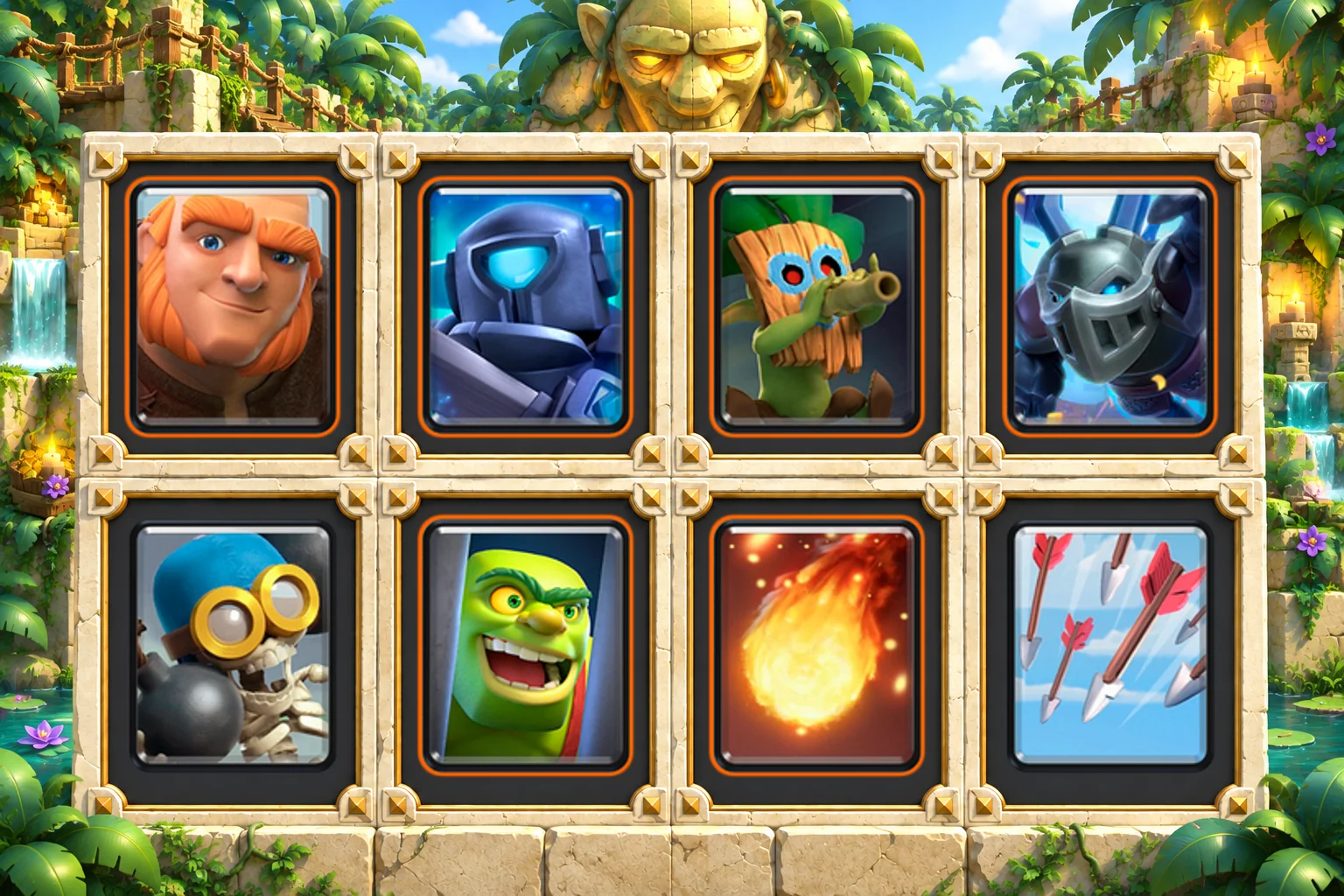
Average elixir: 3.5
Eight cards and their jobs
- Giant (5 elixir): Building-targeting tank placed in front of surviving defenders.
- Mini P.E.K.K.A (4 elixir): Concentrated ground damage against a tank or other high-health attacker.
- Dart Goblin (3 elixir): Fragile long-range air and ground shooter; give him a clear firing angle and avoid shared spell damage.
- Mega Minion (3 elixir): Durable single flying attacker for focused air or ground damage.
- Bomber (2 elixir): Cheap ground splash behind a tank or defensive distraction; cannot shoot air.
- Goblin Cage (4 elixir): Pulls building-targeting threats, then releases a ground Brawler counterpush.
- Fireball (4 elixir): Immediate area damage and knockback; spend for useful defense or support value.
- Arrows (3 elixir): Wide air and ground swarm removal; no reset effect.
Give each defender a separate job
Mini P.E.K.K.A damages tanks, Bomber clears ground swarms, and Dart Goblin shoots from range. Place Giant ahead of a useful surviving defender after the defense. Buying every supporting troop for a fresh push is too expensive to make your default attack.
Opening and double elixir
Wait for a Cage target or use a protected Dart Goblin position while learning what can reach him. Set him far enough from the pull that splash aimed at the tank cannot catch him as well. In double elixir, a surviving Brawler can already demand an answer; Giant is worth adding only if the remaining hand still covers the opposite lane.
Defensive order and matchups
Against Hog Rider: Watch the Hog's path before adding another defender. A Cage that draws it into tower fire can make a second four-elixir ground card unnecessary; use the backup when the placement, support or level difference demands it.
Against Balloon: Give Dart Goblin shooting time before Balloon arrives. Place Mega Minion on a separate approach so a spell aimed at the fragile shooter does not remove the entire defense. Cage is a diversion, not air damage.
A decision during the match
For example, you defend and have a Brawler walking forward, but the opponent removes Dart Goblin with Arrows. Adding Giant is tempting. If Balloon is their next threat, keep Mega Minion and enough elixir to draw it instead. A smaller counterpush is worth more than donating the next tower.
Mistake to avoid: Treating Dart Goblin as a durable Musketeer.
One-card alternatives and upgrades
- Musketeer for Dart Goblin: Sturdier air shooter for one extra elixir. New average 3.6 elixir.
- Valkyrie for Bomber: Durable ground splash but two extra elixir. New average 3.8 elixir.
Upgrade focus: Giant, Dart Goblin, Fireball, Mini P.E.K.K.A.
Giant and Mini P.E.K.K.A need useful levels in their direct fights. Dart Goblin earns upgrades when he survives long enough to contribute; if he is far behind, use the sturdier substitution rather than pretending range compensates for every level gap.
Goblin Barrel Dart Bait
First bait choice for players who track a small spell.
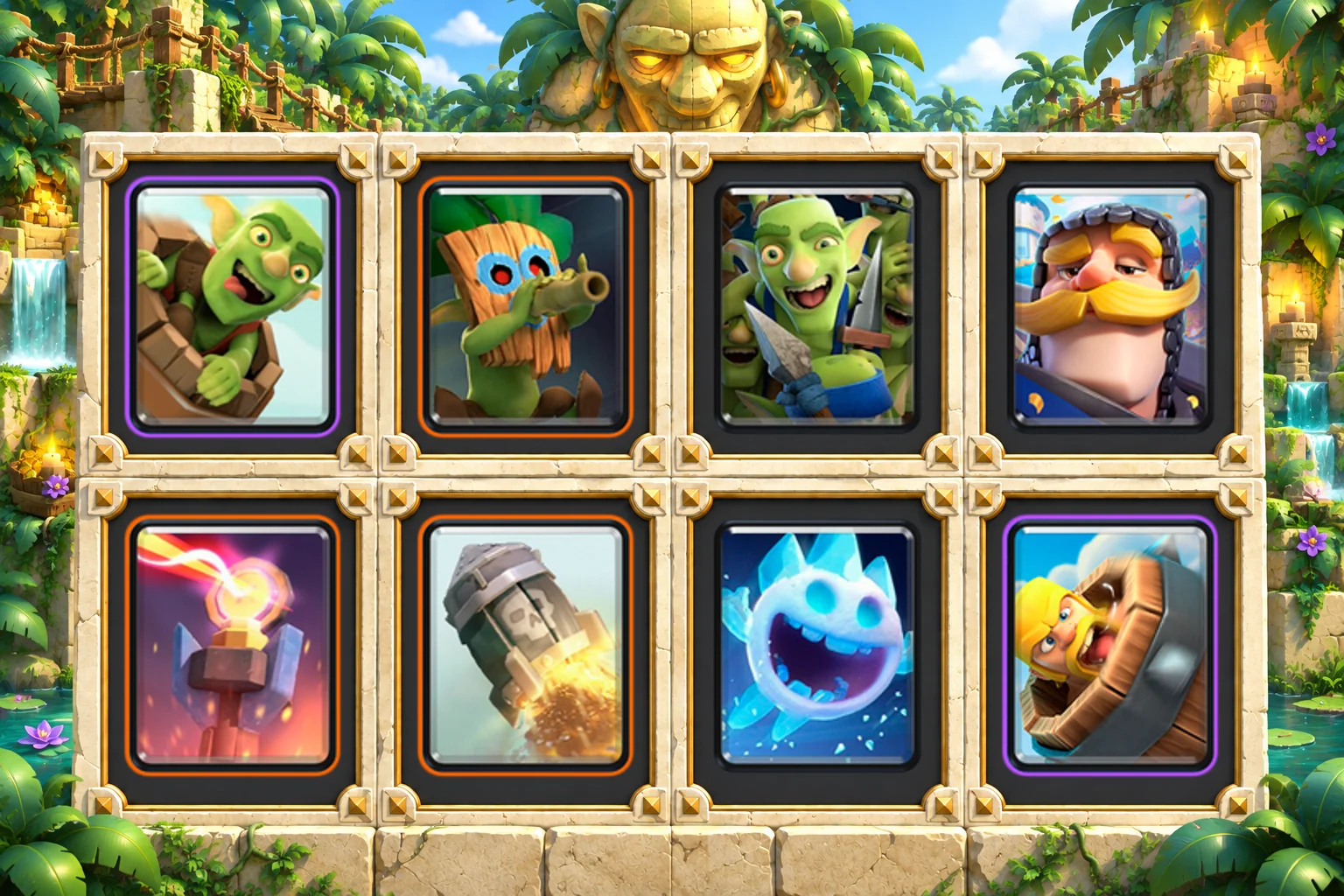
Average elixir: 3.3
Eight cards and their jobs
- Goblin Barrel (3 elixir): Tower pressure that rewards tracking the opponent's small-spell cycle.
- Dart Goblin (3 elixir): Fragile long-range air and ground shooter; protect his firing angle and spell exposure.
- Goblin Gang (3 elixir): Mixed melee and spear bodies for surrounds and supplementary air damage; fragile to spells.
- Knight (3 elixir): Low-cost ground tank that occupies support and protects ranged damage.
- Inferno Tower (5 elixir): Increasing damage against a focused target; protect it against reset and distractions.
- Rocket (6 elixir): Expensive concentrated damage; check current level-specific tower damage before a finish.
- Ice Spirit (1 elixir): Brief freeze and a cheap rotation; buys time rather than sustained damage.
- Barbarian Barrel (2 elixir): Ground-line removal and a Barbarian body; cannot damage air.
Track both answers to Goblin Barrel
Bait works because the opponent has more than one problem to answer, not because Goblin Barrel becomes unstoppable. Knight buys Inferno Tower time, while the ranged units invite spells you would prefer to draw away from the attacking Barrel. Preserve that defensive structure before trying to create a spell shortage.
Opening and double elixir
The first Barrel is a question: which card stops it, and from what position? Once you know, watch the opponent's next plays. In double elixir you can probe more often, but a six-elixir Rocket leaves little room for an emergency Inferno. Check the tower damage displayed in your game before attempting a finish.
Defensive order and matchups
Against Giant: Do not surround a Giant while Wizard is freely shooting through the Gang. Knight must occupy or separate the support first. If the support cannot be reached safely, delay the Gang and accept a smaller trade rather than losing every body to splash.
Against Balloon: Dart Goblin should begin shooting while Balloon is travelling toward Inferno. Protect the building's beam from distractions. Spear Goblins add damage, but relying on them alone invites the opponent's small spell to decide the exchange.
A decision during the match
Suppose Zap clears your Gang and the opponent still has Arrows. Sending Barrel immediately does not exploit a missing answer. Use Dart Goblin to defend the next push, see whether Arrows is committed there, and only then judge whether Barrel can profit. Sometimes their second answer is a troop instead.
Mistake to avoid: Spending Barbarian Barrel as if it could clear an air swarm.
One-card alternatives and upgrades
- Arrows for Barbarian Barrel: Air swarm removal at extra cost, loses Barbarian. New average 3.4 elixir.
- Valkyrie for Knight: Ground splash at a heavier cycle. New average 3.4 elixir.
Upgrade focus: Goblin Barrel, Dart Goblin, Inferno Tower, Rocket.
Barrel levels matter only when its Goblins reach the tower. Keep Inferno and Dart Goblin strong enough to earn repeated attacks, then improve Rocket if its actual damage is part of your endgame. Do not abandon defense just to chase a spell finish.
Hog Poison Valkyrie
A slower area-control Hog alternative to Fireball.

Average elixir: 3.1
Eight cards and their jobs
- Hog Rider (4 elixir): Main tower-pressure card; hold defensive elixir after sending him.
- Valkyrie (4 elixir): Ground splash defender for clustered support and swarms; cannot attack air.
- Musketeer (4 elixir): Sustained ranged air and ground damage; keep her away from overlapping spell value.
- Goblin Gang (3 elixir): Mixed melee and spear bodies for surrounds and supplementary air damage; fragile to spells.
- Cannon (3 elixir): Cheap ground-targeting pull; can draw Balloon but cannot shoot it.
- Ice Spirit (1 elixir): Brief freeze and a cheap rotation; buys time rather than sustained damage.
- Poison (4 elixir): Damage over time and area denial; not an instant removal spell.
- Zap (2 elixir): Small air and ground hit plus brief stun/reset; does not replace heavy damage.
Use Poison when defenders stay in its area
This Hog list trades immediate spell impact for control of an area. Poison can make a repeated defensive position uncomfortable, but Hog does not wait patiently for every tick. The combination is worthwhile when the spell also damages a building or support that would otherwise survive and counterattack.
Opening and double elixir
Wait for an approaching threat before placing Cannon. A lone Hog can reveal the first defense when you retain enough elixir for the return attack. Keep the four elixir for Poison until the defender actually appears. In double elixir, send another Hog when you can cover the return attack; do not cycle Cannon out of hand merely to reach the next offensive card.
Defensive order and matchups
Against Witch: Witch continues creating a problem while Poison works. Put Valkyrie where she can engage the support without dragging Musketeer into the same splash line. Cannon draws the front unit so those jobs can happen separately.
Against Balloon: Deploy Musketeer with room to shoot before Balloon reaches the pull. If their spell threatens her, Gang is a secondary contribution rather than a substitute for the main shooter. Zap buys a moment but cannot supply the missing sustained damage.
A decision during the match
Imagine Hog has already been pulled across the middle and is nearly defeated. Poisoning the building now may leave you without the four elixir needed for Musketeer against Balloon. Let that Hog go, defend, and use the information about their building placement on the next attack.
Mistake to avoid: Treating Poison like instant knockback or a reset.
One-card alternatives and upgrades
- Fireball for Poison: Immediate damage and knockback, loses lingering control. New average 3.1 elixir.
- Guards for Goblin Gang: Shields for ground defense, loses Spear Goblin air help. New average 3.1 elixir.
Upgrade focus: Hog Rider, Musketeer, Poison, Cannon.
A playable Musketeer is central to this list. After Hog, put resources into the defensive interaction that repeatedly fails, then the spell. The Fireball replacement keeps the same average cost but changes the timing of the deck substantially.
Bait decks that track the small spell
A spell spent on one threat creates an opportunity only if the opponent lacks a suitable second answer. The following lists reward watching the remaining hand before committing another Barrel.
Double Barrel Knight Bait
For a player whose Barrel is always met by one ready spell.
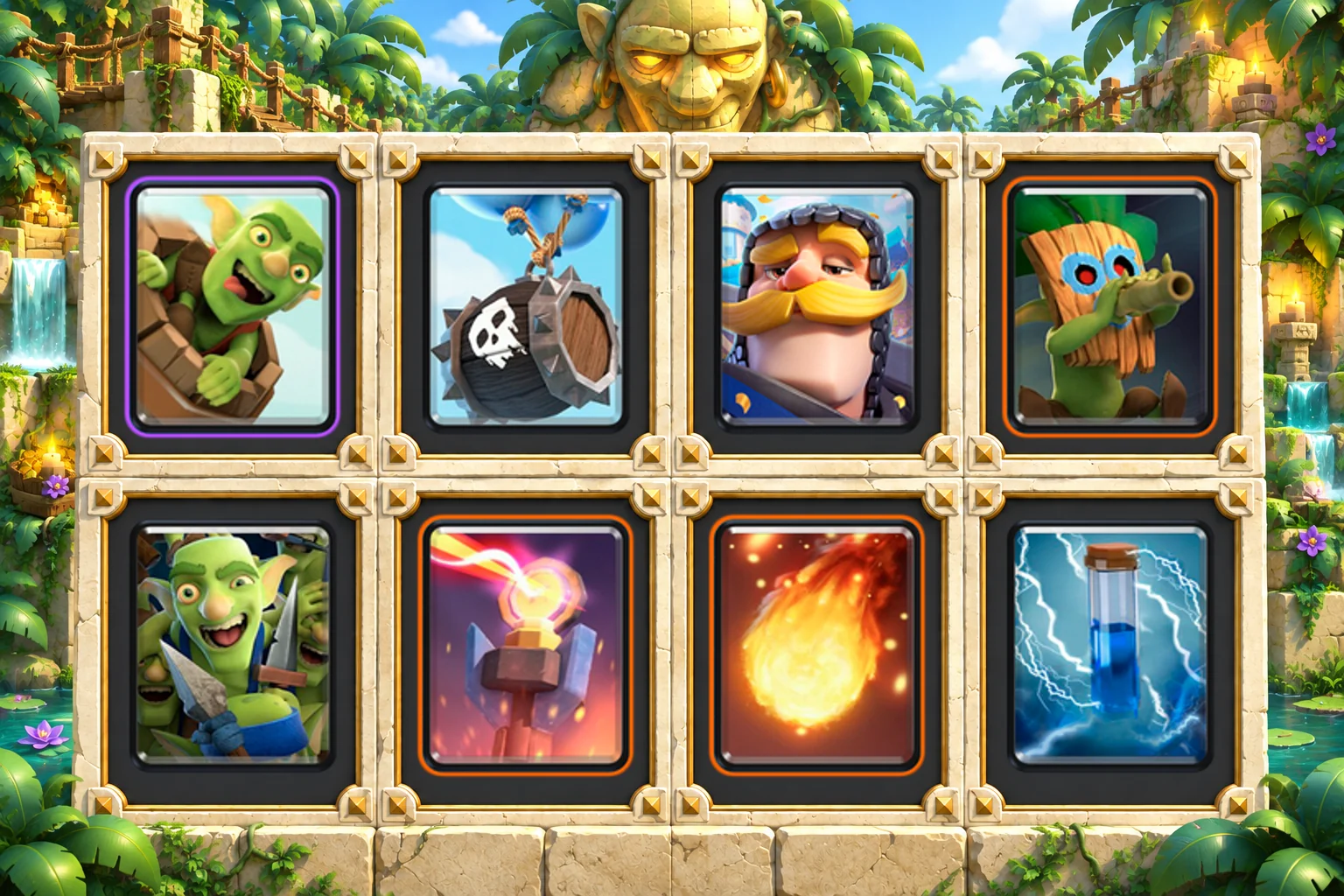
Average elixir: 3.3
Eight cards and their jobs
- Goblin Barrel (3 elixir): Tower pressure that rewards tracking the opponent's small-spell cycle.
- Skeleton Barrel (3 elixir): Flying building-targeting delivery; leaves a ground Skeleton threat when destroyed.
- Knight (3 elixir): Low-cost ground tank that occupies support and protects ranged damage.
- Dart Goblin (3 elixir): Fragile long-range air and ground shooter; protect his firing angle and spell exposure.
- Goblin Gang (3 elixir): Mixed melee and spear bodies for surrounds and supplementary air damage; fragile to spells.
- Inferno Tower (5 elixir): Increasing damage against a focused target; protect it against reset and distractions.
- Fireball (4 elixir): Immediate area damage and knockback; spend for useful defense or support value.
- Zap (2 elixir): Small air and ground hit plus brief stun/reset; does not replace heavy damage.
Stagger the two Barrel arrivals
The two Barrels demand different answers. Skeleton Barrel must travel and can draw air fire before releasing Skeletons; Goblin Barrel arrives directly at the target. Use that difference to learn whether their defense relies on a spell, a ranged troop, or both. Neither attack justifies sacrificing Inferno coverage.
Opening and double elixir
Send one Barrel at a time early. If you stack both before seeing the response, one splash defender can stop both attacks. Later, stagger their arrival so the second threat reaches the tower after the first answer is committed.
Defensive order and matchups
Against P.E.K.K.A: Inferno needs a clean target and time. Knight should interfere with the supporting unit, not simply join the beam on P.E.K.K.A. Once the seven-elixir threat is contained, a cheap Barrel can make the opponent defend instead of rebuilding support.
Against Balloon: Your Skeleton Barrel cannot fight their Balloon. Keep Dart Goblin alive and use Inferno's air targeting. If both are out of hand, another attacking Barrel only deepens the problem; cycle toward the real defense.
Against Goblin Barrel: Keep Goblin Gang available when the opponent's Barrel is ready, and read its landing spot before placing the response. This list has no Log, and Zap alone is not a reliable full clear. If Gang has been removed or committed, use a timely Knight or Dart Goblin response with tower fire and accept that some damage may get through. Do not send both Barrels simply because your first defense left a survivor; recover the ground answer before giving the opponent another unopposed Barrel.
A decision during the match
After Arrows removes Gang, look at the unit still near their tower. A surviving Wizard may cover Skeleton Barrel effectively even without the spell. Goblin Barrel placed for a different angle may be the better question, or neither attack may be justified until Wizard is occupied.
Mistake to avoid: Two Barrels plus Gang all inside the same splash response.
One-card alternatives and upgrades
- Valkyrie for Knight: Stronger ground splash at extra cost. New average 3.4 elixir.
- Giant Snowball for Zap: Displacement but no Inferno Tower beam reset. New average 3.3 elixir.
Upgrade focus: Goblin Barrel, Skeleton Barrel, Dart Goblin, Inferno Tower.
Upgrade the two win conditions only if you intend to keep this dual-pressure style. Inferno and Dart Goblin must remain dependable enough to support it. A heavier Valkyrie improves ground splash but makes reckless double-Barrel commitments harder to recover from.
Skeleton Barrel Mortar Bait
Specialist choice that mixes ground siege and air delivery.
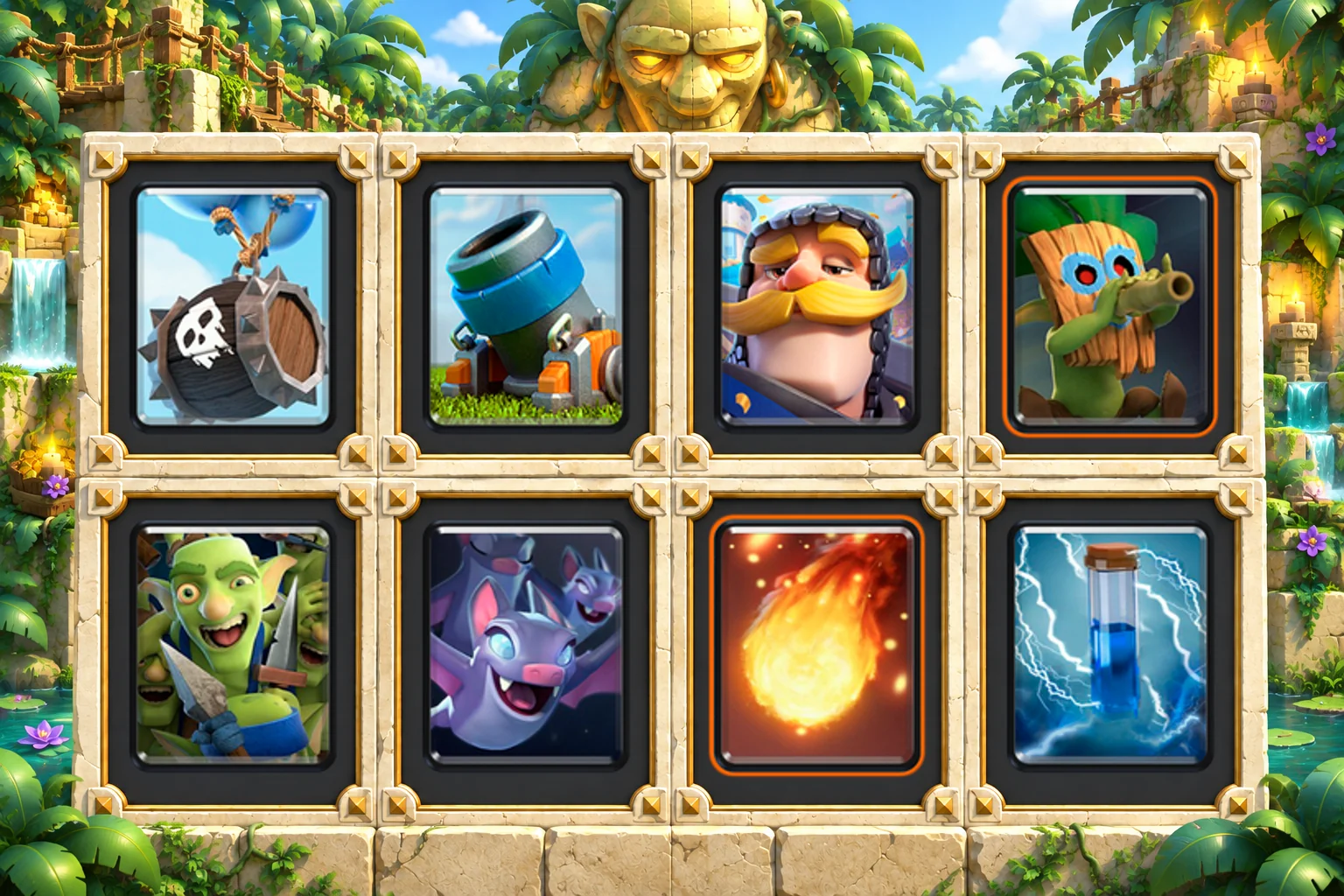
Average elixir: 3.0
Eight cards and their jobs
- Skeleton Barrel (3 elixir): Flying building-targeting delivery; leaves a ground Skeleton threat when destroyed.
- Mortar (4 elixir): Ranged tower threat or defensive pull; cannot shoot air or enemies inside its blind spot.
- Knight (3 elixir): Low-cost ground tank that occupies support and protects ranged damage.
- Dart Goblin (3 elixir): Fragile long-range air and ground shooter; protect his firing angle and spell exposure.
- Goblin Gang (3 elixir): Mixed melee and spear bodies for surrounds and supplementary air damage; fragile to spells.
- Bats (2 elixir): Cheap flying damage; vulnerable to small spells and splash.
- Fireball (4 elixir): Immediate area damage and knockback; spend for useful defense or support value.
- Zap (2 elixir): Small air and ground hit plus brief stun/reset; does not replace heavy damage.
Choose which threat deserves support
Mortar and Skeleton Barrel pressure different routes, but they share a need for cheap protection. Knight buys firing time and Dart Goblin covers from range. The deck is strongest when you choose which attack deserves support instead of trying to maintain two expensive battles at once.
Opening and double elixir
A defensive Mortar is a sensible first use against an unknown win condition. Once you have seen their tank and spell, look for an offensive placement after that tank is committed elsewhere. Double elixir gives more options, not permission to send Barrel whenever Mortar is threatened.
Defensive order and matchups
Against Giant: The pull stretches the Giant's journey while your damage units work. If Wizard or another splash troop follows, Knight must occupy that support before Gang joins. Protect Dart Goblin's angle rather than piling every defender around the Giant.
Against Balloon: Start Dart Goblin early. Hold Bats until the opponent spends the spell that clears them or until survival requires both answers. A Mortar can change Balloon's route, but its ground-only shots contribute nothing to killing the air unit.
A decision during the match
If Giant crosses toward your offensive Mortar, a Barrel opposite lane can look like a free punish. Count what remains for Giant and its support first. When Knight and the air defenders are unavailable, spend on stopping the push; a few Skeleton hits do not repay a lost tower.
Mistake to avoid: Expecting Mortar to shoot a Balloon.
One-card alternatives and upgrades
- Guards for Goblin Gang: Ground shields, loses ranged air help. New average 3.0 elixir.
- Mega Minion for Bats: Sturdier air damage but slower rotation. New average 3.1 elixir.
Upgrade focus: Mortar, Skeleton Barrel, Dart Goblin, Fireball.
Mortar's durability and the damage of your ranged support affect the same defensive exchanges. Prioritize those alongside Skeleton Barrel. The Mega Minion substitution reduces fragile air dependence, but the extra elixir slows how quickly you reach another Mortar.
Goblin Barrel Valkyrie Poison
A bait-control option against defenders repeatedly placed together.
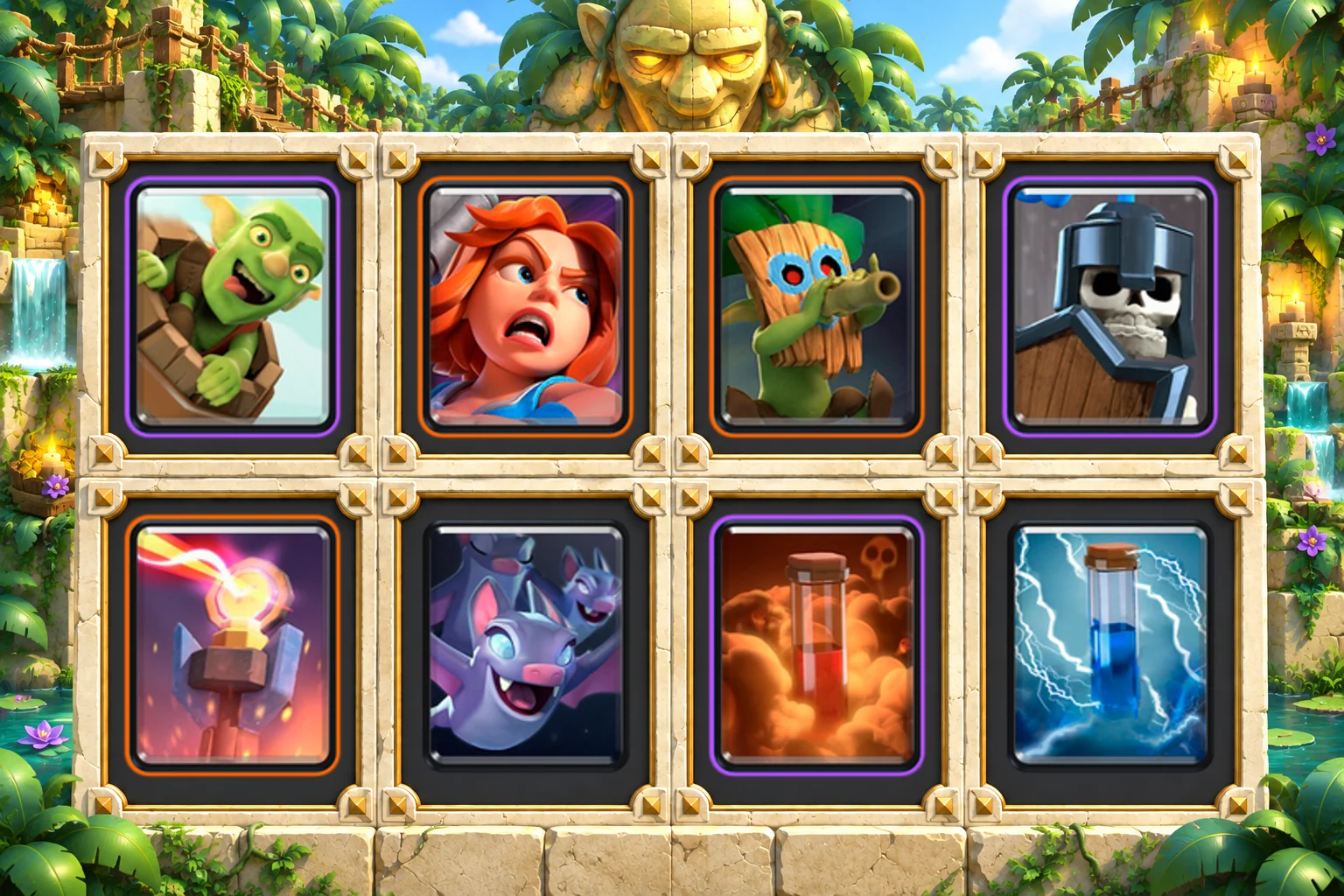
Average elixir: 3.3
Eight cards and their jobs
- Goblin Barrel (3 elixir): Tower pressure that rewards tracking the opponent's small-spell cycle.
- Valkyrie (4 elixir): Ground splash defender for clustered support and swarms; cannot attack air.
- Dart Goblin (3 elixir): Fragile long-range air and ground shooter; protect his firing angle and spell exposure.
- Guards (3 elixir): Shielded ground surround and distraction; no air targeting.
- Inferno Tower (5 elixir): Increasing damage against a focused target; protect it against reset and distractions.
- Bats (2 elixir): Cheap flying damage; vulnerable to small spells and splash.
- Poison (4 elixir): Damage over time and area denial; not an instant removal spell.
- Zap (2 elixir): Small air and ground hit plus brief stun/reset; does not replace heavy damage.
Occupy the defender before poisoning the area
This is a controlled Goblin Barrel deck rather than a race to throw as many Barrels as possible. Guards hold single ground attackers, Valkyrie deals with crowded support, and Poison punishes defenders that must remain in one area. You still need the opponent's immediate Barrel answer to become awkward.
Opening and double elixir
Keep Poison out of the first blind attack. Watch where the opponent places the defender and whether that unit stays there. In double elixir, send Barrel after a useful defense and hold Poison until the defender’s placement justifies it.
Defensive order and matchups
Against Giant Witch: Inferno's job is the tank. Valkyrie needs access to Witch without bringing her splash across the fragile defenders. Poison can cover the support area, but it does not make Skeletons and incoming damage vanish at the moment of casting.
Against Balloon: Separate Dart Goblin from the Inferno placement so one attack does not disrupt both. Bats are useful after Zap or Arrows is spent. If that spell remains ready, rely on the sturdier defensive sequence instead of counting Bats as guaranteed damage.
Against Goblin Barrel: Hold Valkyrie for a placement that brings the landing Goblins into her splash rather than deploying her on the far side of the tower. Guards provide a backup when she is unavailable, with placement adjusted to the Barrel's actual landing. Poison deals its damage over time and Zap is not a dependable blanket clear, so neither should be the entire defensive plan. Keep one troop response in hand instead of committing Valkyrie and Guards together behind your own Barrel.
A decision during the match
A Valkyrie waiting beside the tower can still erase the Barrel Goblins inside Poison. Repeating the same seven-elixir attack gives away the lesson. Try to occupy her with your defense and counterpush, or attack after she is committed elsewhere. The spell is not a substitute for that timing.
Mistake to avoid: Calling every Poisoned Barrel a guaranteed hit.
One-card alternatives and upgrades
- Fireball for Poison: Immediate damage, no lingering zone. New average 3.3 elixir.
- Goblin Gang for Guards: More bodies and some air coverage, loses shields. New average 3.3 elixir.
Upgrade focus: Goblin Barrel, Dart Goblin, Inferno Tower, Poison.
Keep Barrel and Dart Goblin competitive, then improve the defensive building or spell whose interaction is costing you. Guards and Gang are not identical swaps: the first resists some single hits through shields, while the second restores a little fragile air coverage.
Goblin Barrel Bomb Tower
Bait variant for ground swarms rather than huge tanks.
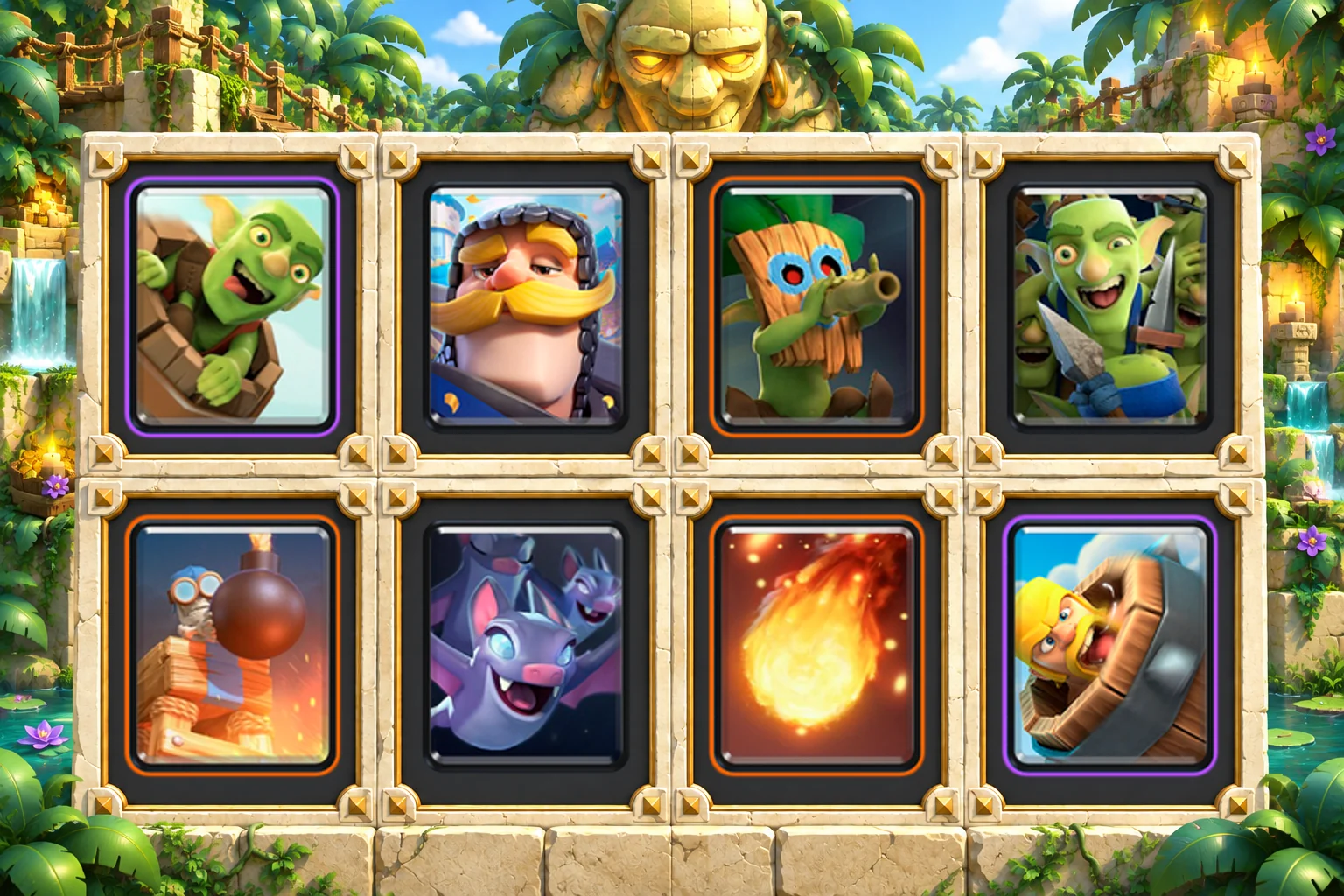
Average elixir: 3.0
Eight cards and their jobs
- Goblin Barrel (3 elixir): Tower pressure that rewards tracking the opponent's small-spell cycle.
- Knight (3 elixir): Low-cost ground tank that occupies support and protects ranged damage.
- Dart Goblin (3 elixir): Fragile long-range air and ground shooter; protect his firing angle and spell exposure.
- Goblin Gang (3 elixir): Mixed melee and spear bodies for surrounds and supplementary air damage; fragile to spells.
- Bomb Tower (4 elixir): Ground splash building and pull; it cannot shoot flying attackers.
- Bats (2 elixir): Cheap flying damage; vulnerable to small spells and splash.
- Fireball (4 elixir): Immediate area damage and knockback; spend for useful defense or support value.
- Barbarian Barrel (2 elixir): Ground-line removal and a Barbarian body; cannot damage air.
Trade Inferno damage for ground splash
Bomb Tower makes this version comfortable against grouped ground attackers. The trade is concentrated tank damage: the building spreads damage rather than ramping like Inferno Tower. Knight, Gang and the air units must finish a large isolated target, which makes the order of the defense important.
Opening and double elixir
Use a restrained Knight opening or test Barrel once. Keep Dart Goblin available until you know whether an air win condition is coming. Later, let Bomb Tower and Knight do the ground work before spending Gang as bait; those Goblins may be your needed damage source.
Defensive order and matchups
Against Royal Hogs: Let the central building collect the Hogs before choosing extra help. Valkyrie support on the opponent's side makes an immediate Gang surround poor. Knight can occupy that support while the tower continues clearing the grouped attackers.
Against Balloon: Bomb Tower draws the Balloon toward the middle but cannot shoot it. Dart Goblin must be firing early, with Bats added away from the obvious removal spell. Barbarian Barrel provides no answer to an air swarm protecting Balloon.
A decision during the match
Against Giant and Wizard, dropping Gang onto Giant first feeds the Goblins to splash. Meet Wizard with Knight when it is safe, allow the pull to separate their positions, and only then add Gang. If that separation never happens, hold the fragile troops rather than forcing the sequence.
Mistake to avoid: Mistaking Bomb Tower's splash for a reliable heavy-tank damage source.
One-card alternatives and upgrades
- Inferno Tower for Bomb Tower: Tank melting for extra cost, loses ground splash. New average 3.1 elixir.
- Arrows for Barbarian Barrel: Air swarm coverage, no Barbarian. New average 3.1 elixir.
Upgrade focus: Goblin Barrel, Dart Goblin, Bomb Tower, Fireball.
This version depends on Bomb Tower staying useful long enough for the other defenders to work. Keep Dart Goblin's damage relevant, and use Inferno Tower instead if large tanks are the recurring problem. That swap trades away the ground splash that defines this list.
Skeleton Barrel Prince Counterpush
For leveled Princes with a cheap air-delivery win condition.

Average elixir: 3.4
Eight cards and their jobs
- Skeleton Barrel (3 elixir): Flying building-targeting delivery; leaves a ground Skeleton threat when destroyed.
- Prince (5 elixir): Single-target ground damage and a charge threat; needs protection against swarms.
- Dark Prince (4 elixir): Ground splash with a shield; clears small bodies around the primary attacker.
- Dart Goblin (3 elixir): Fragile long-range air and ground shooter; protect his firing angle and spell exposure.
- Goblin Gang (3 elixir): Mixed melee and spear bodies for surrounds and supplementary air damage; fragile to spells.
- Mega Minion (3 elixir): Durable single flying attacker for focused air or ground damage.
- Fireball (4 elixir): Immediate area damage and knockback; spend for useful defense or support value.
- Zap (2 elixir): Small air and ground hit plus brief stun/reset; does not replace heavy damage.
Use the surviving Prince to open an air route
Prince supplies focused damage and Dark Prince clears small ground defenders. A Skeleton Barrel can follow their surviving pressure without requiring another five- or six-elixir tank. The weakness is the missing building: you cannot assume a central pull will rescue a poorly timed ground commitment.
Opening and double elixir
Defend first with whichever Prince fits the threat. Against a small swarm, paying for both is wasteful; against a healthy single attacker, Dark Prince alone may lack the damage. In double elixir, add Barrel after a survivor draws attention, keeping an air defender in hand.
Defensive order and matchups
Against Hog Rider: Meet Hog promptly with Prince rather than giving him a long walk. Gang can add damage when their small spell is unavailable, but spending both before seeing support can overcommit. Expect placement and levels to affect how much damage gets through.
Against Balloon: Put Dart Goblin to work from range and Mega Minion close enough to engage Balloon. Keep them separated. Zap delays the attack, but there is no building to redirect it if those two defenders were spent behind a Prince.
A decision during the match
Dark Prince forcing Wizard to shoot is not proof that Skeleton Barrel is safe. Wizard can still hit the airborne attacker as it approaches the same lane. Either wait for a different defensive commitment or accept that a single surviving Prince is the entire counterpush this time.
Mistake to avoid: Assuming ground commitment means their air splash is unavailable.
One-card alternatives and upgrades
- Guards for Goblin Gang: More resilient ground distraction, loses air spears. New average 3.4 elixir.
- Musketeer for Dart Goblin: Sturdier air shooter at extra cost. New average 3.5 elixir.
Upgrade focus: Skeleton Barrel, Prince, Dart Goblin, Fireball.
Do not upgrade both Princes at the expense of the air pair. The deck loses its structure when every air attack forces an emergency Fireball. Musketeer offers a sturdier ranged choice at extra cost if Dart Goblin keeps being removed too easily.
Goblin Giant decks for a protected counterpush
Goblin Giant is expensive enough that the supporting defense matters. Prefer a tank placed ahead of a survivor to a full army purchased from an empty board.
Goblin Giant Prince Spear Support
Main Goblin Giant option for players with strong Princes.
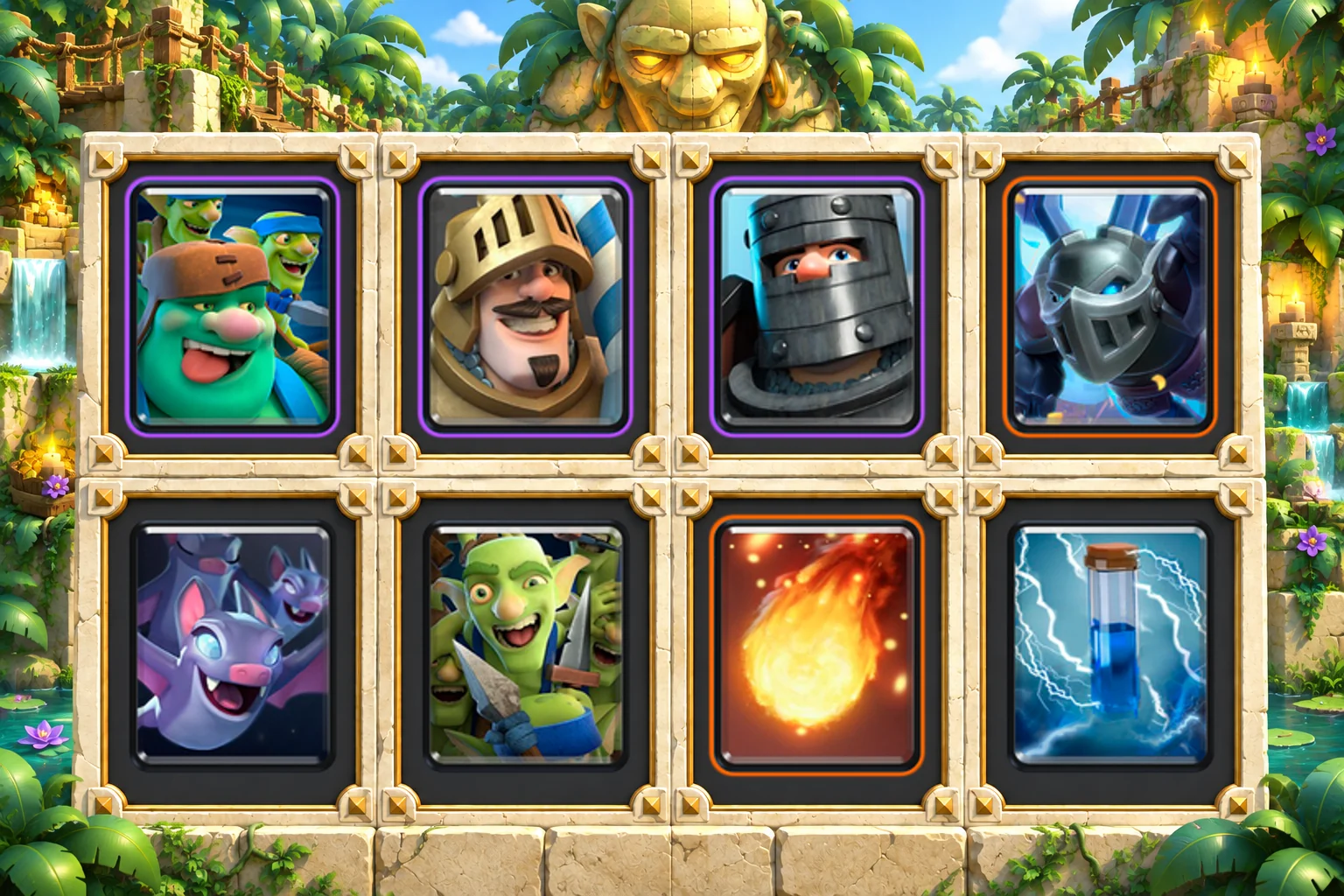
Average elixir: 3.6
Eight cards and their jobs
- Goblin Giant (6 elixir): Building-targeting tank with carried Spear Goblin support; does not replace a full air defense.
- Prince (5 elixir): Single-target ground damage and a charge threat; needs protection against swarms.
- Dark Prince (4 elixir): Ground splash with a shield; clears small bodies around the primary attacker.
- Mega Minion (3 elixir): Durable single flying attacker for focused air or ground damage.
- Bats (2 elixir): Cheap flying damage; vulnerable to small spells and splash.
- Goblin Gang (3 elixir): Mixed melee and spear bodies for surrounds and supplementary air damage; fragile to spells.
- Fireball (4 elixir): Immediate area damage and knockback; spend for useful defense or support value.
- Zap (2 elixir): Small air and ground hit plus brief stun/reset; does not replace heavy damage.
Put Goblin Giant ahead of surviving defenders
Goblin Giant's carried Spear Goblins add support while he draws defensive attention. The Princes supply the ground damage and splash the tank lacks. This creates a threatening counterpush, but buying the tank and Prince together costs eleven elixir before any spell or air defense is considered.
Opening and double elixir
Build that attack from a defense, not from an empty board. A Prince that has already earned value is the reason to put Goblin Giant in front. In double elixir, let elixir recover as the units travel and hold Zap until a particular swarm or ramping beam requires it.
Defensive order and matchups
Against Inferno Tower: Wait for Inferno to build damage before resetting if the tank can survive that wait. An early Zap can leave the dangerous part of the beam untouched. If another distraction still prevents tower access, a second support purchase may simply deepen the loss.
Against Balloon: Mega Minion needs to engage before Balloon reaches the tower. Bats can contribute after their removal spell, while Gang's spears are backup. Keeping all three behind Goblin Giant gives the opponent an obvious lane to punish.
A decision during the match
When their Mini P.E.K.K.A is committed opposite lane, do not automatically send Goblin Giant at the bridge. That Mini P.E.K.K.A still needs an answer. Defend it with the appropriate Prince or distraction, then use the resulting survivor to make a counterpush you can afford.
Mistake to avoid: Spending Zap before their Inferno beam becomes dangerous.
One-card alternatives and upgrades
- Minions for Bats: More sustained air damage at a higher cost. New average 3.8 elixir.
- Guards for Goblin Gang: Ground shields, less air help. New average 3.6 elixir.
Upgrade focus: Goblin Giant, Prince, Mega Minion, Fireball.
Goblin Giant and Prince are the expensive core, but Mega Minion prevents air matches from becoming a race. Fireball needs levels appropriate to the support you keep meeting. Replacing Bats with Minions adds sustained damage at the cost of a slower recovery.
Goblin Giant Mini P.E.K.K.A Control
Clear defensive jobs for a first Goblin Giant deck.
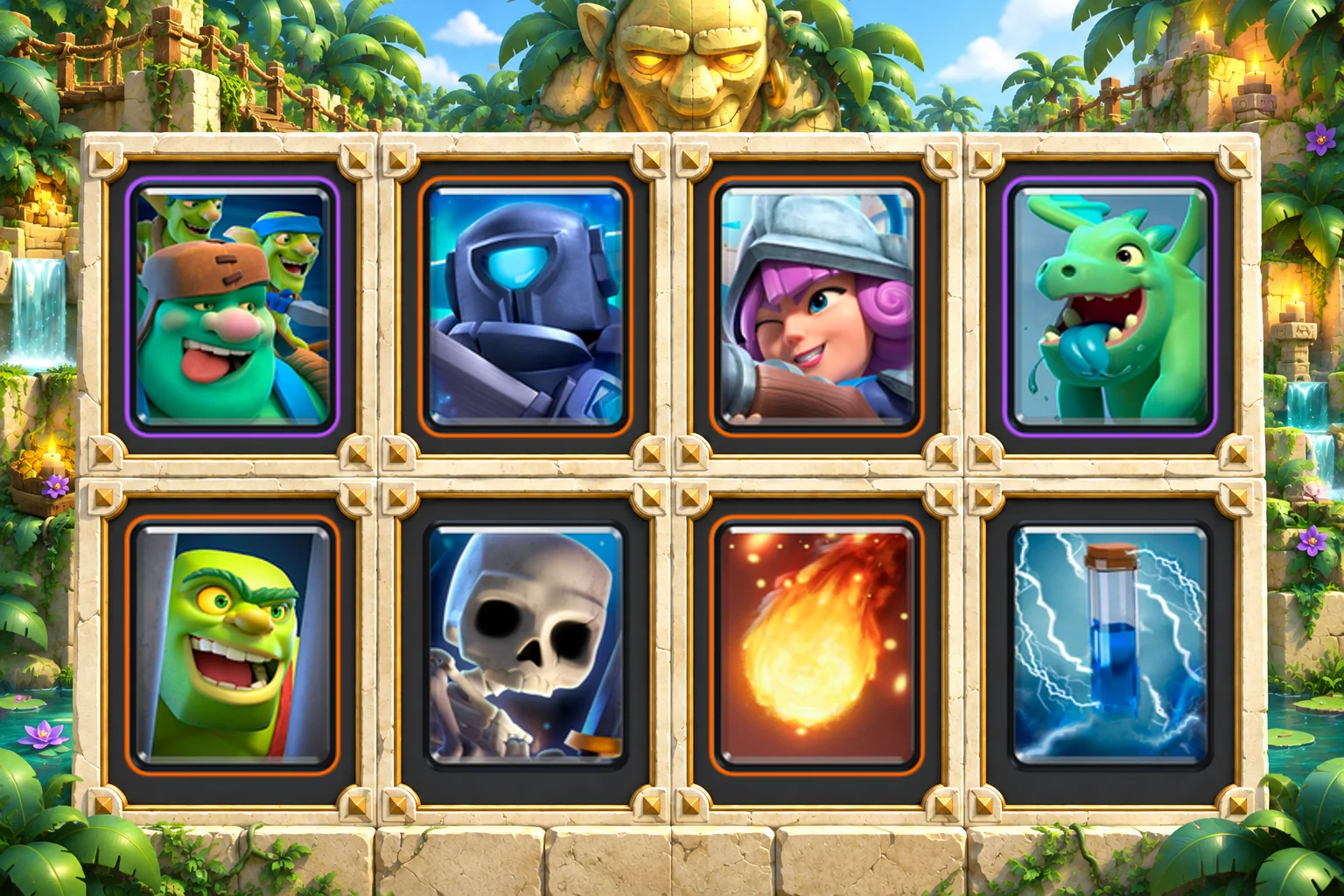
Average elixir: 3.6
Eight cards and their jobs
- Goblin Giant (6 elixir): Building-targeting tank with carried Spear Goblin support; does not replace a full air defense.
- Mini P.E.K.K.A (4 elixir): Concentrated ground damage against a tank or other high-health attacker.
- Musketeer (4 elixir): Sustained ranged air and ground damage; keep her away from overlapping spell value.
- Baby Dragon (4 elixir): Durable flying splash support; its damage alone is not a fast tank solution.
- Goblin Cage (4 elixir): Pulls building-targeting threats, then releases a ground Brawler counterpush.
- Skeletons (1 elixir): One-elixir ground distraction that buys shots and helps rotate the hand.
- Fireball (4 elixir): Immediate area damage and knockback; spend for useful defense or support value.
- Zap (2 elixir): Small air and ground hit plus brief stun/reset; does not replace heavy damage.
Keep Mini P.E.K.K.A available for the return attack
Cage pulls the win condition, Mini P.E.K.K.A damages ground tanks, Musketeer shoots air troops, and Baby Dragon clears swarms. Goblin Giant turns useful survivors into a counterpush. These defenders are easier to keep separate than several fragile ranged attackers.
Opening and double elixir
Split Skeletons only when they are not needed to interrupt a known attack. Let Cage answer actual pressure rather than spending it just to cycle. During double elixir, put the tank ahead of one worthwhile survivor; Baby Dragon is an addition for a real swarm problem, not a mandatory second support.
Defensive order and matchups
Against Hog Rider: Give Cage time to do its job. If Hog is contained, preserve Mini P.E.K.K.A for the next ground threat. Adding it automatically can leave an expensive hand and no elixir to protect Musketeer from support.
Against Balloon: Musketeer is the main damage source, with Baby Dragon helping rather than replacing her. Cage extends the path and Zap interrupts briefly. Do not group the two air defenders so a single Fireball clips both and the tower.
A decision during the match
A surviving Brawler does not obligate you to spend six on Goblin Giant. If Musketeer is out of hand and their Balloon is ready, keep the tank back. Use the Brawler as small pressure while you recover your air response; the next defended push can become the larger attack.
Mistake to avoid: Stacking Musketeer and Baby Dragon behind the tank into one spell.
One-card alternatives and upgrades
- Ice Spirit for Skeletons: Air-capable delay in place of bodies. New average 3.6 elixir.
- Mega Minion for Baby Dragon: Cheaper focused damage, less splash. New average 3.5 elixir.
Upgrade focus: Goblin Giant, Musketeer, Mini P.E.K.K.A, Fireball.
Goblin Giant, Musketeer and Mini P.E.K.K.A need to win their respective jobs. Upgrade the spell after checking the actual interaction that fails. Swapping Baby Dragon for Mega Minion saves elixir but removes the airborne splash that keeps a swarm from surrounding the counterpush.
Goblin Giant Poison Dark Prince
Choose when support troops repeatedly defend the same area.
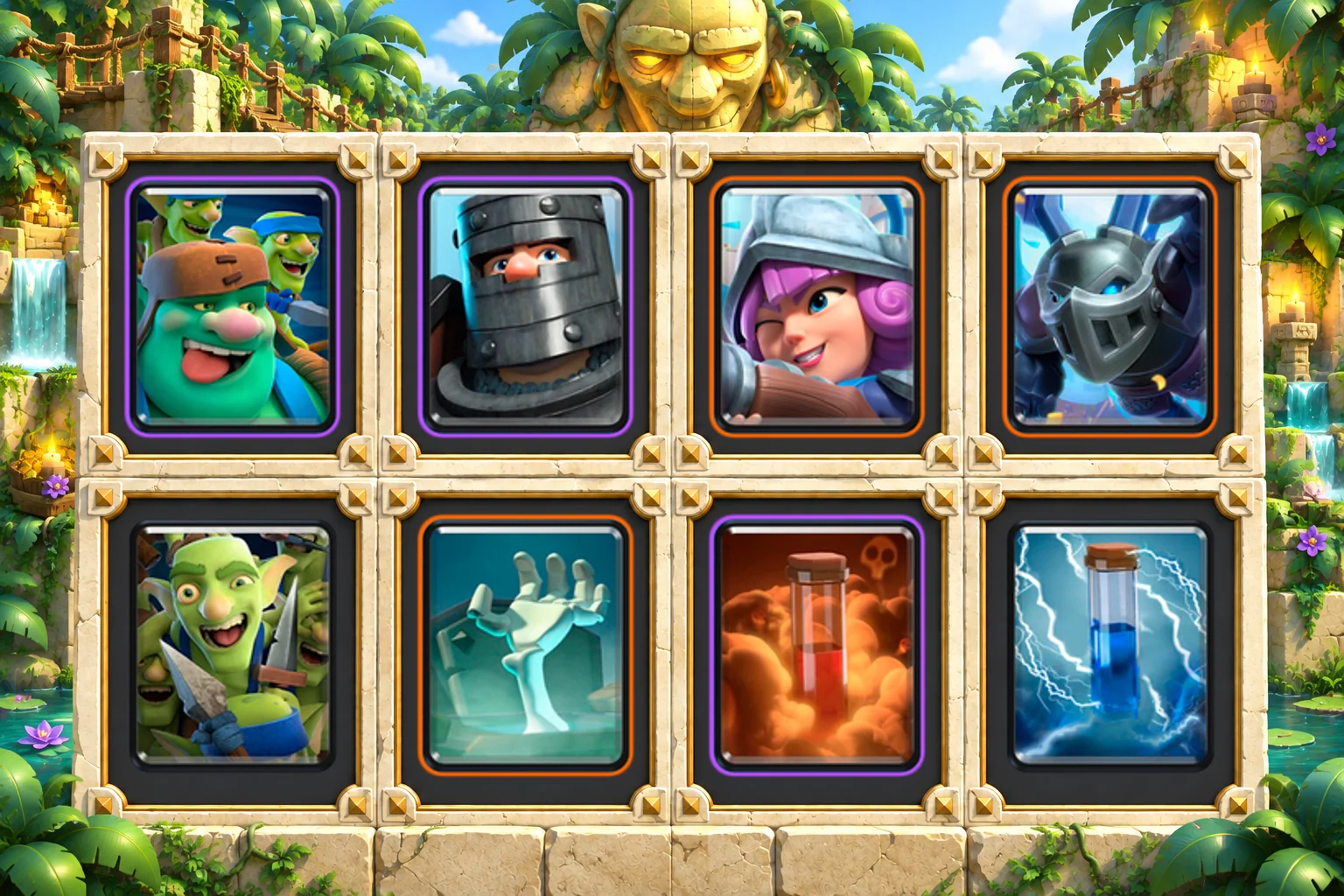
Average elixir: 3.6
Eight cards and their jobs
- Goblin Giant (6 elixir): Building-targeting tank with carried Spear Goblin support; does not replace a full air defense.
- Dark Prince (4 elixir): Ground splash with a shield; clears small bodies around the primary attacker.
- Musketeer (4 elixir): Sustained ranged air and ground damage; keep her away from overlapping spell value.
- Mega Minion (3 elixir): Durable single flying attacker for focused air or ground damage.
- Goblin Gang (3 elixir): Mixed melee and spear bodies for surrounds and supplementary air damage; fragile to spells.
- Tombstone (3 elixir): Defensive pull with Skeleton distractions; vulnerable to splash.
- Poison (4 elixir): Damage over time and area denial; not an instant removal spell.
- Zap (2 elixir): Small air and ground hit plus brief stun/reset; does not replace heavy damage.
Wait for a useful Poison target
Poison suits a push whose defenders remain near the same building or tower. Dark Prince clears the small bodies in front while Musketeer and Mega Minion provide reliable damage. The list does not have a dedicated high-damage ground troop, so Tombstone and Gang must create time against a large tank.
Opening and double elixir
Wait for a target before placing Tombstone. An empty opening does not require an expensive tank at the back. In double elixir, a Dark Prince survivor can justify Goblin Giant, but Poison should follow the defender's position rather than announce where you hope they will stand.
Defensive order and matchups
Against Witch: Dark Prince handles spawned Skeletons only while he can reach them. Keep Musketeer out of Witch's splash and let Poison cover support that stays in range. The opponent can move or replace support, so maintain enough elixir to finish the defense.
Against Balloon: Tombstone can redirect Balloon but neither its Skeletons nor Dark Prince shoot air. Start Musketeer early and retain Mega Minion for extra damage. Spending Poison offensively just before this exchange can cost more than the attack earned.
A decision during the match
If their Musketeer walks away from the Poison zone, the spell has not secured the push. Let Goblin Giant absorb the response without adding more troops blindly. Your next decision is whether to defend the surviving Musketeer or prepare a different attack angle, not to justify the previous four-elixir spend.
Mistake to avoid: Expecting Poison to rescue a tank already surrounded at low health.
One-card alternatives and upgrades
- Fireball for Poison: Faster burst, no zone denial. New average 3.6 elixir.
- Guards for Goblin Gang: Shielded ground defense, no air spears. New average 3.6 elixir.
Upgrade focus: Goblin Giant, Musketeer, Poison, Dark Prince.
Musketeer's level is particularly valuable because she participates in most defenses. Goblin Giant and Poison define the attack, while Dark Prince needs to survive the support exchanges. Guards can make ground distractions less fragile, but remove Gang's limited air help.
Goblin Giant Double Ranged
For players who can protect fragile ranged attackers.
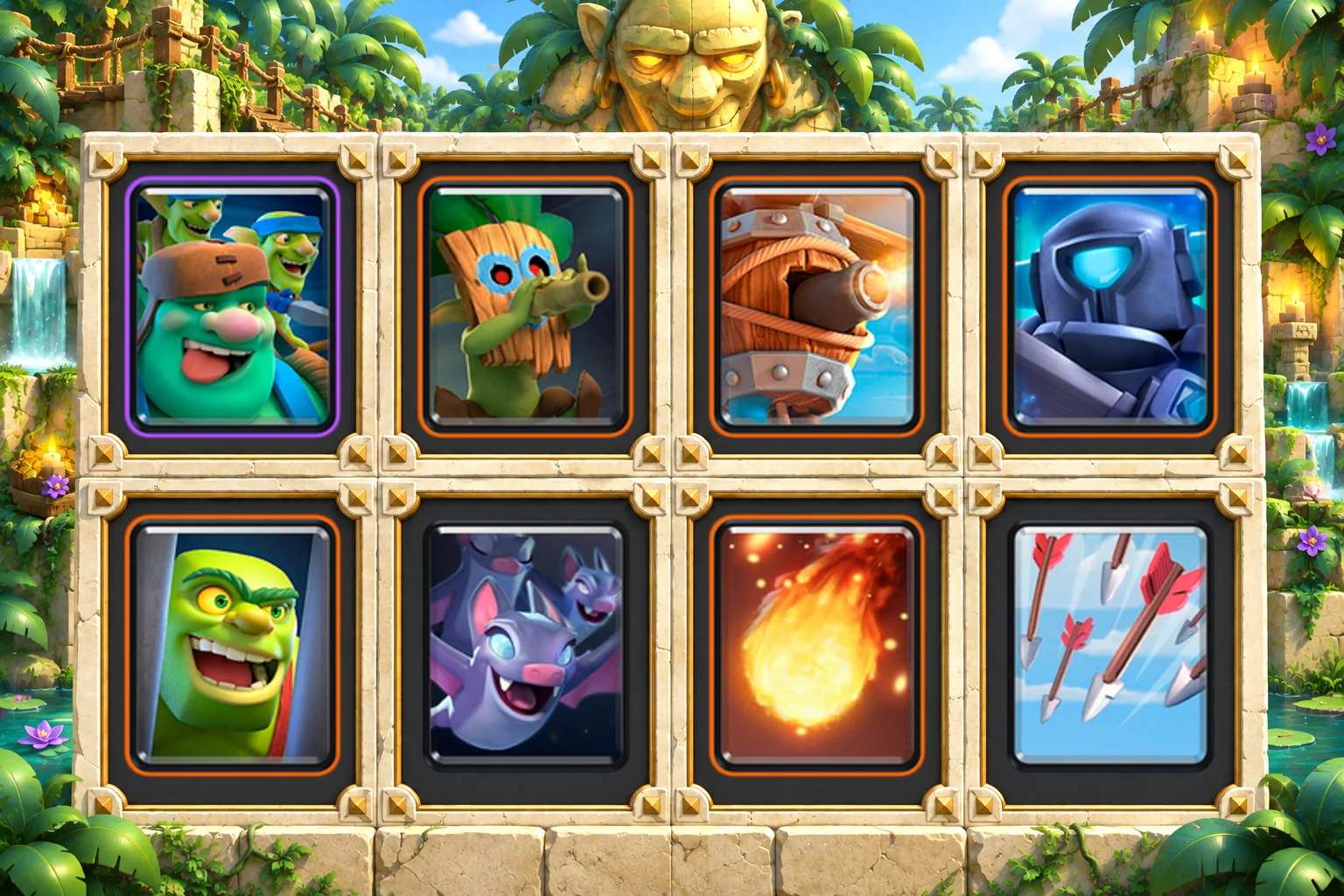
Average elixir: 3.8
Eight cards and their jobs
- Goblin Giant (6 elixir): Building-targeting tank with carried Spear Goblin support; does not replace a full air defense.
- Dart Goblin (3 elixir): Fragile long-range air and ground shooter; protect his firing angle and spell exposure.
- Flying Machine (4 elixir): Fragile flying ranged support; place far enough away to use its reach.
- Mini P.E.K.K.A (4 elixir): Concentrated ground damage against a tank or other high-health attacker.
- Goblin Cage (4 elixir): Pulls building-targeting threats, then releases a ground Brawler counterpush.
- Bats (2 elixir): Cheap flying damage; vulnerable to small spells and splash.
- Fireball (4 elixir): Immediate area damage and knockback; spend for useful defense or support value.
- Arrows (3 elixir): Wide air and ground swarm removal; no reset effect.
Keep Dart Goblin and Flying Machine apart
Two long-range attackers create awkward defensive angles, but both are vulnerable if you stack them. Mini P.E.K.K.A and Cage do the close work while one shooter survives behind them. The second shooter is insurance against a spell, not merely another card to place behind Goblin Giant.
Opening and double elixir
Place the ranged units at different times as well as different locations. Opening with both reveals your air coverage and invites spell value. In double elixir, choose the healthiest useful survivor to support with Goblin Giant; keep the other lane covered before adding Bats.
Defensive order and matchups
Against Royal Giant: Cage draws Royal Giant into a place where Mini P.E.K.K.A can engage. A ranged shooter should stand outside the obvious tower-and-Cage spell area. If support blocks Mini P.E.K.K.A, clear or distract that support before buying a tank for the counterpush.
Against Balloon: Flying Machine and Dart Goblin can shoot Balloon, but a spell can remove the fragile part of that defense. Do not deploy Bats beside Dart Goblin into known Arrows. Cage buys time for the shooter that remains.
A decision during the match
Suppose Arrows catches Dart Goblin and Bats together. You may still have a healthy Goblin Giant walking up, but Flying Machine now has to cover the next air attack. Adding it to the offensive stack leaves no ranged insurance. Accept the smaller push and avoid repeating that overlap.
Mistake to avoid: Grouping Dart Goblin and Flying Machine where one spell can remove both air defenders.
One-card alternatives and upgrades
- Musketeer for Dart Goblin: Sturdier shooter but one more elixir. New average 3.9 elixir.
- Mega Minion for Bats: Less small-spell vulnerability at extra cost. New average 3.9 elixir.
Upgrade focus: Goblin Giant, Flying Machine, Dart Goblin, Fireball.
Keep the two shooters at usable levels, but only invest in both if their spacing suits your play. Musketeer offers a less fragile ground replacement for Dart Goblin. Mega Minion for Bats is heavier but helps when small spells repeatedly remove your backup.
Goblin Giant Lightning Reset
Advanced building-breaking choice with an expensive spell.

Average elixir: 3.8
Eight cards and their jobs
- Goblin Giant (6 elixir): Building-targeting tank with carried Spear Goblin support; does not replace a full air defense.
- Prince (5 elixir): Single-target ground damage and a charge threat; needs protection against swarms.
- Musketeer (4 elixir): Sustained ranged air and ground damage; keep her away from overlapping spell value.
- Mega Minion (3 elixir): Durable single flying attacker for focused air or ground damage.
- Tombstone (3 elixir): Defensive pull with Skeleton distractions; vulnerable to splash.
- Skeletons (1 elixir): One-elixir ground distraction that buys shots and helps rotate the hand.
- Lightning (6 elixir): Expensive damage and stun on selected high-health targets; seek building plus support value.
- Zap (2 elixir): Small air and ground hit plus brief stun/reset; does not replace heavy damage.
Save Lightning for a building and support
Lightning is selected to damage valuable support and a building in the same exchange. It is not a general answer to every cheap defender. Prince supplies the focused damage behind Goblin Giant, while two air defenders keep the six-elixir spell from becoming your only emergency response.
Opening and double elixir
There is no sensible blind Lightning opening. Defend with Tombstone and the appropriate damage card, then decide whether the survivor warrants a tank. In double elixir, let your reserve rebuild as the tank moves; Goblin Giant and Lightning together still cost twelve, not ten.
Defensive order and matchups
Against Inferno Tower: Zap can interrupt the beam when it becomes dangerous. Lightning is justified when its target area contains the building and meaningful support, and when that investment leaves the attack able to progress. Check the actual targets rather than assuming the spell will hit everything you want.
Against Balloon: Keep Musketeer and Mega Minion available on different angles, with Tombstone changing Balloon's route. A defensive Lightning may be necessary in an emergency, but repeatedly needing it means the normal air defense was spent or placed poorly.
A decision during the match
You defend with Prince and have a slow counterpush developing. Wait for enough elixir before committing Goblin Giant, then inspect their building and support. If they answer with only a cheap distraction, preserve Lightning. Spending six to rescue a poor push can give away the next attack window.
Mistake to avoid: Using six-elixir Lightning on a cheap distraction.
One-card alternatives and upgrades
- Ice Spirit for Skeletons: Brief freeze instead of ground bodies. New average 3.8 elixir.
- Minions for Mega Minion: More bodies and spell risk for the same cost. New average 3.8 elixir.
Upgrade focus: Goblin Giant, Prince, Lightning, Musketeer.
Lightning levels matter in the exact support interactions you expect it to change. Do not improve that spell while leaving Musketeer unable to defend ordinary air pressure. Minions offer more bodies for the same cost as Mega Minion, with greater exposure to swarm-clearing spells.
Goblin Giant Skeleton Barrel
Two building-targeting threats for players who avoid all-in stacks.
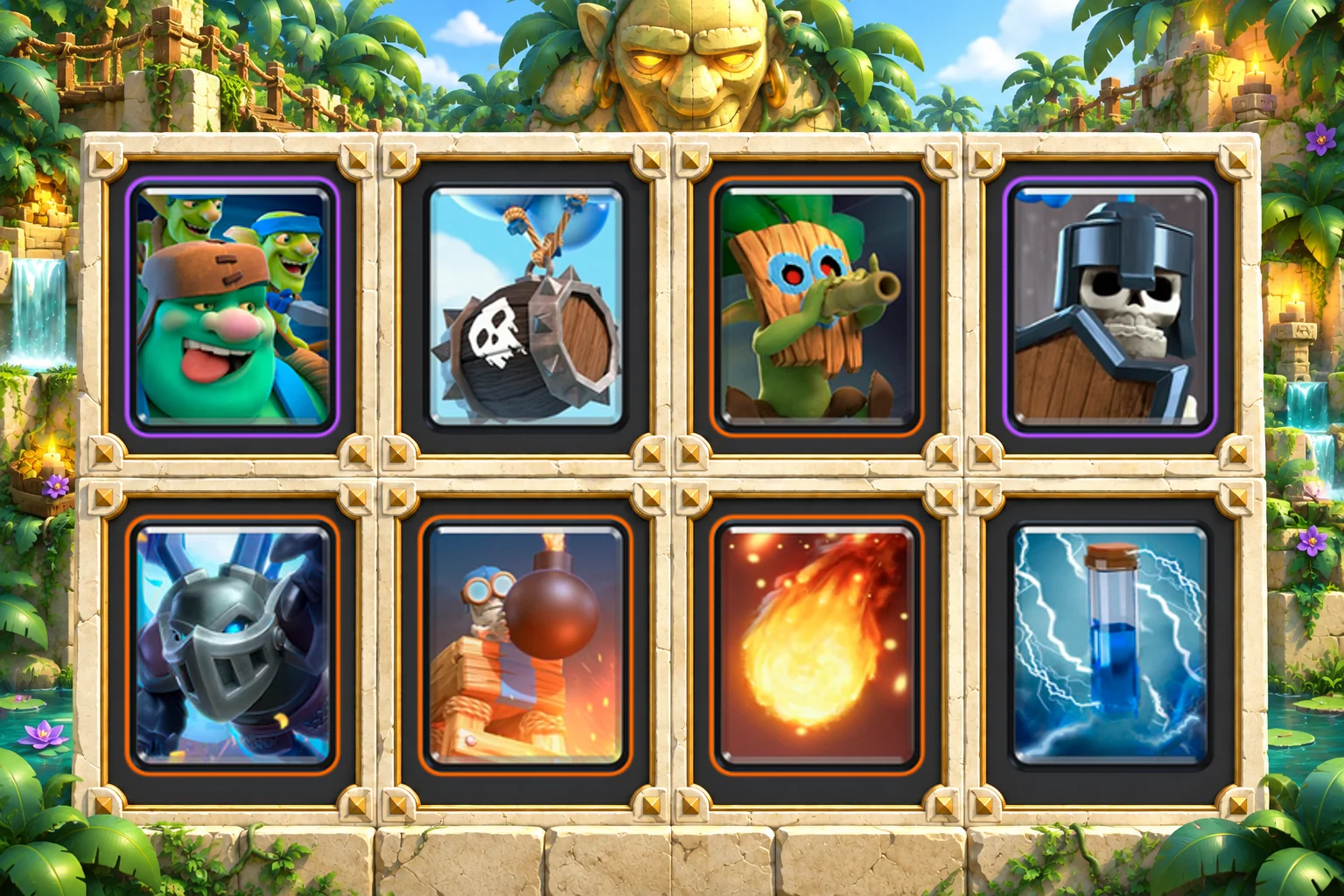
Average elixir: 3.5
Eight cards and their jobs
- Goblin Giant (6 elixir): Building-targeting tank with carried Spear Goblin support; does not replace a full air defense.
- Skeleton Barrel (3 elixir): Flying building-targeting delivery; leaves a ground Skeleton threat when destroyed.
- Dart Goblin (3 elixir): Fragile long-range air and ground shooter; protect his firing angle and spell exposure.
- Guards (3 elixir): Shielded ground surround and distraction; no air targeting.
- Mega Minion (3 elixir): Durable single flying attacker for focused air or ground damage.
- Bomb Tower (4 elixir): Ground splash building and pull; it cannot shoot flying attackers.
- Fireball (4 elixir): Immediate area damage and knockback; spend for useful defense or support value.
- Zap (2 elixir): Small air and ground hit plus brief stun/reset; does not replace heavy damage.
Choose between the ground tank and flying Barrel
Goblin Giant applies sustained ground pressure while Skeleton Barrel offers a cheaper air-delivered threat. That gives you choices about lane and timing. It does not force an opponent's central building to choose badly if both attackers enter the same pull area together.
Opening and double elixir
Use Skeleton Barrel to identify the first answer without spending the six-elixir tank. Keep Bomb Tower for the return attack. During double elixir, split pressure only after a defensive commitment makes the second lane worthwhile; nine elixir of simultaneous win conditions is a serious investment.
Defensive order and matchups
Against P.E.K.K.A: Let the building draw P.E.K.K.A and use Guards to interrupt her attacks after splash support is occupied. Dart Goblin and Mega Minion can supply damage from safety. Goblin Giant is not the defender you want to buy just to absorb her hits.
Against Balloon: Bomb Tower is the pull, Mega Minion meets Balloon, and Dart Goblin needs distance to shoot. Skeleton Barrel cannot replace any of those damage jobs. Save Zap for a meaningful interruption rather than using it just to cycle.
A decision during the match
A central Inferno Tower may attract both Goblin Giant and Skeleton Barrel if you send them together. Let one pressure tool draw the initial commitment, then decide whether the other can use a genuinely different path or a later timing. If not, defend and wait for the building's useful window to end.
Mistake to avoid: Assuming two win conditions automatically split one central building.
One-card alternatives and upgrades
- Goblin Gang for Guards: Some air spears but loses shields. New average 3.5 elixir.
- Goblin Cage for Bomb Tower: Counterpush body instead of splash. New average 3.5 elixir.
Upgrade focus: Goblin Giant, Skeleton Barrel, Dart Goblin, Fireball.
Choose whether Goblin Giant or Skeleton Barrel is the main long-term investment rather than spreading resources across every option in the guide. Dart Goblin and Fireball support either plan. Cage changes Bomb Tower's ground splash into a surviving counterpush body.
Hog decks with Jungle Arena support
These Hog lists differ mainly in the support they can preserve. Pick the air answer and ground defense you can use consistently before judging the cycle speed.
Hog Dart Goblin Cycle
Fast attacks with new Jungle cards, for precise defenders.
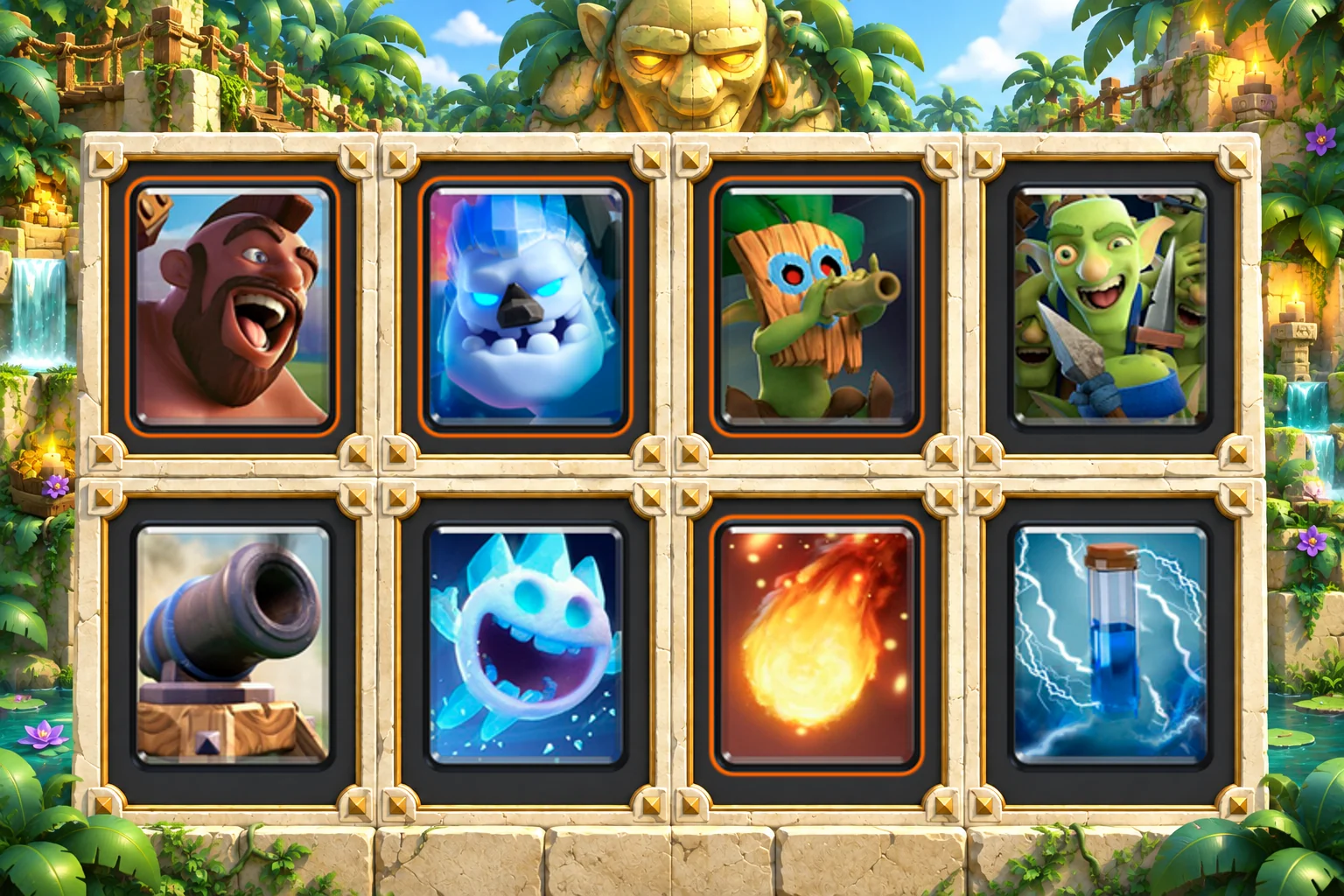
Average elixir: 2.8
Eight cards and their jobs
- Hog Rider (4 elixir): Main tower-pressure card; hold defensive elixir after sending him.
- Ice Golem (2 elixir): Building-targeting distraction and kiting body with a death slow; not a damage dealer.
- Dart Goblin (3 elixir): Fragile long-range air and ground shooter; protect his firing angle and spell exposure.
- Goblin Gang (3 elixir): Mixed melee and spear bodies for surrounds and supplementary air damage; fragile to spells.
- Cannon (3 elixir): Cheap ground-targeting pull; can draw Balloon but cannot shoot it.
- Ice Spirit (1 elixir): Brief freeze and a cheap rotation; buys time rather than sustained damage.
- Fireball (4 elixir): Immediate area damage and knockback; spend for useful defense or support value.
- Zap (2 elixir): Small air and ground hit plus brief stun/reset; does not replace heavy damage.
Keep Dart Goblin available for air defense
The low cost produces more Hog attacks only when the defense remains intact. Ice Golem separates attackers; he does not kill them. Dart Goblin and Gang do much of the damage, which makes a lost ranged defender more serious than the cheap average suggests.
Opening and double elixir
Cycle Ice Spirit only when its delay is not about to be needed. Save Dart Goblin until you understand the air threat and small spell. In double elixir, reach another Hog through useful defenses, not by dumping every cheap card and hoping the next hand repairs itself.
Defensive order and matchups
Against P.E.K.K.A: Draw P.E.K.K.A across the middle with Ice Golem while the ranged damage works. Gang should arrive after splash support is busy. If you throw the Gang into that support first, the apparent cheap defense becomes an expensive series of replacements.
Against Balloon: Cannon changes Balloon's path but contributes no air damage. Dart Goblin must shoot early, with Ice Spirit and Zap extending the window. If their spell removes the shooter, recognize that your remaining delay cards do not finish the job by themselves.
A decision during the match
After Dart Goblin is removed, a fast Hog attack can feel like the only way to keep tempo. Against a ready Balloon, recovering the ranged defender is more important. Use the cheapest safe defensive cycle and hold Hog until the next air exchange is covered.
Mistake to avoid: Calling the deck easy because average elixir is low.
One-card alternatives and upgrades
- Musketeer for Dart Goblin: More durable air defense, slower cycle. New average 2.9 elixir.
- Guards for Goblin Gang: Shields, less air help. New average 2.8 elixir.
Upgrade focus: Hog Rider, Dart Goblin, Cannon, Fireball.
Hog and Dart Goblin are the main damage investments. Keep Cannon useful enough to buy the needed time, and Fireball relevant against support. The Musketeer version is slower but often more forgiving when fragile ranged defense is the recurring failure.
Hog Barbarian Barrel Control
Balanced Hog option with a ground spell and two air defenders.

Average elixir: 3.3
Eight cards and their jobs
- Hog Rider (4 elixir): Main tower-pressure card; hold defensive elixir after sending him.
- Valkyrie (4 elixir): Ground splash defender for clustered support and swarms; cannot attack air.
- Musketeer (4 elixir): Sustained ranged air and ground damage; keep her away from overlapping spell value.
- Mega Minion (3 elixir): Durable single flying attacker for focused air or ground damage.
- Goblin Cage (4 elixir): Pulls building-targeting threats, then releases a ground Brawler counterpush.
- Skeletons (1 elixir): One-elixir ground distraction that buys shots and helps rotate the hand.
- Fireball (4 elixir): Immediate area damage and knockback; spend for useful defense or support value.
- Barbarian Barrel (2 elixir): Ground-line removal and a Barbarian body; cannot damage air.
The Barbarian cannot replace an air spell
Barbarian Barrel offers a ground spell and a surviving body. Musketeer and Mega Minion provide the air coverage it lacks. Cage and Valkyrie let you defend without turning every exchange into a Hog race, making this a controlled alternative to a very light cycle list.
Opening and double elixir
Split Skeletons only if they are not needed for the opponent's immediate threat. Use Barbarian Barrel because a ground target warrants it, not because you are impatient to reach Hog. In double elixir, a survivor can support the next attack while one air defender stays behind.
Defensive order and matchups
Against Goblin Barrel: Watch the Barrel's landing position and release your rolling answer in time to cover the Goblins. Off-centre placements can change the response. Do not assume the presence of Barbarian Barrel means every incoming Barrel disappears without attention.
Against Balloon: Musketeer and Mega Minion supply the damage while Cage pulls. If the opponent groups air support behind Balloon, Fireball may earn value there. Preserve enough elixir for those cards rather than spending the spell on a low-value offensive target.
A decision during the match
When Minions stop Hog, Barbarian Barrel in your hand does not clear them. Fireball can be worthwhile if it also catches valuable support or protects a decisive attack, but accepting the defense is often better than spending four more automatically. Keep that information for the next cycle.
Mistake to avoid: Treating Barbarian Barrel as The Log or an air spell.
One-card alternatives and upgrades
- Zap for Barbarian Barrel: Air hit/reset but loses the Barbarian. New average 3.3 elixir.
- Ice Spirit for Skeletons: Air delay instead of bodies. New average 3.3 elixir.
Upgrade focus: Hog Rider, Musketeer, Fireball, Cage.
Musketeer deserves attention because neither Valkyrie nor the small spell can replace her air targeting. Cage's survivor becomes useful pressure after defense. Zap changes the small-spell job toward reset and air interruption, at the cost of the Barbarian body.
Hog Goblin Gang Splash Guard
For ground-swarm matchups where a very light cycle feels brittle.

Average elixir: 3.4
Eight cards and their jobs
- Hog Rider (4 elixir): Main tower-pressure card; hold defensive elixir after sending him.
- Valkyrie (4 elixir): Ground splash defender for clustered support and swarms; cannot attack air.
- Archers (3 elixir): Split-capable air and ground damage; avoid clustering both with another fragile defender.
- Goblin Gang (3 elixir): Mixed melee and spear bodies for surrounds and supplementary air damage; fragile to spells.
- Bomb Tower (4 elixir): Ground splash building and pull; it cannot shoot flying attackers.
- Mega Minion (3 elixir): Durable single flying attacker for focused air or ground damage.
- Fireball (4 elixir): Immediate area damage and knockback; spend for useful defense or support value.
- Zap (2 elixir): Small air and ground hit plus brief stun/reset; does not replace heavy damage.
Save Goblin Gang for ground defense
This list pays for two kinds of ground splash so that Gang does not have to survive every crowded fight. Archers and Mega Minion share air duty, reducing reliance on a single fragile card. Hog provides straightforward tower pressure after those defenders have earned a trade.
Opening and double elixir
Split Archers when the opening is safe and preserve Gang until the small spell is known. In double elixir, adding Gang behind every Hog is unnecessary. Their best job may be stopping the next isolated tank after Valkyrie has occupied the support.
Defensive order and matchups
Against Royal Hogs: Bomb Tower handles grouped Hogs while Valkyrie can meet supporting troops. Do not spend both splash cards before you know whether pressure is split. Fireball is most useful when it changes a support exchange rather than merely duplicating damage already covered.
Against Balloon: Archers begin firing while Mega Minion engages closer to Balloon. Bomb Tower supplies a route change only. If their Fireball damages or removes the Archers, keep the flying defender available instead of treating it as automatic offensive support.
A decision during the match
You have a Valkyrie walking forward, but the opponent just used Fireball on your Archers. Hog in front of her is an option only if Mega Minion and the building can cover the next air attack. A ground counterpush does not compensate for having no damage card left for Balloon.
Mistake to avoid: Overspending both ground splash cards on a small troop while air defense is needed.
One-card alternatives and upgrades
- Guards for Goblin Gang: Ground shields instead of Spear Goblin help. New average 3.4 elixir.
- Cannon for Bomb Tower: Faster cycle but less splash. New average 3.3 elixir.
Upgrade focus: Hog Rider, Archers, Bomb Tower, Fireball.
Hog, Archers and Bomb Tower should support the deck's basic rhythm before extra offensive experiments. Cannon makes the cycle lighter but removes the splash that justifies this particular version. Guards lose the Spear Goblins while offering shields for ground exchanges.
Giant decks that reward patient defense
Giant is the building-targeting threat, but the important work happens before he is played. Separate the opposing support, keep your damage alive and decide whether a counterpush is affordable.
Giant Poison Witch
A patient Giant option for leveled Witch collections.
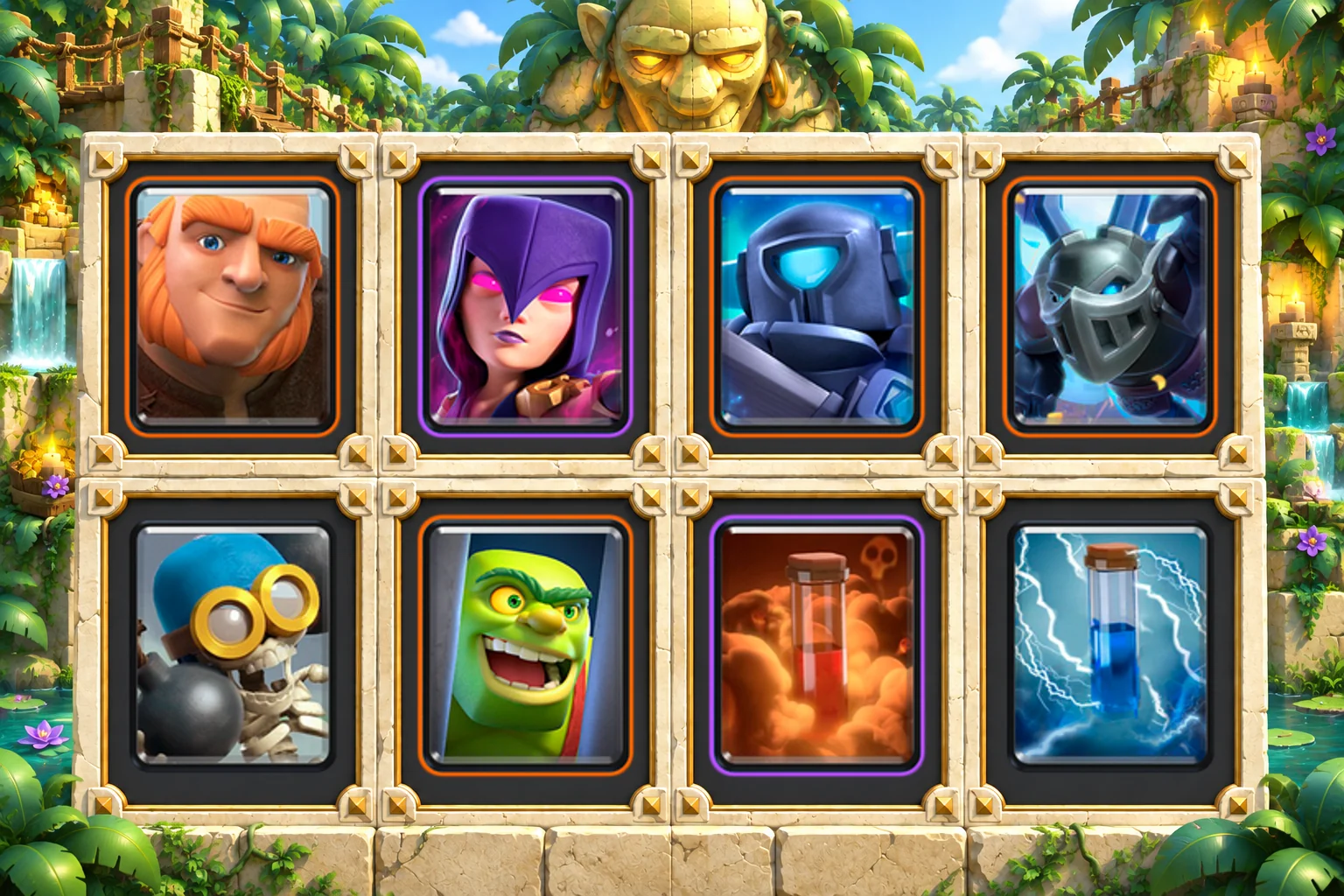
Average elixir: 3.6
Eight cards and their jobs
- Giant (5 elixir): Building-targeting tank placed in front of surviving defenders.
- Witch (5 elixir): Ranged splash and Skeleton distractions; keep her away from enemy splash and large spell value.
- Mini P.E.K.K.A (4 elixir): Concentrated ground damage against a tank or other high-health attacker.
- Mega Minion (3 elixir): Durable single flying attacker for focused air or ground damage.
- Bomber (2 elixir): Cheap ground splash behind a tank or defensive distraction; cannot shoot air.
- Goblin Cage (4 elixir): Pulls building-targeting threats, then releases a ground Brawler counterpush.
- Poison (4 elixir): Damage over time and area denial; not an instant removal spell.
- Zap (2 elixir): Small air and ground hit plus brief stun/reset; does not replace heavy damage.
Build the Witch push from a defense
Witch contributes bodies and support behind a defended Giant push. Mini P.E.K.K.A supplies the concentrated damage those Skeletons cannot reliably deliver through splash. Poison controls the space occupied by defenders, but the deck still needs Mega Minion ready when the opponent attacks through the air.
Opening and double elixir
A full-health Giant and Witch purchased together consumes ten elixir before any response. Let Cage, Mini P.E.K.K.A or Witch defend first, then build from what survives. Double elixir makes this easier to fund, but Poison still belongs after the opponent commits support.
Defensive order and matchups
Against Giant Wizard: Cage should draw Giant away from its ranged support where possible. Mini P.E.K.K.A attacks the tank while Poison pressures the Wizard's area. Keep Witch's Skeletons out of the direct splash line until Wizard is occupied or removed.
Against Balloon: Mega Minion needs to start early, with Witch helping from range. Cage buys time and Zap delays. Bomber cannot contribute against Balloon, so spending Mega Minion casually behind Giant can leave an impressive ground push and a losing defense.
A decision during the match
If Fireball removes Witch before the counterpush reaches the bridge, reassess immediately. The Skeleton support you planned around is gone. Hold Giant or reduce the support spend, then protect the surviving defender. Continuing the original attack plan just because it looked good a moment ago is the expensive error.
Mistake to avoid: Treating Skeleton production as reliable against untouched splash.
One-card alternatives and upgrades
- Musketeer for Witch: Cheaper focused air damage, loses Skeletons. New average 3.5 elixir.
- Baby Dragon for Bomber: Airborne splash but two extra elixir. New average 3.9 elixir.
Upgrade focus: Giant, Mini P.E.K.K.A, Witch, Poison.
Witch should have a useful level if she is the reason you choose this deck. If she is underlevelled, Musketeer is a cheaper focused shooter. Baby Dragon for Bomber adds air splash but raises the cost and changes how quickly you can recover after a failed push.
Giant Prince Barbarian Barrel
For single-target counterpushes with a reliable ground swarm answer.
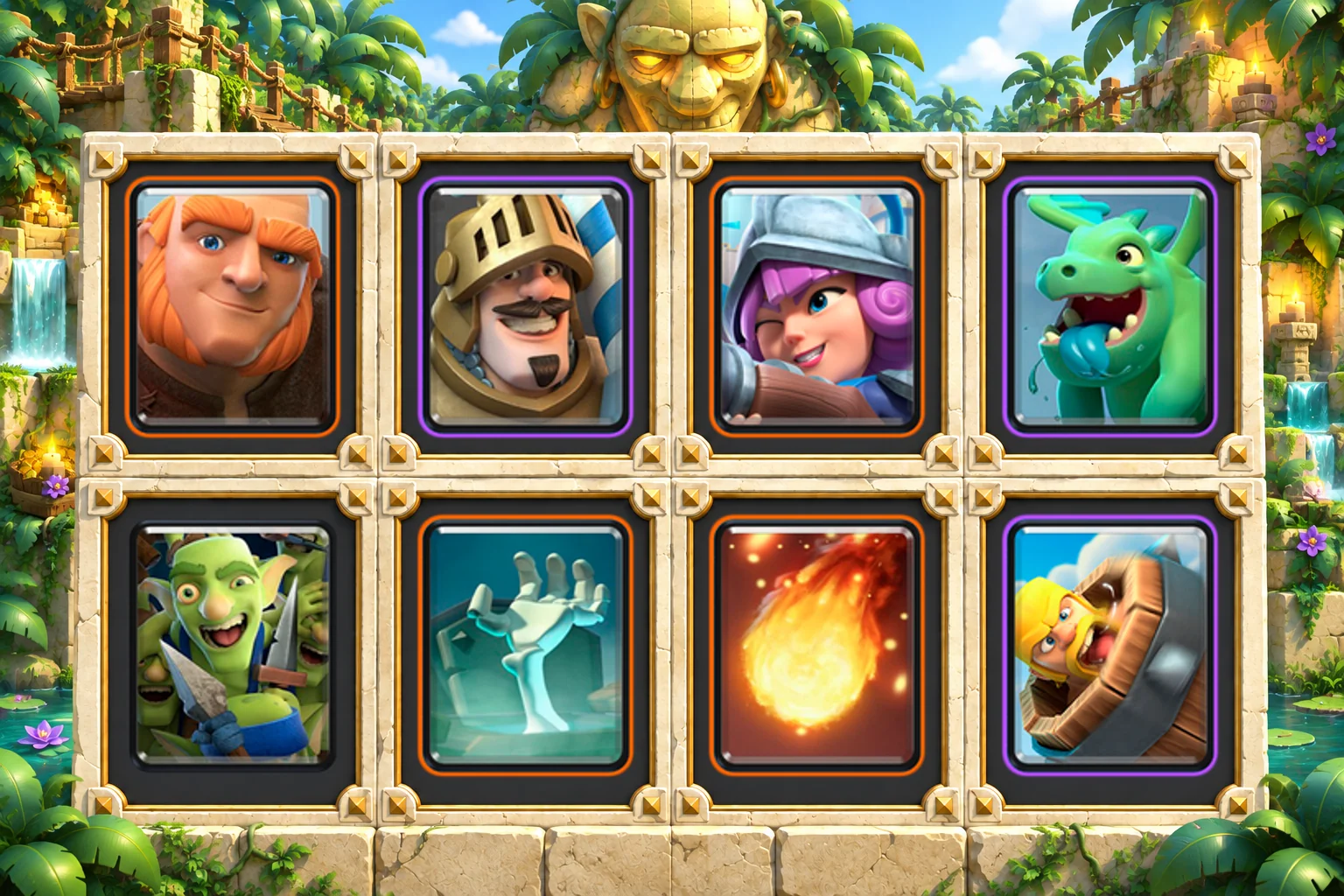
Average elixir: 3.8
Eight cards and their jobs
- Giant (5 elixir): Building-targeting tank placed in front of surviving defenders.
- Prince (5 elixir): Single-target ground damage and a charge threat; needs protection against swarms.
- Musketeer (4 elixir): Sustained ranged air and ground damage; keep her away from overlapping spell value.
- Baby Dragon (4 elixir): Durable flying splash support; its damage alone is not a fast tank solution.
- Goblin Gang (3 elixir): Mixed melee and spear bodies for surrounds and supplementary air damage; fragile to spells.
- Tombstone (3 elixir): Defensive pull with Skeleton distractions; vulnerable to splash.
- Fireball (4 elixir): Immediate area damage and knockback; spend for useful defense or support value.
- Barbarian Barrel (2 elixir): Ground-line removal and a Barbarian body; cannot damage air.
Let Prince supply damage behind Giant
Prince can defend a single ground threat and then provide damage behind Giant. Baby Dragon covers swarms while Barbarian Barrel clears a useful ground line. The absence of a reset matters: neither of those splash answers interrupts an Inferno beam simply by being played.
Opening and double elixir
Keep the first Giant until you have learned their tank answer. Tombstone and Musketeer can establish the defense without committing the whole hand. In double elixir, Giant belongs ahead of a surviving Prince when you can still protect the air defender and answer a second lane.
Defensive order and matchups
Against Skeleton Army: Roll Barbarian Barrel through the ground swarm when it actually blocks Prince. Baby Dragon can help wider groups, but purchasing both answers for the same small threat wastes the resources needed for the rest of the push.
Against Balloon: Tombstone extends Balloon's travel while Musketeer supplies the main damage. Baby Dragon assists, particularly against nearby small air units. Keep these defenders apart instead of allowing one spell to catch the ranged shooter and the whole support stack.
A decision during the match
With an Inferno Tower already waiting, Giant plus Prince may simply feed its defense. This version has no reset, so wait for the building to be used or lose enough lifetime to make pressure sensible. The Zap substitution changes that interaction, but also removes the useful Barbarian body.
Mistake to avoid: Adding Giant before protecting Musketeer against a Balloon punish.
One-card alternatives and upgrades
- Zap for Barbarian Barrel: Reset and air hit, loses body. New average 3.8 elixir.
- Guards for Goblin Gang: Ground shields, loses spears. New average 3.8 elixir.
Upgrade focus: Giant, Prince, Musketeer, Fireball.
Prince and Giant are meaningful investments only if the support can survive long enough to deliver them. Musketeer and Fireball deserve priority when air or ranged support repeatedly stops you. Guards give a different ground distraction but cannot restore Gang's air spears.
Giant Skeleton Dart Control
Heavy specialist for congested ground pushes.
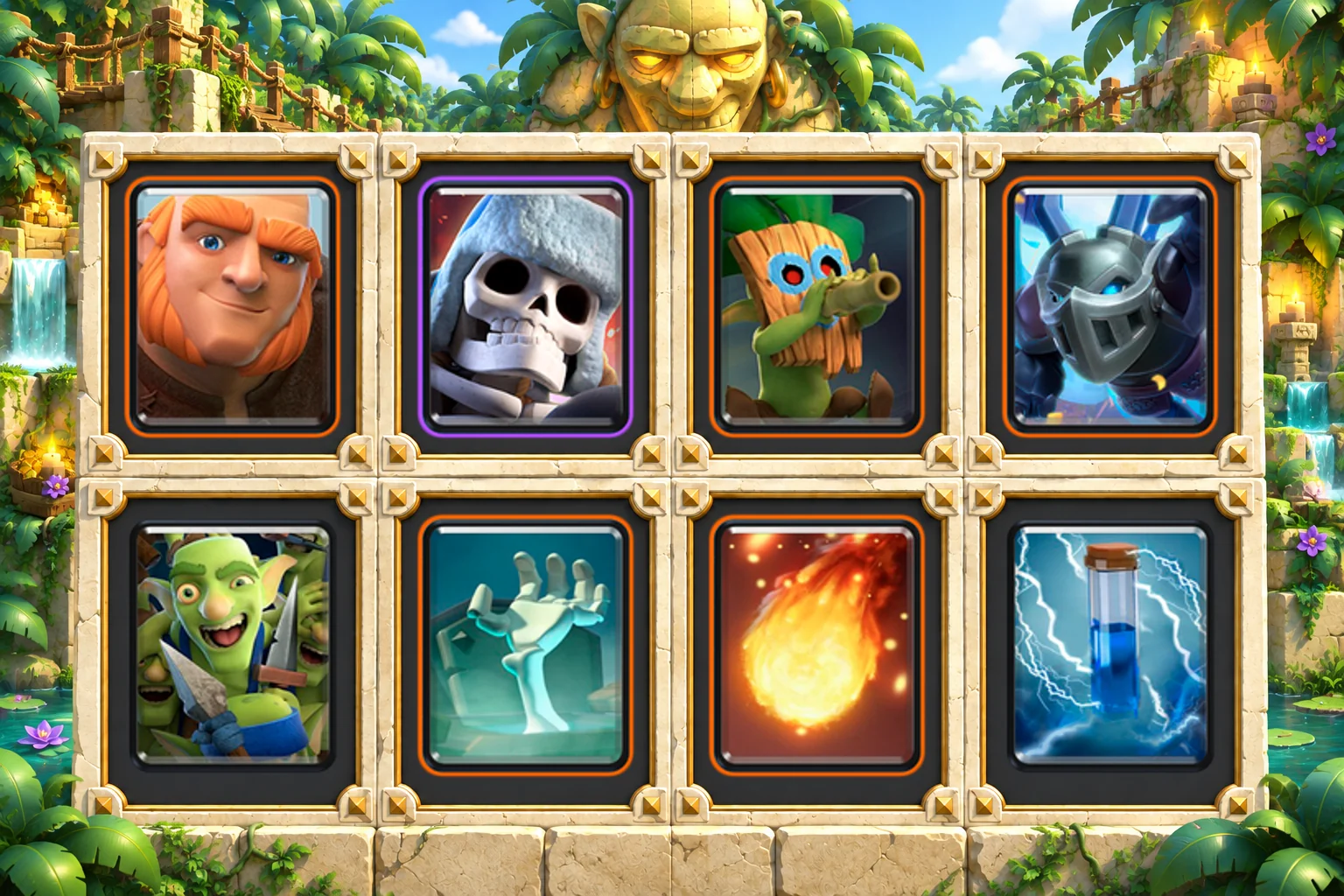
Average elixir: 3.6
Eight cards and their jobs
- Giant (5 elixir): Building-targeting tank placed in front of surviving defenders.
- Giant Skeleton (6 elixir): Ground support blocker whose death bomb controls space; tower damage is conditional.
- Dart Goblin (3 elixir): Fragile long-range air and ground shooter; protect his firing angle and spell exposure.
- Mega Minion (3 elixir): Durable single flying attacker for focused air or ground damage.
- Goblin Gang (3 elixir): Mixed melee and spear bodies for surrounds and supplementary air damage; fragile to spells.
- Tombstone (3 elixir): Defensive pull with Skeleton distractions; vulnerable to splash.
- Fireball (4 elixir): Immediate area damage and knockback; spend for useful defense or support value.
- Zap (2 elixir): Small air and ground hit plus brief stun/reset; does not replace heavy damage.
Use Giant Skeleton to finish the defense first
Giant Skeleton is chosen for defensive congestion and the threat of his death bomb, while Giant remains the building-targeting win condition. Their combined cost is eleven. The deck therefore relies on surviving defenders and patient spending, not on placing both large bodies whenever they appear together.
Opening and double elixir
React with Tombstone and the relevant damage unit in the opening. Use Giant Skeleton when he can occupy meaningful ground support, rather than as a routine six-elixir cycle. In double elixir, inspect what survives and where the bomb will land before buying Giant for the return journey.
Defensive order and matchups
Against Giant Witch: Tombstone changes Giant's path while Giant Skeleton occupies the support. Witch may keep her distance, so the death bomb is not guaranteed to solve the entire push. Preserve a ranged angle and enough elixir to finish any surviving support.
Against Balloon: Dart Goblin and Mega Minion are the damage cards; neither large ground unit shoots Balloon. Tombstone only buys time. Keep the air pair separate so a spell does not turn your heavy hand into a collection of irrelevant defenders.
A decision during the match
A Giant Skeleton is nearly defeated, but Witch is standing outside the likely bomb area. Placing Giant immediately can leave the surviving Witch free to rebuild behind another attacker. Remove or occupy her first. A bomb animation is not proof that the defensive job has been completed.
Mistake to avoid: Using eleven elixir of tanks without preserved air damage.
One-card alternatives and upgrades
- Guards for Goblin Gang: Shielded ground bodies, loses air help. New average 3.6 elixir.
- Musketeer for Dart Goblin: More durability for extra elixir. New average 3.8 elixir.
Upgrade focus: Giant, Dart Goblin, Giant Skeleton, Fireball.
Upgrade Giant Skeleton for the exchanges that actually make you choose him, while keeping Dart Goblin and Mega Minion useful against air. Giant supplies the tower plan, and Fireball helps remove support that refuses to enter the death-bomb area.
Split Royal Hogs after a defender commits
Splitting Hogs can stretch one splash defender. It does not erase a second splash card or a central building, so inspect both lanes before buying support.
Royal Hogs Recruits Dart
Split-lane pressure for players who already have leveled Recruits.
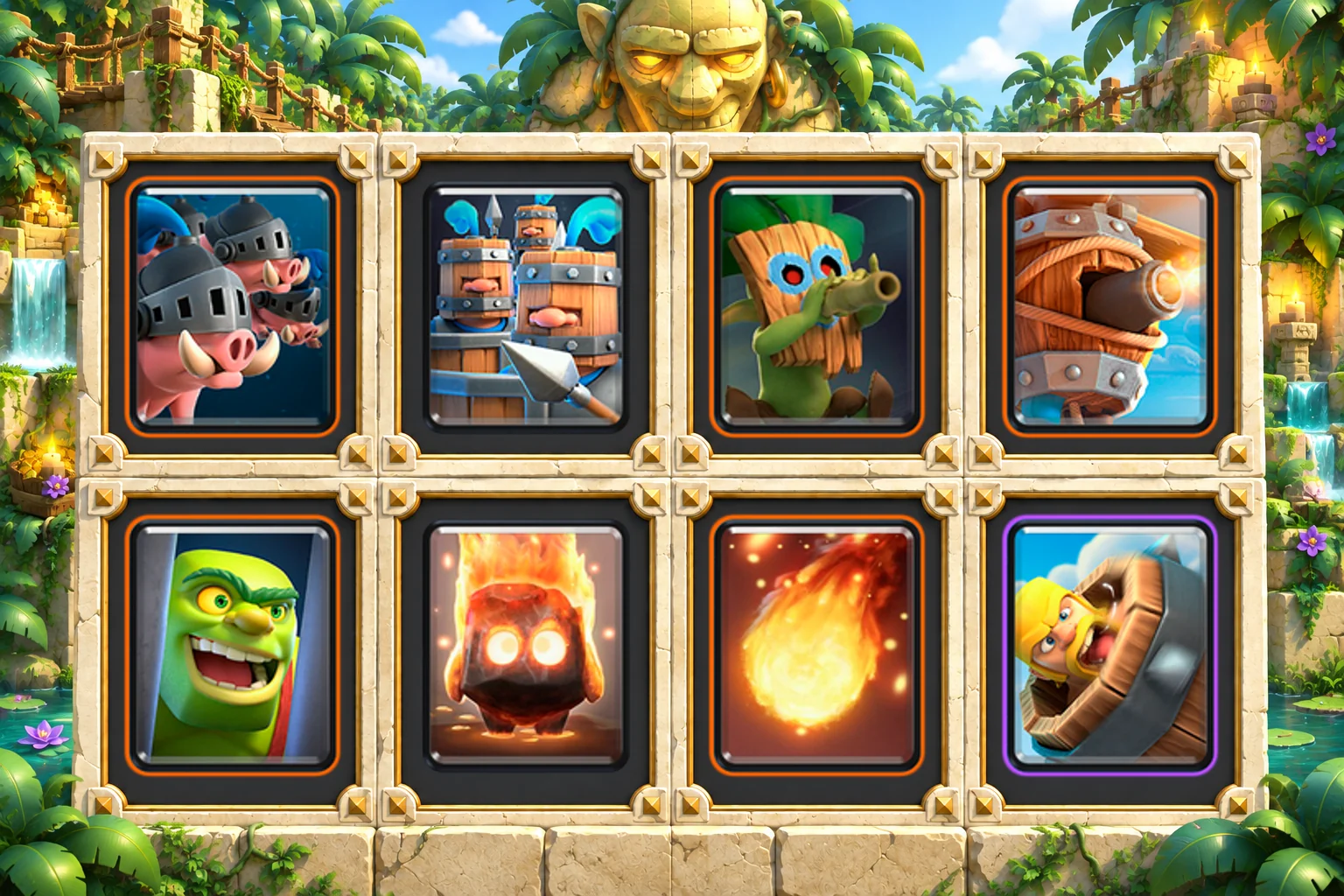
Average elixir: 3.8
Eight cards and their jobs
- Royal Hogs (5 elixir): Building-targeting pressure that can be split to stretch one splash defender.
- Royal Recruits (7 elixir): Split ground defense with shields; expensive, so deploy to answer real pressure.
- Dart Goblin (3 elixir): Fragile long-range air and ground shooter; protect his firing angle and spell exposure.
- Flying Machine (4 elixir): Fragile flying ranged support; place far enough away to use its reach.
- Goblin Cage (4 elixir): Pulls building-targeting threats, then releases a ground Brawler counterpush.
- Fire Spirit (1 elixir): Cheap area damage against grouped defenders; does not replace an air shooter.
- Fireball (4 elixir): Immediate area damage and knockback; spend for useful defense or support value.
- Barbarian Barrel (2 elixir): Ground-line removal and a Barbarian body; cannot damage air.
Make each half of the Recruits useful
Recruits can leave defenders in both lanes, which gives Royal Hogs a choice of where to apply pressure. Dart Goblin and Flying Machine shoot behind that screen. Both are fragile, so drawing a spell is useful only when another air answer and the elixir to deploy it remain.
Opening and double elixir
Use Cage against real pressure and avoid an opening Recruits commitment simply because the hand is heavy. In double elixir, observe which lane has the weaker defense before splitting or concentrating Hogs. Surviving Recruits are already an investment; you do not need to add every ranged card to make them count.
Defensive order and matchups
Against Valkyrie: A split can prevent one Valkyrie from covering everything, but the opponent may have another splash card or building. Watch the second response before buying extra support. Put your ranged troops where Valkyrie's approach does not drag them into a common spell area.
Against Balloon: Cage redirects while the two shooters work from separate positions. Fireball can help when it earns a useful interruption or catches support. Fire Spirit provides only a brief contribution; losing both ranged cards leaves the deck exposed.
A decision during the match
If Fireball removes Flying Machine, using Dart Goblin at the bridge as bait is a dangerous follow-up against Balloon. Keep the surviving air role available. Hogs can still ask for a response without that extra card, and a defended next push creates another split-lane opportunity.
Mistake to avoid: Calling every spell-bait trade positive without counting the defense left.
One-card alternatives and upgrades
- Ice Spirit for Fire Spirit: More delay, less burst. New average 3.8 elixir.
- Arrows for Barbarian Barrel: Air swarm coverage, loses ground body. New average 3.9 elixir.
Upgrade focus: Royal Hogs, Flying Machine, Dart Goblin, Cage.
Royal Hogs and the ranged pair determine whether pressure survives beyond the first exchange. Cage must also hold up long enough for them to work. Focus one version of this deck instead of upgrading every possible spell-bait support at once.
Royal Hogs Poison Cage
Royal Hogs with delayed zone control around a defensive building.
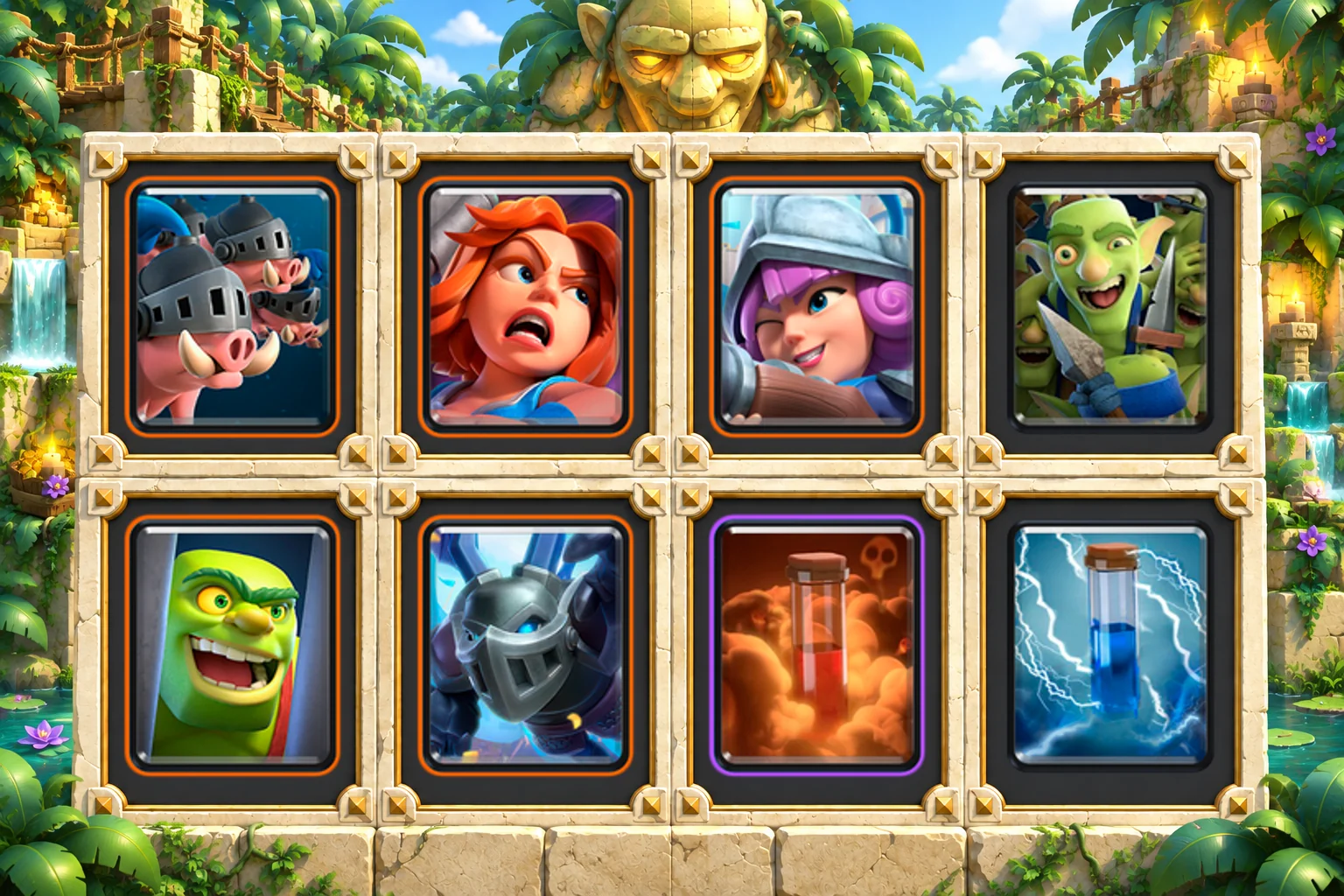
Average elixir: 3.6
Eight cards and their jobs
- Royal Hogs (5 elixir): Building-targeting pressure that can be split to stretch one splash defender.
- Valkyrie (4 elixir): Ground splash defender for clustered support and swarms; cannot attack air.
- Musketeer (4 elixir): Sustained ranged air and ground damage; keep her away from overlapping spell value.
- Goblin Gang (3 elixir): Mixed melee and spear bodies for surrounds and supplementary air damage; fragile to spells.
- Goblin Cage (4 elixir): Pulls building-targeting threats, then releases a ground Brawler counterpush.
- Mega Minion (3 elixir): Durable single flying attacker for focused air or ground damage.
- Poison (4 elixir): Damage over time and area denial; not an instant removal spell.
- Zap (2 elixir): Small air and ground hit plus brief stun/reset; does not replace heavy damage.
Poison defenders near the tower
Valkyrie and Cage give this Royal Hogs list a stable ground defense while Musketeer and Mega Minion cover air. Poison is selected for a useful area of support, not for instantly deleting the building that attracted the Hogs. That distinction determines which attacks deserve the extra four elixir.
Opening and double elixir
Learn the opponent's splash card before sending all Hogs down one lane. If their answer is reliable and available, defend first rather than repeating the same attack. In double elixir, a split may ask for two responses, but only when your remaining cards can cover their counterpush.
Defensive order and matchups
Against Bomb Tower: A healthy Bomb Tower is designed to handle grouped ground attackers. Hogs plus Poison is a large commitment if the spell only scratches that building. Look for useful support overlap or wait for its lifetime and cycle instead of forcing the interaction.
Against Balloon: Musketeer and Mega Minion should engage before Balloon reaches the Cage. Keep one away from the likely spell. Poison deals damage over time; by itself it does not provide the emergency interruption needed when Balloon is already near the tower.
A decision during the match
Suppose Valkyrie lands outside the Poison circle and meets the Hogs before they reach the tower. The spell did not remove the key defense. On the next attack, change the lane split or wait for Valkyrie to be occupied rather than paying nine elixir for the same unsuccessful plan.
Mistake to avoid: Using Poison as an instant way to remove a building.
One-card alternatives and upgrades
- Fireball for Poison: Faster burst and knockback. New average 3.6 elixir.
- Guards for Goblin Gang: Shields for ground defense, loses spears. New average 3.6 elixir.
Upgrade focus: Royal Hogs, Musketeer, Poison, Cage.
A reliable Musketeer keeps this deck from becoming a ground-only race. Improve Hogs and the spell interaction you actually use, with Cage supporting the defensive rhythm. Preserve that balance when choosing between a cheaper cycle and more durable support.
Royal Hogs Goblin Gang Cycle
Low-cost split pressure for careful spell tracking.
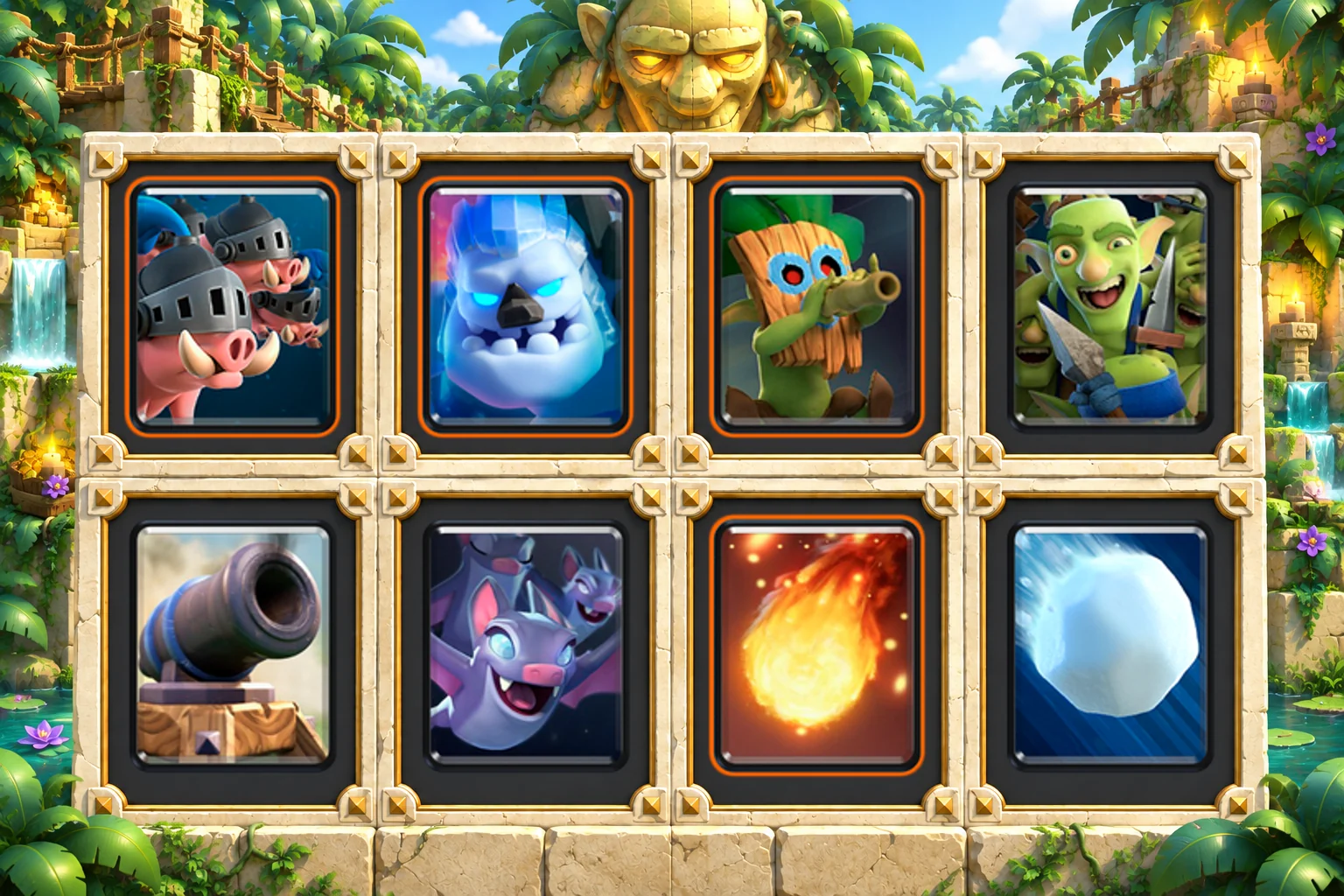
Average elixir: 3.0
Eight cards and their jobs
- Royal Hogs (5 elixir): Building-targeting pressure that can be split to stretch one splash defender.
- Ice Golem (2 elixir): Building-targeting distraction and kiting body with a death slow; not a damage dealer.
- Dart Goblin (3 elixir): Fragile long-range air and ground shooter; protect his firing angle and spell exposure.
- Goblin Gang (3 elixir): Mixed melee and spear bodies for surrounds and supplementary air damage; fragile to spells.
- Cannon (3 elixir): Cheap ground-targeting pull; can draw Balloon but cannot shoot it.
- Bats (2 elixir): Cheap flying damage; vulnerable to small spells and splash.
- Fireball (4 elixir): Immediate area damage and knockback; spend for useful defense or support value.
- Giant Snowball (2 elixir): Area damage, slow and eligible knockback; does not reset the Inferno Tower beam.
Split pressure without losing both air answers
Cheap defenders help this version return to Hogs sooner, but most of the air damage is fragile. Ice Golem and Cannon delay while Dart Goblin, Gang and Bats do the killing. If a small spell removes those units together, the attractive cycle cost does not repair the missing damage.
Opening and double elixir
Do not cycle both air-targeting troops to reach Hogs. Learn whether the opponent holds Arrows, Zap or a splash troop before using them as offensive support. In double elixir, send Hogs after a specific counter is committed, keeping enough for the next Cannon and ranged response.
Defensive order and matchups
Against P.E.K.K.A: Ice Golem can draw P.E.K.K.A through the middle, letting ranged damage work. Gang should surround only after the supporting splash unit has been occupied. A premature surround gives away the damage you needed for an otherwise efficient defense.
Against Balloon: Cannon changes the route while Dart Goblin starts shooting early. Delay Bats until the removal spell is spent when possible. Use Snowball’s slow and knockback to give the surviving air defenders more firing time.
A decision during the match
If Arrows is still in hand, a bridged Dart Goblin followed by Bats on defense can lose to the same spell sequence repeatedly. Hold Dart Goblin for the air threat and let Hogs pressure alone. You need to preserve two separate answers, not merely count two air cards in the deck.
Mistake to avoid: Assuming Snowball resets the Inferno Tower beam.
One-card alternatives and upgrades
- Zap for Giant Snowball: Reset instead of knockback. New average 3.0 elixir.
- Mega Minion for Bats: Sturdier air unit at extra cost. New average 3.1 elixir.
Upgrade focus: Royal Hogs, Dart Goblin, Fireball, Cannon.
Dart Goblin and Cannon support the repeated attacks, so do not neglect them while improving Hogs. Fireball helps when a defender offers real support value. This remains a precise deck even at good levels because its cheap troops must be deployed around spells.
Ground counterpushes with Battle Ram
Battle Ram makes a defended ground exchange matter at the other end of the arena. Its path, the surviving defender and the opponent's building all affect whether that charge is worth purchasing.
P.E.K.K.A Ram Poison
Patient counterpush with Jungle spell control.
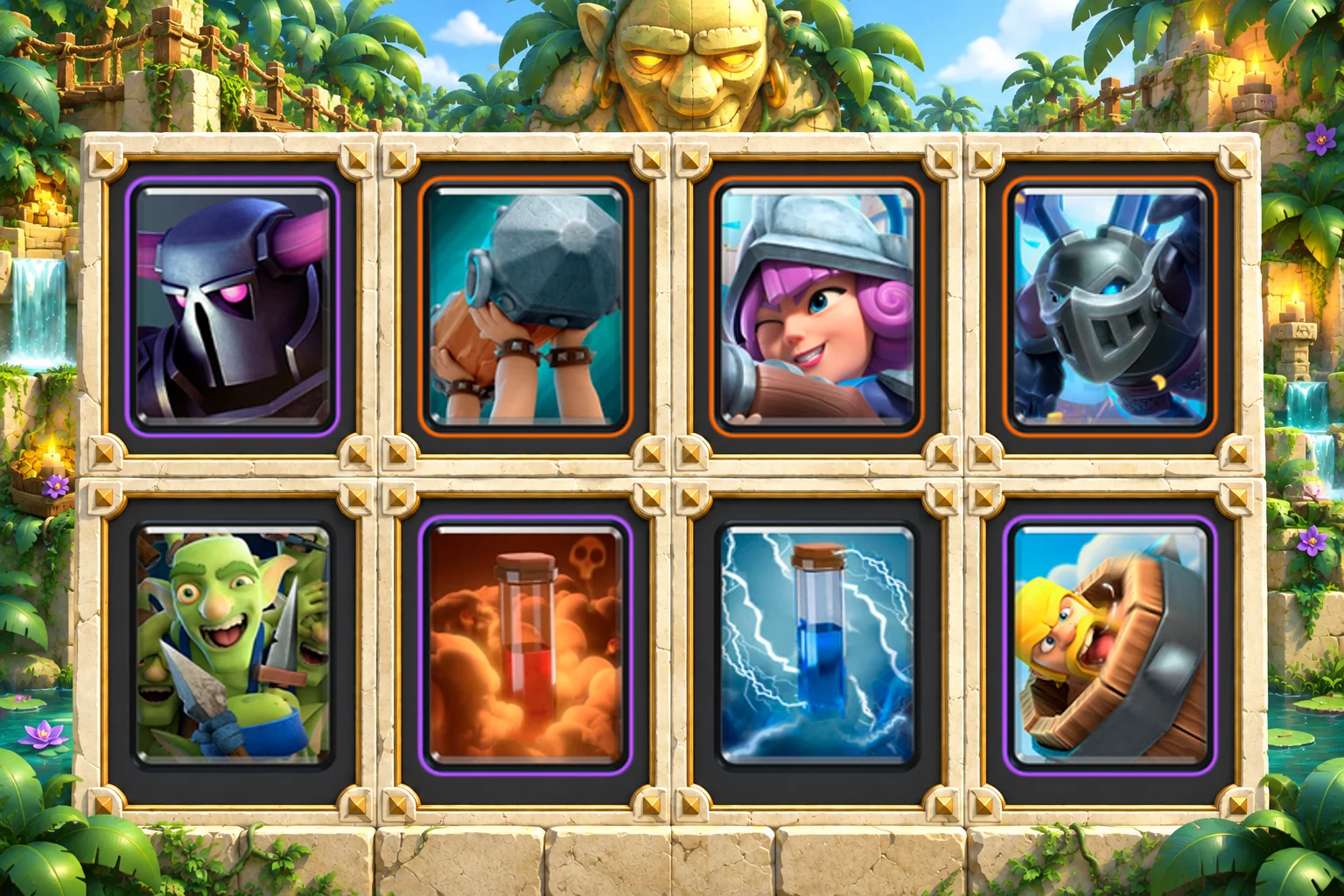
Average elixir: 3.6
Eight cards and their jobs
- P.E.K.K.A (7 elixir): Heavy ground damage on defense; a surviving unit can lead a counterpush.
- Battle Ram (4 elixir): Building-targeting charge and surviving Barbarians; punish a committed counter.
- Musketeer (4 elixir): Sustained ranged air and ground damage; keep her away from overlapping spell value.
- Mega Minion (3 elixir): Durable single flying attacker for focused air or ground damage.
- Goblin Gang (3 elixir): Mixed melee and spear bodies for surrounds and supplementary air damage; fragile to spells.
- Poison (4 elixir): Damage over time and area denial; not an instant removal spell.
- Zap (2 elixir): Small air and ground hit plus brief stun/reset; does not replace heavy damage.
- Barbarian Barrel (2 elixir): Ground-line removal and a Barbarian body; cannot damage air.
Turn the P.E.K.K.A defense into one Ram attack
P.E.K.K.A converts a serious ground defense into a threat the opponent must answer. Battle Ram can exploit that attention, while Poison and Barbarian Barrel remove different kinds of support. With no defensive building, however, the two air attackers cannot both be borrowed for every counterpush.
Opening and double elixir
Wait for a worthwhile ground target before spending seven on P.E.K.K.A. If you defend a small attack cheaply, there is no need to manufacture a huge push. In double elixir, Ram can join a survivor or use the other lane, provided Musketeer and Mega Minion remain affordable.
Defensive order and matchups
Against Giant Witch: Let P.E.K.K.A focus on Giant while the spell or rolling Barrel deals with support and Skeletons. Do not spend both spells automatically. Choosing the smaller answer where it works keeps elixir for the next defending troop.
Against Balloon: There is no building to extend Balloon's route. Musketeer and Mega Minion must begin dealing damage early, from different positions if a spell threatens them. P.E.K.K.A, Ram and Barbarian Barrel do not solve an airborne emergency.
A decision during the match
If the opponent kites P.E.K.K.A into the other lane, Ram pressure can be attractive, but the kiting unit and support still exist. Count what they can send back and what you have to stop it. A counterpush is optional; preventing an undefended air attack is not.
Mistake to avoid: Poison plus Barrel into a small swarm when one answer was enough.
One-card alternatives and upgrades
- Guards for Goblin Gang: More robust ground shields, less air help. New average 3.6 elixir.
- Fireball for Poison: Immediate burst instead of zone. New average 3.6 elixir.
Upgrade focus: Battle Ram, P.E.K.K.A, Musketeer, Poison.
Ram supplies the tower plan while P.E.K.K.A earns defensive value. Musketeer's level prevents air coverage from becoming the weak link. Poison needs to solve an actual support interaction rather than serve as a routine four-elixir tax on every attack.
Prince Ram Dart Pressure
Ground counterpressure with two charge threats and a clear pull.
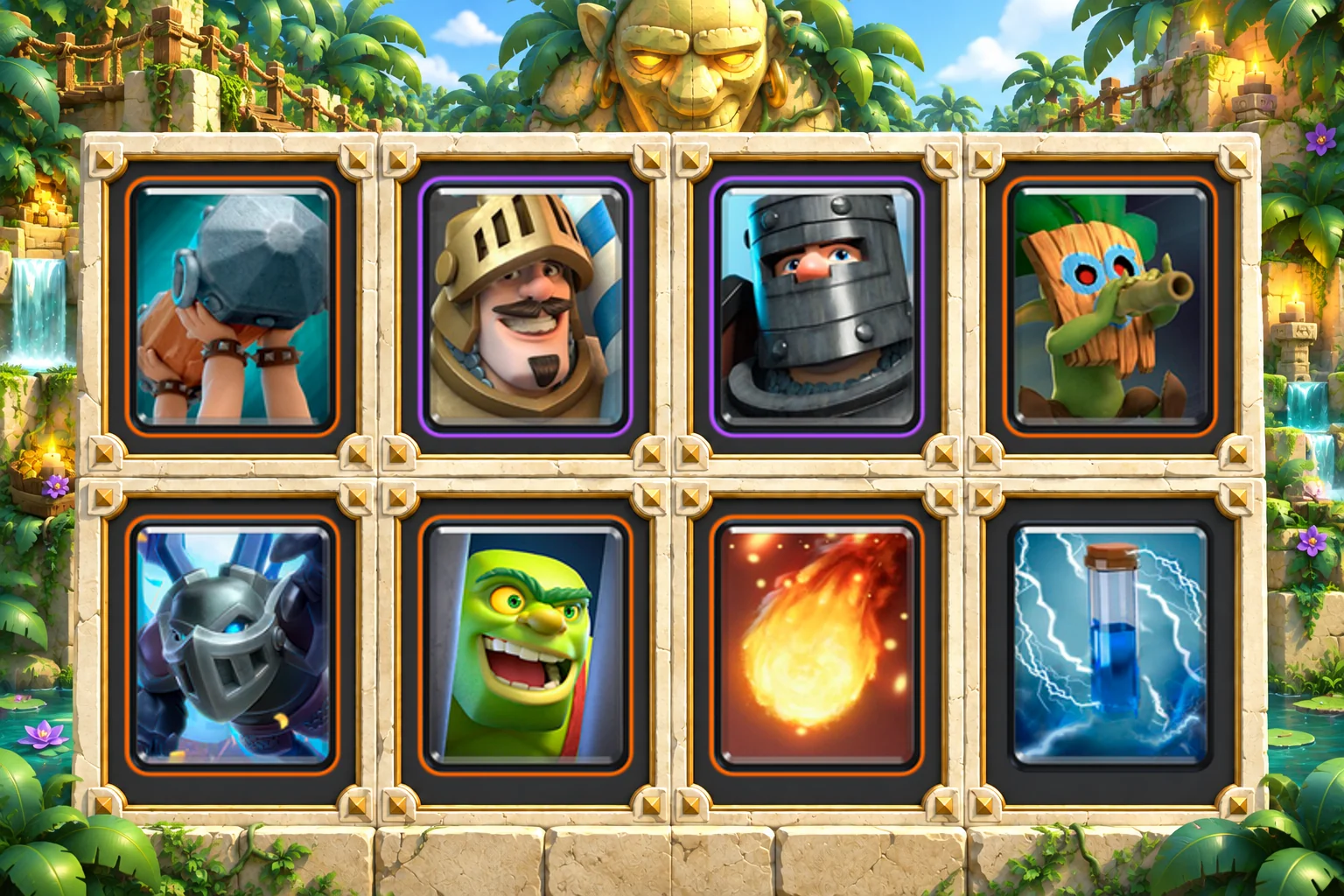
Average elixir: 3.6
Eight cards and their jobs
- Battle Ram (4 elixir): Building-targeting charge and surviving Barbarians; punish a committed counter.
- Prince (5 elixir): Single-target ground damage and a charge threat; needs protection against swarms.
- Dark Prince (4 elixir): Ground splash with a shield; clears small bodies around the primary attacker.
- Dart Goblin (3 elixir): Fragile long-range air and ground shooter; protect his firing angle and spell exposure.
- Mega Minion (3 elixir): Durable single flying attacker for focused air or ground damage.
- Goblin Cage (4 elixir): Pulls building-targeting threats, then releases a ground Brawler counterpush.
- Fireball (4 elixir): Immediate area damage and knockback; spend for useful defense or support value.
- Zap (2 elixir): Small air and ground hit plus brief stun/reset; does not replace heavy damage.
Defend with one Prince before adding Battle Ram
The two Princes divide ground defense between focused damage and splash. Cage gives them a pull to work around, and Ram supplies a building-targeting threat after the defense. This version rewards choosing the appropriate defender, not launching every charge in the hand at once.
Opening and double elixir
Use Cage to reveal the route of the first win condition. Add Prince for health or Dark Prince for a group, rather than both by habit. In double elixir, a surviving Dark Prince can clear the Ram's path, but preserve Dart Goblin or Mega Minion for the next air exchange.
Defensive order and matchups
Against Royal Giant: Draw Royal Giant with Cage and get Prince onto it while Dark Prince handles nearby small support if required. Position Dart Goblin away from the tower-and-Cage spell area. An expensive ground defense should not also hand the opponent free ranged-support damage.
Against Balloon: Neither Prince shoots Balloon. Dart Goblin needs time at range and Mega Minion must engage close, with Cage changing the route. Zap is a short interruption; it cannot replace the damage card you just used behind Ram.
A decision during the match
If their central building can attract the Prince and Ram together, simultaneous pressure may simply give one defender two targets. Let the first threat draw a response and observe the remaining lifetime or supporting troops. Delayed Ram pressure can be better than stacking another charge into the same prepared answer.
Mistake to avoid: Putting Dart Goblin in the same spell radius as the tower and Cage.
One-card alternatives and upgrades
- Musketeer for Dart Goblin: Sturdier air shooter at extra cost. New average 3.8 elixir.
- Valkyrie for Dark Prince: Stationary splash without charge or shield. New average 3.6 elixir.
Upgrade focus: Battle Ram, Prince, Dart Goblin, Fireball.
Keep Prince useful in the heavy ground exchanges that justify his cost, and Ram strong enough to threaten damage. Dart Goblin and Fireball support that plan from range. Their effectiveness depends on avoiding shared spell value as much as on upgrades.
Battle Ram Gang Defense
Ground-swarm control with Ram as a modest counterattack.

Average elixir: 3.4
Eight cards and their jobs
- Battle Ram (4 elixir): Building-targeting charge and surviving Barbarians; punish a committed counter.
- Valkyrie (4 elixir): Ground splash defender for clustered support and swarms; cannot attack air.
- Musketeer (4 elixir): Sustained ranged air and ground damage; keep her away from overlapping spell value.
- Goblin Gang (3 elixir): Mixed melee and spear bodies for surrounds and supplementary air damage; fragile to spells.
- Bats (2 elixir): Cheap flying damage; vulnerable to small spells and splash.
- Bomb Tower (4 elixir): Ground splash building and pull; it cannot shoot flying attackers.
- Fireball (4 elixir): Immediate area damage and knockback; spend for useful defense or support value.
- Barbarian Barrel (2 elixir): Ground-line removal and a Barbarian body; cannot damage air.
Preserve Musketeer through the ground exchange
Bomb Tower and Valkyrie handle crowded ground fights, allowing Gang to damage a separated target. Ram then uses a surviving Valkyrie as cover. Bats and Musketeer supply air damage, but the deck has no reset, so spell and building matchups need deliberate timing.
Opening and double elixir
A quiet opening is preferable to exposing Musketeer before the opponent's air threat is known. If you split Gang, keep enough elixir for a real defense. In double elixir, Ram follows a positive trade; Barbarian Barrel waits for the ground swarm that would actually stop it.
Defensive order and matchups
Against Royal Hogs: Let Bomb Tower collect the Hogs while Valkyrie handles support or the uncovered lane. Fireball can be preserved if those two cards already complete the job. Using every splash answer at once leaves no flexibility against the next push.
Against Balloon: Musketeer does the sustained work while the building changes Balloon's path. Add Bats after the removal spell when possible. Barbarian Barrel cannot hit air and there is no Zap reset, so late emergency reactions are particularly expensive.
A decision during the match
You used Barbarian Barrel to defend and now have Valkyrie walking forward. If Skeleton Army is their known Ram answer, adding Ram requires either a worthwhile Fireball or a different timing. Do not assume the surviving Valkyrie will automatically arrive in the right position to clear everything.
Mistake to avoid: Treating Bats and Gang together as safe against one small spell.
One-card alternatives and upgrades
- Zap for Barbarian Barrel: Air hit and reset, loses Barbarian. New average 3.4 elixir.
- Mega Minion for Bats: Stronger single body at extra cost. New average 3.5 elixir.
Upgrade focus: Battle Ram, Musketeer, Bomb Tower, Fireball.
Ram, Musketeer and Bomb Tower establish the deck's basic attack and defense. Keep Fireball appropriate to the support you meet. Protect Bats and Gang from overlapping removal; upgrading two fragile groups does not make stacking them into one spell a sound habit.
Mortar decks for patient ranged pressure
Mortar can be a defensive pull or an attacking threat. These lists ask you to change that job according to the board rather than chase a lock at any price.
Mortar Goblin Gang Control
Mortar control with Goblin Gang for ground distraction and limited air help.

Average elixir: 2.9
Eight cards and their jobs
- Mortar (4 elixir): Ranged tower threat or defensive pull; cannot shoot air or enemies inside its blind spot.
- Knight (3 elixir): Low-cost ground tank that occupies support and protects ranged damage.
- Archers (3 elixir): Split-capable air and ground damage; avoid clustering both with another fragile defender.
- Goblin Gang (3 elixir): Mixed melee and spear bodies for surrounds and supplementary air damage; fragile to spells.
- Mega Minion (3 elixir): Durable single flying attacker for focused air or ground damage.
- Ice Spirit (1 elixir): Brief freeze and a cheap rotation; buys time rather than sustained damage.
- Fireball (4 elixir): Immediate area damage and knockback; spend for useful defense or support value.
- Barbarian Barrel (2 elixir): Ground-line removal and a Barbarian body; cannot damage air.
Decide when Mortar should remain defensive
Mortar can threaten a tower or perform the less glamorous job of drawing a tank. Knight and Gang protect the ground around it, while Archers and Mega Minion cover air. Treating every Mortar as an offensive commitment is how this otherwise controlled list becomes wasteful.
Opening and double elixir
Split Archers when safe and identify the opposing win condition before forcing a tower lock. In double elixir, attack after their tank is committed if your defense allows it. If Mortar is clearly blocked, preserve the next support card rather than spending it to defend an attack that cannot connect.
Defensive order and matchups
Against Giant: A defensive Mortar can buy time for Mega Minion or Gang. Knight needs to meet the support, especially if splash would erase the Goblins. Choose the damage unit based on their spell instead of deploying both in one vulnerable cluster.
Against Balloon: Mortar draws Balloon but cannot shoot it. Keep Archers and Mega Minion on distinct angles and use Ice Spirit to extend their firing time. Barbarian Barrel does not clear an air escort, so Fireball may have to cover a valuable group.
A decision during the match
If every Mortar is needed to stop Giant, accept that phase of the match. Saving tower health and keeping a ranged defender alive can eventually create a better offensive window. Sacrificing the pull merely to prove the deck can get a lock gives the opponent the exchange they want.
Mistake to avoid: Calling a tank-blocked Mortar an attack that must always be protected.
One-card alternatives and upgrades
- Arrows for Barbarian Barrel: Air swarm coverage for extra cost. New average 3.0 elixir.
- Valkyrie for Knight: Ground splash at extra cost. New average 3.0 elixir.
Upgrade focus: Mortar, Archers, Fireball, Mega Minion.
Mortar and Archers need useful levels because they participate in both halves of the game. Mega Minion provides steadier air damage than fragile swarms. Improve Fireball for relevant support interactions, while avoiding unsupported assumptions about a spell finish.
Mortar Barrel Dart Pressure
Advanced two-building control for players who track rotation.
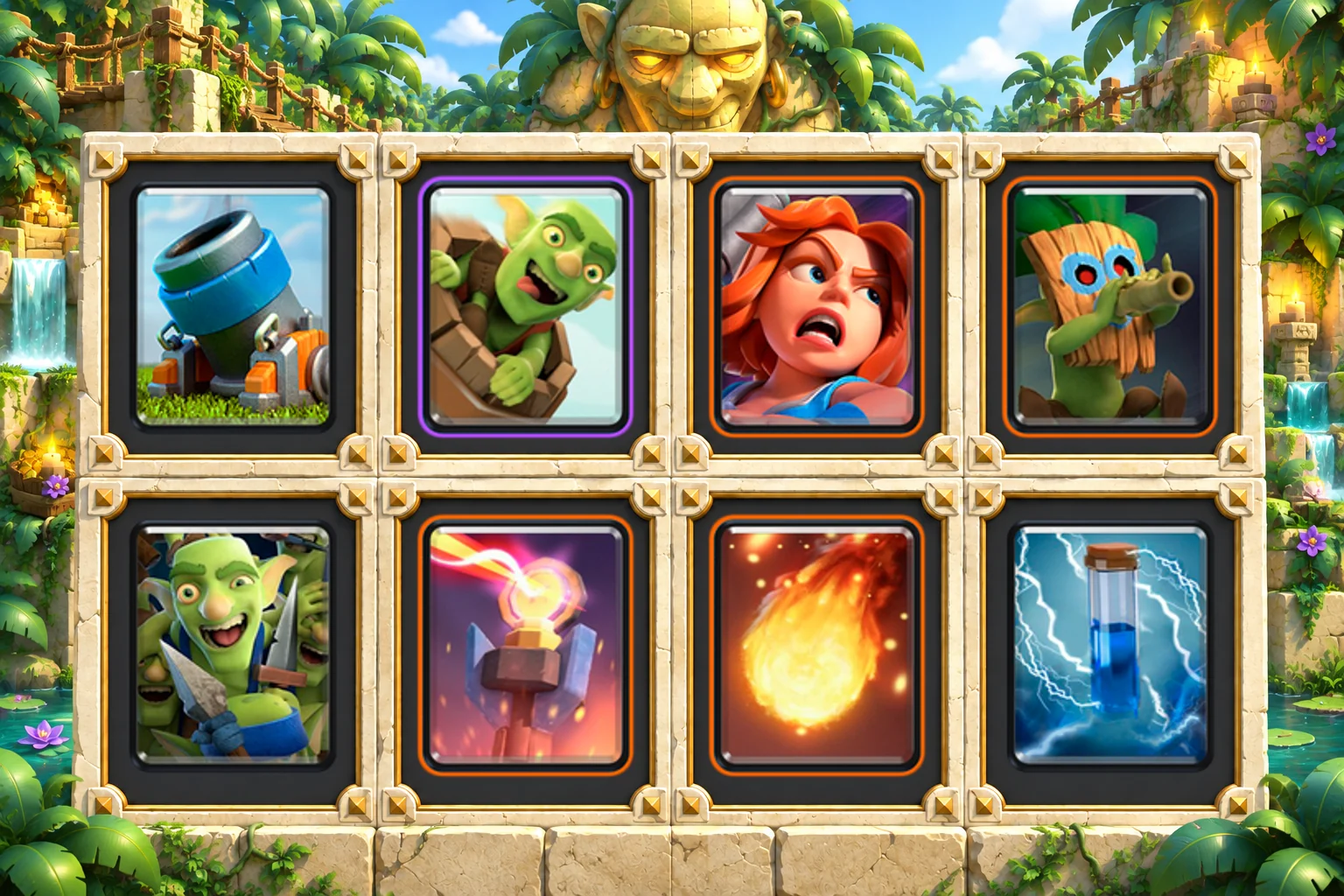
Average elixir: 3.5
Eight cards and their jobs
- Mortar (4 elixir): Ranged tower threat or defensive pull; cannot shoot air or enemies inside its blind spot.
- Goblin Barrel (3 elixir): Tower pressure that rewards tracking the opponent's small-spell cycle.
- Valkyrie (4 elixir): Ground splash defender for clustered support and swarms; cannot attack air.
- Dart Goblin (3 elixir): Fragile long-range air and ground shooter; protect his firing angle and spell exposure.
- Goblin Gang (3 elixir): Mixed melee and spear bodies for surrounds and supplementary air damage; fragile to spells.
- Inferno Tower (5 elixir): Increasing damage against a focused target; protect it against reset and distractions.
- Fireball (4 elixir): Immediate area damage and knockback; spend for useful defense or support value.
- Zap (2 elixir): Small air and ground hit plus brief stun/reset; does not replace heavy damage.
Give Barrel and Mortar separate attack windows
Goblin Barrel attacks the tower directly while Mortar asks the opponent to commit a ground answer. Inferno is the heavy-tank insurance. The cost of carrying two buildings is a hand that can become awkward, so spend them for separate jobs instead of covering the arena with structures.
Opening and double elixir
Test Barrel once without automatically adding Mortar. If the opponent immediately pressures, use the building needed for that threat. Double elixir lets you alternate attack routes, but placing Mortar, Inferno and Barrel together still consumes twelve elixir and can leave no troop protecting them.
Defensive order and matchups
Against P.E.K.K.A: Inferno draws P.E.K.K.A and needs a clear beam. Valkyrie can occupy support while Gang waits outside splash. Once the defense is stable, choose the pressure tool that asks for a different answer from the one the opponent just used.
Against Balloon: Inferno and Dart Goblin supply the relevant damage. Mortar can add a diversion but cannot shoot air, so do not mistake a second building for a second complete Balloon defense. Keep the ranged shooter away from a spell aimed at the building.
A decision during the match
If the same small spell stops every Barrel, inspect the opponent's tank cycle. A Mortar attack after that tank is committed elsewhere can demand a different response. Continue holding Barrel until it has a reason to be used; predictable chip attempts are not valuable merely because they are cheap.
Mistake to avoid: Using both buildings prematurely and losing the next pull.
One-card alternatives and upgrades
- Guards for Goblin Gang: Shields for ground defense, loses ranged spears. New average 3.5 elixir.
- Knight for Valkyrie: Lighter cycle, loses splash. New average 3.4 elixir.
Upgrade focus: Mortar, Goblin Barrel, Dart Goblin, Inferno Tower.
Both pressure tools need support, so avoid upgrading them while Dart Goblin and Inferno fall behind. The deck's complexity comes from deciding which building is needed next. Extra levels do not undo spending both structures before the opponent shows the real threat.
Send Balloon after its air counter is committed
Balloon needs a real opening in the air defense. A small spell being spent is only part of that picture; a ready Musketeer or building can still stop the attack.
Balloon Dart Snowball
Air pressure for players whose new ranged card is ready.
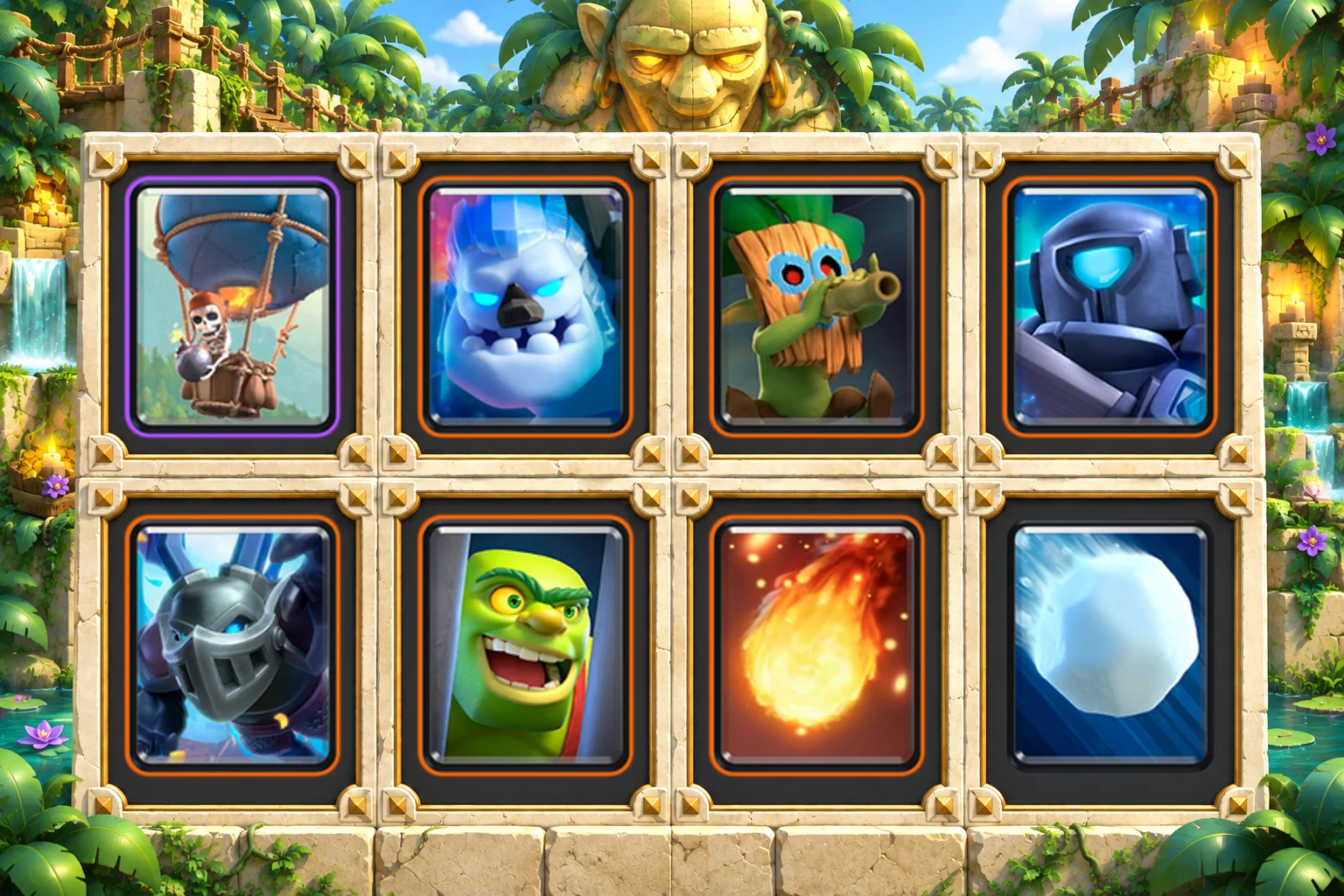
Average elixir: 3.4
Eight cards and their jobs
- Balloon (5 elixir): Air win condition; threaten only when the air counter or building can be managed.
- Ice Golem (2 elixir): Building-targeting distraction and kiting body with a death slow; not a damage dealer.
- Dart Goblin (3 elixir): Fragile long-range air and ground shooter; protect his firing angle and spell exposure.
- Mini P.E.K.K.A (4 elixir): Concentrated ground damage against a tank or other high-health attacker.
- Mega Minion (3 elixir): Durable single flying attacker for focused air or ground damage.
- Goblin Cage (4 elixir): Pulls building-targeting threats, then releases a ground Brawler counterpush.
- Fireball (4 elixir): Immediate area damage and knockback; spend for useful defense or support value.
- Giant Snowball (2 elixir): Area damage, slow and eligible knockback; does not reset the Inferno Tower beam.
Put a distraction ahead of Balloon
Balloon supplies damage while the cheap tank and ground defenders create an opening. Dart Goblin's range and Mega Minion's focused attacks keep air defense separate from the win condition. Snowball helps timing but does not grant a reset against Inferno Tower.
Opening and double elixir
Start with a reactive Cage and a protected ranged defender rather than using Dart Goblin as blind bridge pressure. In double elixir, send Balloon behind a surviving Ice Golem or Brawler when that body can draw attention and the opponent's air answers are genuinely manageable.
Defensive order and matchups
Against Hog Rider: Cage is the initial Hog response, with Mini P.E.K.K.A available if the trade needs extra damage. Using the backup automatically can leave no elixir for air support. Let the surviving ground unit pressure without requiring Balloon every time.
Against Inferno Tower: A waiting Inferno Tower remains dangerous because Snowball cannot reset its ramping beam. Attack after the building is committed or near the end of its useful lifetime, or accept the defense. Fireball is not an automatic replacement for a reset either.
A decision during the match
Dart Goblin draws Arrows, but the opponent still has Musketeer ready. Balloon is not suddenly undefendable. First look for Musketeer's commitment, position and available support. If she can shoot comfortably behind a building, wait for a better exchange instead of treating one spent spell as the entire window.
Mistake to avoid: Treating one spent spell as proof all air defense is gone.
One-card alternatives and upgrades
- Zap for Giant Snowball: Beam reset, no displacement. New average 3.4 elixir.
- Musketeer for Dart Goblin: Sturdier ranged damage for one extra elixir. New average 3.5 elixir.
Upgrade focus: Balloon, Dart Goblin, Fireball, Mini P.E.K.K.A.
Balloon and the durable defensive cards deserve priority over speculative support combinations. Dart Goblin's level matters if he repeatedly supplies your first air damage. Check the interaction before spending resources on Snowball; its main value here is timing and displacement.
Balloon Giant Skeleton Poison
Patient air counterpush with support-zone control.
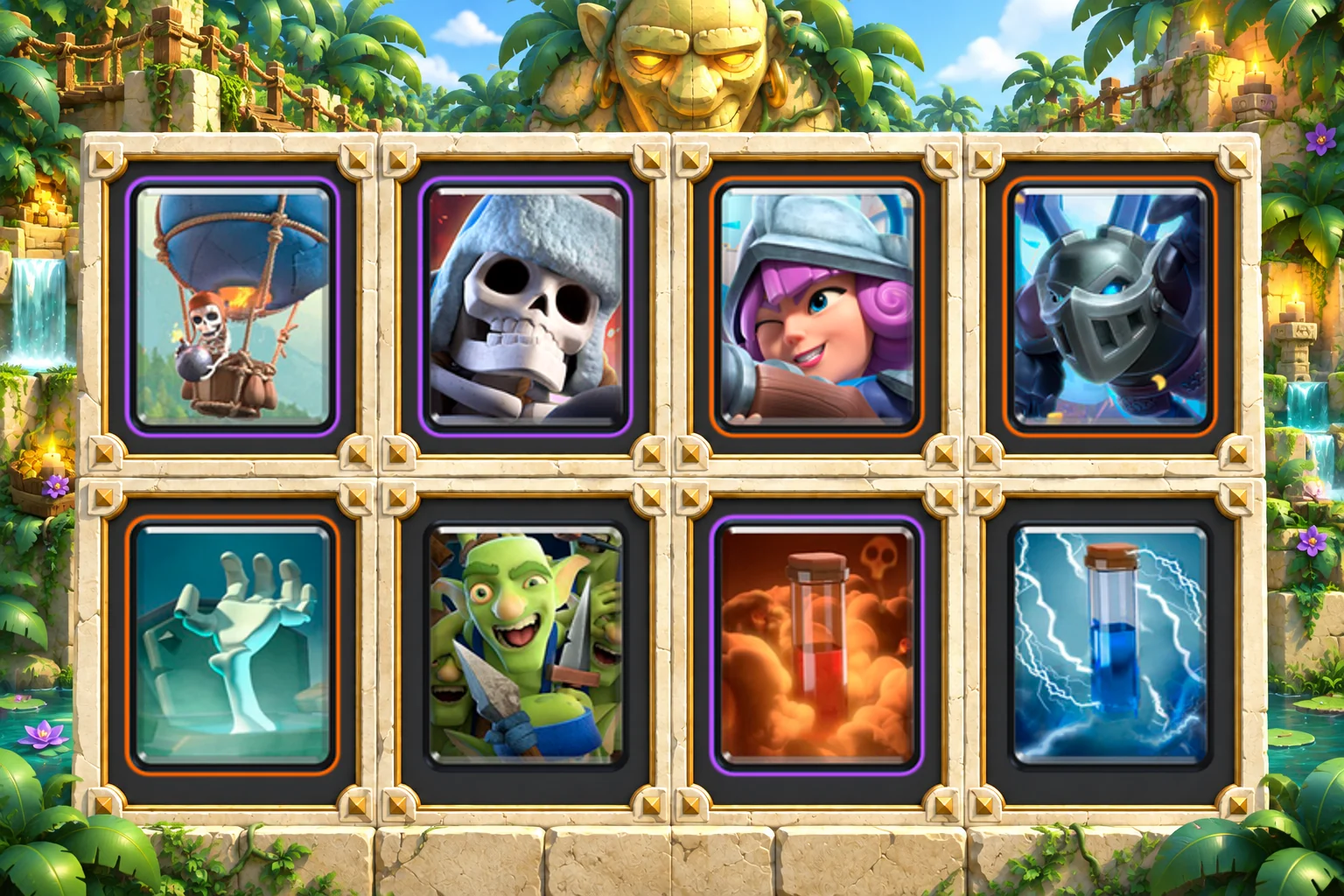
Average elixir: 3.8
Eight cards and their jobs
- Balloon (5 elixir): Air win condition; threaten only when the air counter or building can be managed.
- Giant Skeleton (6 elixir): Ground support blocker whose death bomb controls space; tower damage is conditional.
- Musketeer (4 elixir): Sustained ranged air and ground damage; keep her away from overlapping spell value.
- Mega Minion (3 elixir): Durable single flying attacker for focused air or ground damage.
- Tombstone (3 elixir): Defensive pull with Skeleton distractions; vulnerable to splash.
- Goblin Gang (3 elixir): Mixed melee and spear bodies for surrounds and supplementary air damage; fragile to spells.
- Poison (4 elixir): Damage over time and area denial; not an instant removal spell.
- Zap (2 elixir): Small air and ground hit plus brief stun/reset; does not replace heavy damage.
Use the bomb to create a safer Balloon window
Giant Skeleton creates a dangerous ground area on defense, and Balloon threatens the tower when that defense leaves a survivor. Poison can deny comfortable support positions. This is a heavy, conditional plan: the bomb's location and the opponent's air response matter more than simply owning both six- and five-elixir troops.
Opening and double elixir
React with Tombstone or the appropriate shooter in the first minute. Giant Skeleton is for a worthwhile ground exchange, not a mandatory opening. In double elixir, Balloon can follow a survivor if you retain defense, and Poison belongs on committed targets rather than where you hope they will stay.
Defensive order and matchups
Against Giant Witch: Draw Giant with Tombstone and bring Giant Skeleton into contact with the support when safe. Witch may stand outside the eventual bomb area. Use Poison for meaningful overlap, but preserve a card that can finish surviving troops after the bomb disappears.
Against Balloon: Musketeer and Mega Minion need to shoot while Tombstone buys time. Poison cannot stop the attack instantly and neither Giant Skeleton nor Gang's ground bodies replace those shooters. Keep the air pair apart when the opponent has a spell ready.
A decision during the match
If their Musketeer walks out of Poison and keeps shooting Balloon, adding more support may only repeat the initial mistake. Let the failed attack end and defend the survivor. The four elixir already spent is gone; the next four should solve the position that actually exists.
Mistake to avoid: Assuming a Poison zone traps troops or guarantees Balloon damage.
One-card alternatives and upgrades
- Fireball for Poison: Immediate damage instead of lingering control. New average 3.8 elixir.
- Guards for Goblin Gang: Ground shields, loses Spear Goblin air help. New average 3.8 elixir.
Upgrade focus: Balloon, Musketeer, Giant Skeleton, Poison.
Balloon is the tower plan, but Musketeer must remain dependable to survive the opponent's own air attacks. Giant Skeleton earns upgrades through defensive exchanges. Poison should be improved for repeated support value, never treated as a promise of Balloon hits.
Track the counter, not just the small spell
A used Zap is useful information. It does not tell you that Arrows, Valkyrie, Skeleton Army or another answer has vanished from the hand. Before committing Goblin Barrel, ask which card stopped it last time and which different card could stop it now.
With Goblin Barrel Dart Bait, imagine Zap removes your Gang. If Arrows has not appeared, a blind Barrel may simply draw that second spell. Defend with Dart Goblin from a protected angle and see whether the opponent spends Arrows there. Only then decide whether Barrel creates meaningful pressure. Do not sacrifice your only air shooter purely to manufacture bait.
The same principle applies to troops. A Valkyrie standing beside the tower can clear Barrel Goblins even after a small spell is spent. Poison does not remove her instantly. You may need to occupy her elsewhere, choose a different pressure route or wait for a more favorable hand.
Counting the opponent’s intervening cards helps you estimate when a response is close to returning. Treat the count as information, not a guaranteed exploit. Their elixir, special forms and other available counters still matter. If the answer is nearly back, a smaller probe can be wiser than an all-in attack.
Keep the right air defender
Dart Goblin plus Bats gives you two air-targeting cards, but both can be removed cheaply if you place them together. Musketeer plus Mega Minion creates a different defensive profile. Neither pair is automatically best for every collection; choose the one you can protect and keep at useful levels.
In Giant Dart Goblin Control, Cage redirects Balloon, Dart Goblin begins shooting from range, and Mega Minion engages from another angle. If the small spell removes Dart Goblin, Mega Minion still has a job. Adding him behind Giant instead can turn a good ground counterpush into an undefended air lane.
Poison also hits air, but its damage arrives over time. When Balloon is already approaching the tower, sustained damage and an appropriate pull or interruption are more useful than hoping a fresh Poison circle solves everything. Keep the air defense in hand before you purchase an expensive tank.
Change one card for a reason
If Dart Goblin is underlevelled in the starting Giant list, Musketeer is a practical alternative. The average rises from 3.5 to 3.6 elixir. You gain a sturdier shooter and lose some cheap ranged pressure, so stop cycling the replacement as casually as a three-elixir card.
In Hog Poison Valkyrie, Fireball for Poison keeps the displayed average at 3.1. The change is about timing: Fireball gives immediate impact and knockback where applicable, while Poison keeps damaging an area. Use the former when support needs to be interrupted now; keep the latter when defenders repeatedly remain in a useful zone.
Before upgrading, identify the exchange that keeps failing. If your win condition reaches the tower but deals too little, its level matters. If Musketeer disappears before the air defense is finished, solve that interaction. If a spell leaves a crucial defender alive, check the current damage at your level. Spreading resources across all 30 lists rarely addresses any one of those problems.
Questions before Hog Mountain
Do I need Legendary cards for Arena 9?
No Legendary card is required by these 30 lists. Older accounts, events and collection differences can produce opponents with cards outside the ordinary arena progression. That does not mean you need to copy an inaccessible card to assemble a working defense.
Should every deck use the newly unlocked Jungle cards?
No. A new card earns a slot by doing a useful job at a playable level. If Dart Goblin is weak but Musketeer is already reliable, keep the ranged defense you can trust. You can learn the new card without rebuilding all eight slots around it.
Why can the copied deck look different in my game?
The copy links select the eight standard cards. Your levels, owned forms and selected Tower Troop affect the result. Supercell’s March deck-slot update gives Trophy Road an Evolution slot from Arena 3 and a Hero slot from Arena 5; the Wild slot begins at Arena 10. An available slot does not mean you own every form. Check the eight cards and form choices in the game before playing.
Should I replace the whole deck at Arena 10?
Keep a deck whose defense you understand and whose levels remain useful. When you reach Hog Mountain, compare the Arena 10 options for a specific improvement rather than starting over automatically. A new unlock is an option, not an obligation.
Which of these decks has the highest win rate?
There is no measured win-rate ranking attached to these recommendations. Their order reflects ease of choosing a suitable plan, followed by more demanding alternatives. Card levels, placement, the opponent’s deck and updates change the outcome, so use the described strengths and weaknesses instead of an unsupported percentage.
Review notes
These are editorial deck recommendations for Jungle Arena. Arena names, trophy thresholds and ordinary card availability were checked against the maintained arena listing. Card access can differ on an individual account, so your in-game collection remains the final check.
The September balance notes changed several relevant interactions, including Fireball’s Crown Tower damage, Ice Golem’s durability and slow, and Battle Ram’s attraction to buildings. Check the damage shown in your game before attempting a spell finish. Advice for a standard card should not be confused with a Hero or Evolution ability.
Start with Giant Dart Goblin Control if its defensive cards fit your levels. Otherwise, choose the closest suitable alternative, keep its air answer available and focus upgrades on that one deck. You can browse the other arena guides when your collection needs a different starting point.
This is an independent fan guide. It is not affiliated with, endorsed by, sponsored by or approved by Supercell. Clash Royale and its game assets belong to Supercell. See the Supercell Fan Content Policy.