
The best deck for Arena 15 depends on your leveled collection. Start Arena 15 with Royal Giant Fisherman Hunter when that collection has useful levels. Fisherman changes a ground target’s position, Hunter supplies the damage from a protected distance, and Royal Giant uses the survivors. Choose Graveyard Ice Wizard Control for patient defense, or Hog Executioner Tornado for a familiar Hog plan against grouped support. Compare the weaknesses first, then commit upgrades to one plan you can defend with.
Miner’s Mine begins at 5,000 trophies, with Executioner’s Kitchen following at 5,500. A new unlock is useful when it repairs an actual job, not simply because it belongs to the new arena. These 30 standard-card configurations serve different leveled collections and decisions; they are not a measured top-ladder ranking or equally easy starting choices.
Choose the best deck for Arena 15 by control style
| Starting choice | Avg. | Fit and main limit |
|---|---|---|
| Royal Giant Fisherman Hunter | 3.0 elixir | Ground repositioning into useful Hunter damage. Hunter must remain ready for air because Fisherman cannot hook Balloon. |
| Graveyard Ice Wizard Control | 3.4 elixir | Patient defense before a healthy survivor tanks for Graveyard. Slow and splash still need a reachable target and enough damage. |
| Hog Executioner Tornado | 3.5 elixir | Useful against grouped support with an established Hog collection. Executioner plus Tornado costs eight, so repeated attacks must preserve that defensive reserve. |
If a leveled core from the Arena 13 guide still handles your opponents’ threats, keep the useful investment. Several options below deliberately retain familiar Hog or Giant plans. A new control card should change a sequence you understand, rather than force eight fresh upgrades.
What the new tools change
The maintained arena card listing places Fisherman, Cannon Cart, Mother Witch and Tornado among the options at this stage. These are the relevant examples used here, not a claim to list every current unlock or account-specific reward.
- Fisherman: changes a ground target’s position. Plan where it lands and what will damage it. The hook cannot pull a flying unit.
- Cannon Cart: supplies moving ground damage until its half-health transformation makes it a building. Inspect its current form before planning an escort.
- Mother Witch: rewards eligible cursed targets dying. A living cursed unit has not yet supplied the payoff, and a matchup without useful targets offers less value.
- Tornado: changes positions. It needs reachable follow-up damage or a safer destination; grouping units by itself does not finish the defense.
Clone, Elixir Collector and Mirror are not prerequisites for a useful Arena 15 deck. Their specialized commitments are not needed to learn the plans below. Keep the ordinary cards that already perform their jobs before adding a new mechanic solely for novelty.
Find the defensive decision you want to improve
Gallery cards read left to right across the top row, then the bottom row. The eight card rows and copy button follow that same order. Each replacement is a separate one-card alternative with its own average; applying both changes the defensive balance again.
Three starting choices for Miner’s Mine
Choose the sequence your leveled collection can actually defend with. These three plans use different damage positions and attack costs, so learn one before adding several new control cards.
Royal Giant Fisherman Hunter

Average elixir: 3.0
Eight cards and their jobs
- Royal Giant (6 elixir): Ranged building-targeting win condition; needs protection from tank killers.
- Fisherman (3 elixir): Ground-target hook and displacement; cannot pull air and needs protected follow-up damage.
- Hunter (4 elixir): Close-range spread damage against air and ground; distance changes how many projectiles connect.
- Royal Ghost (3 elixir): Ground splash pressure with invisibility between engagements; no air targeting.
- Skeletons (1 elixir): One-elixir ground distraction that buys shots and helps rotate the hand.
- Electro Spirit (1 elixir): Chain stun and small damage across multiple targets; not a sustained defender.
- Fireball (4 elixir): Immediate area damage and knockback; spend for useful defense or support value.
- The Log (2 elixir): Ground-line damage and knockback; cannot clear flying units.
Choose the hook's landing point before buying pressure
Choose this Royal Giant version when you want to learn Fisherman’s landing point without paying for a second flying support card. Skeletons cost three less than Phoenix, letting you rotate the hook and Hunter sooner, but you lose Phoenix’s sustained air damage and possible egg recovery. Hunter is therefore the only sustained air shooter. Let Skeletons or Ghost handle ground distractions when they can do so safely, and retain Hunter for air. The hook changes the target’s position and still needs protected damage to finish it.
Opening and double elixir
Wait or split Skeletons when safe, keeping Fisherman until the main ground attacker is identified. In double elixir, Royal Giant can lead a useful survivor while Fireball waits for a real support target. Preserve Hunter if the next air threat is unknown rather than moving the whole defensive arrangement into an attack.
Defensive order and matchups
Against Hog Rider: Fisherman needs time to complete a useful hook, so place him before the attacker is already delivering the damage you intended to prevent. Hunter or tower fire must finish the resulting target. Supporting troops can change the safe landing point, so the pull may still allow Hog to hit the tower.
Against Balloon: Fisherman cannot hook the flying attacker. Hunter needs a protected position at a useful range, with Electro Spirit supplying a brief interruption if it reaches the target. Ghost and Skeletons do not replace that air damage, so keep the shooter available before paying six for Royal Giant.
A decision during the match
Hunter is the only immediate air answer while a Ghost survivor invites a counterpush. Sending Hunter behind Royal Giant may leave the next Balloon with only delay against it. Let the other survivor pressure, or hold Royal Giant until the ranged reserve can cover the return.
One-card alternatives and upgrades
- Valkyrie for Royal Ghost: Stronger stationary ground splash at extra cost. New average 3.1 elixir.
- Ice Spirit for Electro Spirit: More localized delay instead of chain coverage. New average 3.0 elixir.
Royal Giant and Hunter deserve useful levels alongside Fireball's real support interactions. Fisherman's placement still matters after upgrades. Valkyrie adds tougher local ground splash at extra cost in Ghost's slot, while Ice Spirit changes chain interruption into localized delay without granting a standalone tower connection.
Graveyard Ice Wizard Control

Average elixir: 3.4
Eight cards and their jobs
- Graveyard (5 elixir): Timed Skeleton pressure around a chosen area; use a surviving tank and manage splash counters.
- Knight (3 elixir): Low-cost ground tank that occupies support and protects ranged damage.
- Baby Dragon (4 elixir): Durable flying splash support; its damage alone is not a fast tank solution.
- Ice Wizard (3 elixir): Ranged air and ground damage with slow; low damage needs a protected partner.
- Tombstone (3 elixir): Defensive pull with Skeleton distractions; vulnerable to splash.
- Poison (4 elixir): Damage over time and area denial; not an instant removal spell.
- Tornado (3 elixir): Repositions troops and damages an area; placement determines whether the pull helps defense.
- Barbarian Barrel (2 elixir): Ground-line removal and a Barbarian body; cannot damage air.
Pull into damage that is already able to fire
This Graveyard configuration exchanges Mega Minion’s focused damage for Tornado at the same three-elixir cost. That is the Arena 15 control choice: you gain the ability to move support into Baby Dragon’s splash or Ice Wizard’s slowing fire, but lose a separate flying damage dealer. Pick it when positioning is the job you need to improve and those two shooters are usable. Tombstone and Knight buy their firing time. If a tank survives because the deck lacks damage, another pull will not replace the missing Mega Minion.
Opening and double elixir
Wait, place Tombstone for an approach or use a safe Knight opening while retaining defense. In double elixir, add Graveyard only when the survivor's health and route support it. Poison follows a known defensive area, rather than becoming an automatic four-elixir companion to every five-elixir Graveyard.
Defensive order and matchups
Against Giant: Tombstone delays Giant while Knight deals with reachable support and Baby Dragon attacks useful groups. Tornado should improve that separation or alignment without dragging dangerous support onto an exposed tower. If Baby Dragon cannot reach the pulled area, the spell has rearranged the problem without solving it.
Against Goblin Barrel: Keep Barbarian Barrel or a suitable Knight-and-tower response available before committing the ground defenders to offense. The Barrel's line and timing must match the Goblins' positions. Spending every answer with Graveyard can leave a cheap returning attack more costly than the pressure you purchased.
A decision during the match
Tombstone has pulled Giant, but its ranged support remains outside Baby Dragon’s splash. If the dragon can safely fire into the new position, Tornado can move that support into its damage. If Baby Dragon is moving or occupied elsewhere, wait or defend the support separately. Spending three to group targets does not replace the continuous damage you gave up by choosing Tornado over Mega Minion.
One-card alternatives and upgrades
- Musketeer for Ice Wizard: More focused air damage but loses slow. New average 3.5 elixir.
- Valkyrie for Knight: Ground splash with a more expensive attack tank. New average 3.5 elixir.
Graveyard and Poison need useful levels, but Baby Dragon and Tombstone earn the opportunity to cast them. Musketeer adds focused air damage in Ice Wizard's place and removes slow. Valkyrie makes Knight's tanking role more expensive while adding ground splash, changing both defense and the cost of an intentional attack tank.
Hog Executioner Tornado

Average elixir: 3.5
Eight cards and their jobs
- Hog Rider (4 elixir): Main tower-pressure card; hold defensive elixir after sending him.
- Valkyrie (4 elixir): Ground splash defender for clustered support and swarms; cannot attack air.
- Executioner (5 elixir): Returning axe supplies air and ground line splash; needs help against high-health targets.
- Cannon (3 elixir): Cheap ground-targeting pull; can draw Balloon but cannot shoot it.
- Skeletons (1 elixir): One-elixir ground distraction that buys shots and helps rotate the hand.
- Tornado (3 elixir): Repositions troops and damages an area; placement determines whether the pull helps defense.
- Rocket (6 elixir): Expensive concentrated damage; check current level-specific tower damage before a finish.
- The Log (2 elixir): Ground-line damage and knockback; cannot clear flying units.
Reserve the eight-elixir air defense before another Hog
Executioner's outgoing and returning axe can gain useful targets from Tornado, while Cannon shapes the main approach and Valkyrie occupies ground support. Hog supplies the repeatable attack. The important cost is that Executioner plus Tornado totals eight, so a spare-looking four-elixir Hog may consume the reserve needed for the next grouped air push.
Opening and double elixir
Split Skeletons when safe or wait instead of opening with a blind five-elixir shooter. In double elixir, send affordable Hog pressure after defense while retaining the control package. Rocket is a separate six-elixir decision requiring verified finishing damage or valuable support targets, not a routine cast because the tower looks low.
Defensive order and matchups
Against Lava Hound: Executioner supplies the actual air damage while Tornado improves a useful line. Cannon can divert a building-targeting threat but does not shoot air. Protect the shooter from supporting removal and use the pull only when the axe or another damage source can reach the resulting position.
Against Royal Giant: Cannon and Executioner need time against Royal Giant's health. Valkyrie should separate supporting ground troops so the shooter can work safely. Do not expect Tornado or splash alone to erase a high-health attacker immediately; preserve the follow-up damage and avoid spending Hog while that job remains unfinished.
A decision during the match
The opponent begins a supported air push and your eight-elixir defensive pair is in hand. Another Hog costs four that may delay the setup until it is too late. Hold pressure, establish Executioner safely and use Tornado for an actual alignment instead of hoping a rushed single card repairs the missing reserve.
One-card alternatives and upgrades
- Fireball for Rocket: Cheaper immediate response but weaker heavy finish. New average 3.3 elixir.
- Tesla for Cannon: Air-capable building at extra cost. New average 3.6 elixir.
Keep Hog and Executioner effective with the building that buys his time. Fireball lowers Rocket's commitment but removes the heavier finishing option. Tesla costs more than Cannon and adds air targeting, which can help the narrow air dependency while changing the budget needed before the next Hog.
Royal Giant with different support jobs
The support choices below change the ground pull, air reserve, swarm conversion and Cart position around the same six-elixir attacker. Select the job you need rather than treating every new support as mandatory.
Royal Giant Mother Witch Punish

Average elixir: 3.4
Eight cards and their jobs
- Royal Giant (6 elixir): Ranged building-targeting win condition; needs protection from tank killers.
- Fisherman (3 elixir): Ground-target hook and displacement; cannot pull air and needs protected follow-up damage.
- Mother Witch (4 elixir): Ranged air and ground support that curses targets for converted Hogs on eligible deaths; protect against removal.
- Mega Minion (3 elixir): Durable single flying attacker for focused air or ground damage.
- Goblin Cage (4 elixir): Pulls building-targeting threats, then releases a ground Brawler counterpush.
- Fireball (4 elixir): Immediate area damage and knockback; spend for useful defense or support value.
- The Log (2 elixir): Ground-line damage and knockback; cannot clear flying units.
- Electro Spirit (1 elixir): Chain stun and small damage across multiple targets; not a sustained defender.
Let cursed targets die before counting the payoff
Mother Witch rewards suitable swarm targets when cursed units die, while Cage and Fisherman organize the ground defense. Mega Minion provides focused air damage and Royal Giant uses useful survivors. This version is a collection-conscious answer to repeated small bodies, not an assumption that every opponent will supply a profitable swarm.
Opening and double elixir
Use Cage for an actual approach and keep Mother Witch until she has a worthwhile target and protection. In double elixir, Royal Giant can follow defense without every support card joining him. Separate the shooters so a Fireball aimed at Mother Witch does not remove the entire next ranged answer.
Defensive order and matchups
Against Skeleton Army: A protected Mother Witch can turn eligible cursed deaths into pressure, but first she has to curse the units and they have to die. Do not Fireball away all the potential targets automatically if the existing defense is safe. If they threaten immediate damage, however, use the removal the position actually needs.
Against Balloon: Cage draws Balloon while Mega Minion supplies the concentrated hits. Mother Witch may contribute, but she is not a fast standalone answer to the health target. Fisherman's ground hook cannot solve the air approach, so keep the flyer available instead of spending it as routine Royal Giant support.
A decision during the match
The opponent shows a deck with few small units and keeps Fireball ready. Mother Witch is now a supporting shooter, not a reason to build an enormous counterpush. Let Royal Giant use a genuinely useful survivor and keep the next air response covered rather than chasing curse value the matchup is not offering.
One-card alternatives and upgrades
- Musketeer for Mother Witch: Reliable focused damage, loses swarm conversion. New average 3.4 elixir.
- Tombstone for Goblin Cage: Cheaper distractions but no Brawler. New average 3.3 elixir.
Royal Giant and Mega Minion remain central even when curse targets are scarce. Musketeer trades Mother Witch's conditional conversion for more reliable focused shooting. Tombstone reduces Cage's cost but loses the Brawler, changing how much surviving ground damage can support the next attack.
Royal Giant Cannon Cart Lane

Average elixir: 3.3
Eight cards and their jobs
- Royal Giant (6 elixir): Ranged building-targeting win condition; needs protection from tank killers.
- Fisherman (3 elixir): Ground-target hook and displacement; cannot pull air and needs protected follow-up damage.
- Cannon Cart (5 elixir): Ranged ground damage that changes from a moving troop to a stationary building; plan around its current form.
- Hunter (4 elixir): Close-range spread damage against air and ground; distance changes how many projectiles connect.
- Skeletons (1 elixir): One-elixir ground distraction that buys shots and helps rotate the hand.
- Ice Spirit (1 elixir): Brief freeze and a cheap rotation; buys time rather than sustained damage.
- Fireball (4 elixir): Immediate area damage and knockback; spend for useful defense or support value.
- The Log (2 elixir): Ground-line damage and knockback; cannot clear flying units.
Inspect whether Cannon Cart can still move
Cannon Cart supplies focused ground damage while Fisherman changes the target's position and Hunter covers close damage and air. Under its reworked mechanic, Cart becomes a building at half health. A healthy moving Cart can follow Royal Giant, but once it becomes a building it stays in place and cannot escort the attack.
Opening and double elixir
Split Skeletons or wait, reserving Hunter for the first air threat. Do not open with the entire ground-control package before seeing what it must handle. In double elixir, place Royal Giant ahead of a still-moving useful Cart only when enough defensive reserve remains; inspect its form before planning the route.
Defensive order and matchups
Against P.E.K.K.A: Fisherman can move a suitable ground tank killer away from Royal Giant while Cart fires. Choose the landing point so supporting troops do not immediately remove the hook or the shooter. If Cart is already stationary, its firing position is fixed and the attack must be planned around that local reach.
Against Balloon: Hunter and Ice Spirit are the immediate air response, while Cannon Cart cannot target Balloon. Keep Hunter at a useful protected distance rather than adding him to a ground push by habit. A Cart still surviving on your side does not mean the air lane has adequate damage.
A decision during the match
Cart has transformed into a building after defense. Paying six for Royal Giant on the assumption that Cart will follow him creates a different attack from the one you imagined. Count Cart as local ground defense, choose another useful survivor or wait instead of buying an unsupported escort plan.
One-card alternatives and upgrades
- Musketeer for Cannon Cart: Cheaper air coverage, loses Cart ground pressure. New average 3.1 elixir.
- Electro Spirit for Ice Spirit: Chain control rather than localized freeze. New average 3.3 elixir.
Royal Giant, Hunter and Cart deserve useful levels in their separate jobs, with Fireball checked against current targets. Musketeer lowers the Cart slot's cost and adds air coverage but removes its ground lane pressure and transformation. Electro Spirit exchanges localized freeze for a conditional chain route, not an identical timing tool.
Royal Giant Phoenix Recovery

Average elixir: 3.4
Eight cards and their jobs
- Royal Giant (6 elixir): Ranged building-targeting win condition; needs protection from tank killers.
- Fisherman (3 elixir): Ground-target hook and displacement; cannot pull air and needs protected follow-up damage.
- Phoenix (4 elixir): Flying single-target damage with a conditional egg rebirth; protect the egg rather than assume it survives.
- Royal Ghost (3 elixir): Ground splash pressure with invisibility between engagements; no air targeting.
- Goblins (2 elixir): Cheap melee damage and surrounds; wait until enemy splash is occupied.
- Electro Spirit (1 elixir): Chain stun and small damage across multiple targets; not a sustained defender.
- Lightning (6 elixir): Expensive damage and stun on selected high-health targets; seek building plus support value.
- The Log (2 elixir): Ground-line damage and knockback; cannot clear flying units.
Protect the egg before assuming a second Phoenix
Phoenix supplies air and ground damage, with possible recovery only if its egg survives. Fisherman and Ghost organize ground threats while Royal Giant creates pressure. Lightning can challenge a valuable building-and-support defense, but the twelve-elixir Royal Giant and Lightning pair needs regeneration and a worthwhile attack left to benefit.
Opening and double elixir
Split Goblins safely or wait instead of exposing Phoenix where its egg will be removed without useful value. In double elixir, start Royal Giant from a productive defense and then judge the Lightning target. A damaged tank with no support may no longer justify six more elixir even when a building looks tempting.
Defensive order and matchups
Against Inferno Tower: Lightning can reset and damage Inferno along with worthwhile support, but the reset needs surviving damage to exploit it. Do not cast solely because Inferno appears. If Royal Giant is nearly gone or another counter still blocks the route, preserve the spell for a defense or a more useful next attack.
Against Balloon: Keep Phoenix available and use Electro Spirit for a helpful interruption. Fisherman cannot hook the air attacker. If Phoenix falls, protect the egg only when the position permits rather than treating rebirth as guaranteed damage already secured by the first four-elixir deployment.
A decision during the match
Royal Giant is almost defeated and the opponent defends with an isolated building. Lightning may damage it while leaving no attacker alive to use the opening. Stop the investment, defend the survivor and seek a future push that turns the spell's reset and damage into something useful.
One-card alternatives and upgrades
- Mega Minion for Phoenix: Lower cost and no egg recovery mechanic. New average 3.3 elixir.
- Fireball for Lightning: Cheaper support removal, loses heavy reset package. New average 3.1 elixir.
Royal Giant and Phoenix form the main repeated exchange, with Lightning upgraded for real target value. Mega Minion lowers the air slot's cost and removes the egg-recovery condition entirely. Fireball lowers the heavy spell commitment while losing the larger reset package and changing which defenses can be challenged.
Royal Giant Cage Hunter

Average elixir: 3.5
Eight cards and their jobs
- Royal Giant (6 elixir): Ranged building-targeting win condition; needs protection from tank killers.
- Fisherman (3 elixir): Ground-target hook and displacement; cannot pull air and needs protected follow-up damage.
- Hunter (4 elixir): Close-range spread damage against air and ground; distance changes how many projectiles connect.
- Goblin Cage (4 elixir): Pulls building-targeting threats, then releases a ground Brawler counterpush.
- Guards (3 elixir): Shielded ground surround and distraction; no air targeting.
- Fireball (4 elixir): Immediate area damage and knockback; spend for useful defense or support value.
- Arrows (3 elixir): Wide air and ground swarm removal; no reset effect.
- Ice Spirit (1 elixir): Brief freeze and a cheap rotation; buys time rather than sustained damage.
Use Cage before adding Fisherman
Cage takes the initial targeting commitment, Fisherman can reposition another ground threat and Hunter supplies concentrated close damage. Guards protect isolated contact, while Arrows provides dependable wide air-group removal. The extra control options are useful when chosen for distinct jobs, but playing them all together can spend more than the attack requires.
Opening and double elixir
Wait, or split Guards only if the rest of the hand can replace their defensive role. In double elixir, Royal Giant may lead a healthy Brawler or Hunter while Arrows waits for a real swarm. Do not buy Fisherman into an empty lane simply because Cage produced a useful survivor.
Defensive order and matchups
Against Royal Hogs: Use Cage to divide attention and Hunter at a protected effective distance, with Fireball considered for useful grouped value. A split can require a separate response rather than one dense defensive stack. Keep the ranged and contact jobs spaced so support removal does not undo both at once.
Against Minion Horde: Retain Arrows when the Horde is known and could threaten meaningful damage. Hunter may contribute with an appropriate protected angle, but Guards cannot attack air. Spending the wide removal offensively without another reliable plan can turn the next air group into an expensive emergency.
A decision during the match
Cage remains healthy after handling the first approach. Adding Fisherman beside it without another ground target spends three for no new defensive job. Keep the hook for the next attacker and use Royal Giant only if the actual survivors and reserve justify a counterpush.
One-card alternatives and upgrades
- Skeletons for Guards: Faster rotation but less resilient ground defense. New average 3.3 elixir.
- The Log for Arrows: Cheaper ground control but removes the reliable wide air spell. New average 3.4 elixir.
Hunter and Cage must perform reliably around Royal Giant's six-elixir attack. Skeletons reduce the Guards slot's price but lose resilient shields. The Log saves elixir over Arrows while removing the dependable wide air spell, a substantial coverage change rather than a simple cycle improvement.
Royal Giant Bowler Tornado

Average elixir: 3.6
Eight cards and their jobs
- Royal Giant (6 elixir): Ranged building-targeting win condition; needs protection from tank killers.
- Bowler (5 elixir): Ground line splash and eligible knockback; cannot shoot air.
- Mega Minion (3 elixir): Durable single flying attacker for focused air or ground damage.
- Tombstone (3 elixir): Defensive pull with Skeleton distractions; vulnerable to splash.
- Tornado (3 elixir): Repositions troops and damages an area; placement determines whether the pull helps defense.
- Lightning (6 elixir): Expensive damage and stun on selected high-health targets; seek building plus support value.
- Barbarian Barrel (2 elixir): Ground-line removal and a Barbarian body; cannot damage air.
- Electro Spirit (1 elixir): Chain stun and small damage across multiple targets; not a sustained defender.
A ground line still needs a flying damage card
Bowler and Tornado specialize in controlling grouped ground support while Tombstone changes the attacker's route. Mega Minion is the essential sustained air damage. Royal Giant follows a useful defense, but this configuration has a narrower air response than its impressive ground control might suggest and should be chosen for that trade knowingly.
Opening and double elixir
Wait or use Tombstone for a real pull when the opening hand is expensive. In double elixir, build one Royal Giant counterpush around a useful Bowler survivor while keeping Mega Minion and the next distraction available. Lightning should solve a valuable defense rather than consume the only reserve against an air punish.
Defensive order and matchups
Against Battle Ram: Tombstone interrupts the charge route and Bowler deals with eligible ground bodies afterward. Tornado can improve a line when Bowler is already able to fire into it. Do not assume every unit can be knocked back, and avoid pulling support into a position that threatens your tower more directly.
Against Balloon: Mega Minion supplies the actual hits while Tombstone changes the route and Electro Spirit buys a brief interruption. Bowler contributes no air damage. Tornado is useful only if the resulting position gives the flyer or tower a safer damaging opportunity, not merely because targets are grouped.
A decision during the match
The opponent's main threat flies and Mega Minion is unavailable. Arranging it neatly in Bowler's line has no damage payoff from Bowler. Recover the air defender or use the appropriate emergency response, and hold Royal Giant until the next air exchange has a genuine answer.
One-card alternatives and upgrades
- Valkyrie for Bowler: Cheaper local splash but no long ground line. New average 3.5 elixir.
- Fireball for Lightning: Lower commitment but weaker heavy building response. New average 3.4 elixir.
Keep Mega Minion effective alongside Royal Giant and the ground control you selected. Valkyrie lowers Bowler's cost but loses his rolling line, while Fireball lowers Lightning's commitment and weakens the heavy building response. Both swaps change how the specialized defense buys the next attack.
Graveyard after a useful defense
Graveyard rewards a healthy useful tank after defense. The important difference is which survivor can take tower fire and which damage card must remain available for the next threat.
Graveyard Cannon Cart Counterpush

Average elixir: 3.6
Eight cards and their jobs
- Graveyard (5 elixir): Timed Skeleton pressure around a chosen area; use a surviving tank and manage splash counters.
- Knight (3 elixir): Low-cost ground tank that occupies support and protects ranged damage.
- Cannon Cart (5 elixir): Ranged ground damage that changes from a moving troop to a stationary building; plan around its current form.
- Baby Dragon (4 elixir): Durable flying splash support; its damage alone is not a fast tank solution.
- Tombstone (3 elixir): Defensive pull with Skeleton distractions; vulnerable to splash.
- Poison (4 elixir): Damage over time and area denial; not an instant removal spell.
- Tornado (3 elixir): Repositions troops and damages an area; placement determines whether the pull helps defense.
- Barbarian Barrel (2 elixir): Ground-line removal and a Barbarian body; cannot damage air.
Choose the moving tank before casting Graveyard
Cart supplies focused ground damage and Baby Dragon supplies splash, with Knight available as a more predictable attack tank. Tornado can align reachable targets for the dragon. This version's air damage is relatively slow, and a Cart near its transformation point is not a dependable mobile escort just because it survived the last defense.
Opening and double elixir
Wait or use a safe Knight position while keeping Baby Dragon for the first air need. In double elixir, cast Graveyard only behind a healthy useful tank and Poison only on a relevant committed defender. Inspect whether Cart is still moving before counting it as the unit that will occupy tower fire.
Defensive order and matchups
Against Giant: Tombstone shapes Giant's route while Cart attacks health and Knight occupies supporting troops. Baby Dragon can clear a useful group, with Tornado improving the alignment where its range permits. Avoid adding Graveyard until the tank and surviving support are actually contained.
Against Balloon: Tombstone redirects while Baby Dragon and Tornado buy time, but this shell lacks fast focused air damage. Place the dragon early enough to contribute and preserve the control spell for a useful destination. Cannon Cart cannot shoot Balloon, even when its ground defense looks secure.
A decision during the match
Cart is close to half health and could become stationary before reaching the tower. Paying five for Graveyard on the assumption it will continue moving risks losing the planned tank. Use a healthy Knight when affordable or wait, treating the Cart's remaining local shots as defensive value.
One-card alternatives and upgrades
- Musketeer for Cannon Cart: Adds focused air coverage and lowers cost. New average 3.5 elixir.
- Giant Snowball for Tornado: Cheaper delay but less control over clustered positions. New average 3.5 elixir.
Maintain Graveyard, Poison and the damage cards that fund the defense. Musketeer lowers Cart's cost and adds focused air coverage, surrendering the ground lane pressure. Snowball is cheaper than Tornado and buys delay on eligible targets, but gives less control over where a clustered support group ends up.
Graveyard Bowler Ice Wizard

Average elixir: 3.5
Eight cards and their jobs
- Graveyard (5 elixir): Timed Skeleton pressure around a chosen area; use a surviving tank and manage splash counters.
- Bowler (5 elixir): Ground line splash and eligible knockback; cannot shoot air.
- Ice Wizard (3 elixir): Ranged air and ground damage with slow; low damage needs a protected partner.
- Mega Minion (3 elixir): Durable single flying attacker for focused air or ground damage.
- Tombstone (3 elixir): Defensive pull with Skeleton distractions; vulnerable to splash.
- Poison (4 elixir): Damage over time and area denial; not an instant removal spell.
- Tornado (3 elixir): Repositions troops and damages an area; placement determines whether the pull helps defense.
- Barbarian Barrel (2 elixir): Ground-line removal and a Barbarian body; cannot damage air.
Keep the air damage separate from the ground control
Bowler and Ice Wizard control the pace of a ground approach while Mega Minion supplies the focused damage they lack. Tombstone buys positioning and Tornado improves a useful line. Graveyard can exploit a healthy Bowler survivor, but the ground-control package does not remove the need for the flyer against a serious air threat.
Opening and double elixir
Wait or place Tombstone for the actual approach, saving Bowler for ground work worth five elixir. In double elixir, use Graveyard after defense only when the survivor can tank and the next air exchange remains covered. Poison follows the committed answer rather than every attack by habit.
Defensive order and matchups
Against Royal Hogs: A split Hogs attack needs attention on both sides. Bowler may control one lane while Tombstone and another appropriate card help the other. Avoid piling Ice Wizard, Mega Minion and the control spell into the first comfortable line while the opposite lane remains unresolved.
Against Lava Hound: Mega Minion provides the focused air hits while Ice Wizard and Tornado help manage the group and timing. Keep the flyer protected from support removal rather than assigning it a needless ground chase. Bowler cannot attack the flying support, so the air defense must be planned around the cards that can.
A decision during the match
Bowler walks toward a fresh Inferno defense. Graveyard only gains value if tower attention remains occupied long enough, not merely because a five-elixir body crossed the bridge. Inspect his remaining health and route before spending another five, and preserve Mega Minion if the next threat is airborne.
One-card alternatives and upgrades
- Musketeer for Ice Wizard: More direct damage but loses slow. New average 3.6 elixir.
- Phoenix for Mega Minion: More expensive air body with conditional egg recovery. New average 3.6 elixir.
Graveyard and Mega Minion are important investments alongside Bowler's selected control role. Musketeer replaces Ice Wizard's slow with more direct damage at extra cost. Phoenix raises the flying slot's price and adds only conditional egg recovery, so do not count a second body unless the egg can survive.
Graveyard Giant Skeleton Space

Average elixir: 3.8
Eight cards and their jobs
- Graveyard (5 elixir): Timed Skeleton pressure around a chosen area; use a surviving tank and manage splash counters.
- Giant Skeleton (6 elixir): Ground support blocker whose death bomb controls space; tower damage is conditional.
- Baby Dragon (4 elixir): Durable flying splash support; its damage alone is not a fast tank solution.
- Archers (3 elixir): Split-capable air and ground damage; avoid clustering both with another fragile defender.
- Tombstone (3 elixir): Defensive pull with Skeleton distractions; vulnerable to splash.
- Poison (4 elixir): Damage over time and area denial; not an instant removal spell.
- Tornado (3 elixir): Repositions troops and damages an area; placement determines whether the pull helps defense.
- Barbarian Barrel (2 elixir): Ground-line removal and a Barbarian body; cannot damage air.
Cast Graveyard while Giant Skeleton can still tank
Giant Skeleton occupies support and leaves a dangerous area after defeat, while Archers and Baby Dragon divide focused and splash coverage. Graveyard needs a living body to occupy tower fire at the useful time. A death bomb may control space, but it is not a unit that continues tanking shots after the defender has died.
Opening and double elixir
Split Archers when safe or wait for a push worth the six-elixir Giant Skeleton. In double elixir, add Graveyard only if the healthy survivor can reach a useful position and the next defense remains affordable. Poison follows an actual response, not the mere appearance of Skeletons around the tower.
Defensive order and matchups
Against P.E.K.K.A: Use Tombstone distractions and ranged damage rather than expecting Giant Skeleton to win the direct health duel alone. His more useful job may be occupying the supporting group and placing the bomb where it controls their movement. Keep the shooters outside the same removal area.
Against Goblin Barrel: Preserve Barbarian Barrel when your main ground tank is committed elsewhere. Its roll and surviving body can address the Goblins when correctly timed, with other support added only if the position requires it. Spending every ground answer on a Graveyard attack can leave the returning Barrel unnecessarily expensive.
A decision during the match
Giant Skeleton is about to die before reaching tower range. Graveyard will not receive tanking from the bomb he leaves behind. Keep the five elixir or use a genuinely healthy alternative body when available, rather than treating the impending explosion as proof the attack has a front line.
One-card alternatives and upgrades
- Knight for Giant Skeleton: Much cheaper tanking but loses space-control bomb. New average 3.4 elixir.
- Musketeer for Archers: Sturdier focused air coverage at extra cost. New average 3.9 elixir.
Maintain Graveyard and the ranged damage that makes the defense viable, with Poison evaluated at actual levels. Knight dramatically lowers the tank's cost but removes the bomb's space control. Musketeer makes Archers' slot sturdier and more focused for extra elixir, surrendering split coverage.
Graveyard Valkyrie Musketeer

Average elixir: 3.6
Eight cards and their jobs
- Graveyard (5 elixir): Timed Skeleton pressure around a chosen area; use a surviving tank and manage splash counters.
- Valkyrie (4 elixir): Ground splash defender for clustered support and swarms; cannot attack air.
- Musketeer (4 elixir): Sustained ranged air and ground damage; keep her away from overlapping spell value.
- Baby Dragon (4 elixir): Durable flying splash support; its damage alone is not a fast tank solution.
- Goblin Cage (4 elixir): Pulls building-targeting threats, then releases a ground Brawler counterpush.
- Poison (4 elixir): Damage over time and area denial; not an instant removal spell.
- Giant Snowball (2 elixir): Area damage, slow and eligible knockback; does not reset the Inferno Tower beam.
- Barbarian Barrel (2 elixir): Ground-line removal and a Barbarian body; cannot damage air.
Keep Musketeer in hand when Valkyrie can tank the attack
This simpler Graveyard version uses Cage for the pull, Valkyrie for ground support and Musketeer for focused damage. Baby Dragon adds flying splash without requiring Tornado to create every useful engagement. A surviving Valkyrie can tank the attack, allowing you to keep an in-hand Musketeer for the next air defense instead of deploying her as extra support.
Opening and double elixir
Wait or use a safe support action only while Cage remains affordable. In double elixir, let Valkyrie establish useful tower attention before Graveyard, then use Poison for a defender worth covering. A damaged troop crossing the bridge is not enough by itself; inspect how much tanking time it can actually provide.
Defensive order and matchups
Against Balloon: Cage changes the route and Musketeer should start firing from a protected range. Snowball can delay on eligible targets, while Baby Dragon contributes where its splash matters. Preserve separated positions so a spell aimed at the main shooter does not remove all air coverage at once.
Against Witch: Valkyrie needs access to the ground support while Baby Dragon clears the spawned group. Cage can separate a front attacker from Witch, allowing those jobs to occur safely. Do not leave Valkyrie attacking the tank while Witch freely rebuilds the small-unit screen behind it.
A decision during the match
Valkyrie survives the defense, Musketeer is still in your hand and the opponent's Balloon is ready. If the Graveyard window is worthwhile, let Valkyrie tank it and save Musketeer for Balloon. Deploying the shooter behind the attack would spend that reserve. A Musketeer already on the battlefield walks automatically; you cannot order her to stay home for the next defense.
One-card alternatives and upgrades
- Tombstone for Goblin Cage: Cheaper distractions but no Brawler. New average 3.5 elixir.
- Tornado for Giant Snowball: More positional control at higher cost. New average 3.8 elixir.
Graveyard, Musketeer and Cage deserve useful interactions before optional support upgrades. Tombstone lowers the pull price and removes the Brawler. Tornado costs more than Snowball and changes simple delay into positional control, which still requires an available damage source rather than automatically improving every defense.
Giant counterpush collections
An established Giant collection can gain different control or supporting damage without buying a completely new attacking plan. Inspect the no-building defenses and preserve the required interception.
Giant Cannon Cart Mother Witch

Average elixir: 3.8
Eight cards and their jobs
- Giant (5 elixir): Building-targeting tank placed in front of surviving defenders.
- Cannon Cart (5 elixir): Ranged ground damage that changes from a moving troop to a stationary building; plan around its current form.
- Mother Witch (4 elixir): Ranged air and ground support that curses targets for converted Hogs on eligible deaths; protect against removal.
- Mega Minion (3 elixir): Durable single flying attacker for focused air or ground damage.
- Mini P.E.K.K.A (4 elixir): Concentrated ground damage against a tank or other high-health attacker.
- Fireball (4 elixir): Immediate area damage and knockback; spend for useful defense or support value.
- Zap (2 elixir): Small air and ground hit plus brief stun/reset; does not replace heavy damage.
- Guards (3 elixir): Shielded ground surround and distraction; no air targeting.
Keep the tank killer ready in a no-building hand
Cannon Cart supplies ground range, Mother Witch punishes suitable cursed deaths and Mega Minion protects the air lane. Giant uses useful survivors, but this list has no pull building you can deploy directly. A Cart that has already transformed may pull from its existing position; you cannot choose that transformation on demand. Keep Mini P.E.K.K.A ready for the fast ground attack rather than assuming another five-elixir Cart will immediately redirect it.
Opening and double elixir
Wait or split Guards while keeping Mini P.E.K.K.A available. In double elixir, place Giant ahead of a healthy moving survivor and choose the next support card for the actual blocker. Cart already transformed into a building remains local; it does not follow the new Giant simply because it survived.
Defensive order and matchups
Against Skeleton Army: A protected Mother Witch can exploit the group when cursed targets actually die. Zap remains an immediate backup if the swarm threatens the important attacker before that payoff arrives. Do not postpone necessary removal merely to chase theoretical Hogs while the target being surrounded is lost.
Against Hog Rider: Mini P.E.K.K.A must be placed in time to deal useful damage before Hog reaches the tower. Guards or other support may be needed according to the board. A Cart that has already transformed and sits on a useful route may pull, but a newly deployed moving Cart is not an immediate building response. Preserve the ground reserve before funding a five-elixir Giant.
A decision during the match
Mother Witch is exposed to a ready Fireball while Cart is still moving with useful health. Judge the Giant attack on the Cart's remaining value, not an assumption that every support card survives. If Cart is also near transformation, a smaller response or a reset may be better than purchasing a tank for disappearing support.
One-card alternatives and upgrades
- Musketeer for Mother Witch: More reliable air damage but loses curse conversion. New average 3.8 elixir.
- Goblin Cage for Guards: Adds a pull at extra cost, loses cheap surround. New average 3.9 elixir.
Maintain Giant and the defensive damage that makes the no-building plan workable. Musketeer trades curse conversion for more reliable focused air shooting. Cage adds a pull in Guards' slot at extra cost and removes the cheap shielded surround, changing both interception and the hand after a counterpush.
Giant Double Prince Tornado

Average elixir: 3.8
Eight cards and their jobs
- Giant (5 elixir): Building-targeting tank placed in front of surviving defenders.
- Prince (5 elixir): Single-target ground damage and a charge threat; needs protection against swarms.
- Dark Prince (4 elixir): Ground splash with a shield; clears small bodies around the primary attacker.
- Electro Wizard (4 elixir): Ranged air and ground damage with stuns; protect his landing and fragile body.
- Mega Minion (3 elixir): Durable single flying attacker for focused air or ground damage.
- Fireball (4 elixir): Immediate area damage and knockback; spend for useful defense or support value.
- Tornado (3 elixir): Repositions troops and damages an area; placement determines whether the pull helps defense.
- Zap (2 elixir): Small air and ground hit plus brief stun/reset; does not replace heavy damage.
Use the second reset only when another interruption is needed
This Double Prince configuration uses Electro Wizard where a second flying swarm might otherwise sit. Compared with Minions, he costs one more elixir and provides immediate interruption plus repeated stuns from a ground body. You lose the swarm’s concentrated flying damage, so keep Mega Minion useful against air. Prince handles ground health, Dark Prince clears reachable groups and Giant protects a productive survivor. Electro Wizard and Zap are two separate timing tools; spending both into the first beam leaves no immediate reset for the next one.
Opening and double elixir
Wait or use Mega Minion cautiously with the ground defense still available. Giant plus both Princes is a fourteen-elixir plan, not a routine opening. In double elixir, lead a worthwhile surviving Prince with Giant and use Tornado only when the resulting position improves damage or tower safety.
Defensive order and matchups
Against Inferno Dragon: Electro Wizard or Zap can interrupt the ramping attack while Mega Minion supplies damage. Watch which reset has already done the job before using the other. If you spend both immediately, the next beam or support interaction may arrive with no interruption left in hand.
Against Royal Hogs: Dark Prince can punish a useful group while Tornado improves alignment, but a split still creates separate lane tasks. Prince or the appropriate ranged support may need to cover the other side. Do not add Giant while one half of the Hogs approach remains active merely because the first lane is comfortable.
A decision during the match
Electro Wizard has just stunned Inferno Dragon while Mega Minion approaches it. Keep Zap until the beam starts rebuilding or another threat needs interruption. Casting both resets together spends two more elixir without securing the next interruption. If Electro Wizard remains safe enough to keep stunning the target, retain Zap for the following exchange instead of adding it automatically.
One-card alternatives and upgrades
- Arrows for Tornado: Reliable swarm removal instead of positional control. New average 3.8 elixir.
- Musketeer for Mega Minion: More expensive ranged air support. New average 3.9 elixir.
Giant and Prince need useful levels, with Electro Wizard preserved for the interruption role. Arrows replaces Tornado with more direct swarm removal but loses repositioning. Musketeer raises the Mega Minion slot's cost and supplies ground-based range, changing the spacing and budget of the air reserve.
Giant Fisherman Hunter

Average elixir: 3.3
Eight cards and their jobs
- Giant (5 elixir): Building-targeting tank placed in front of surviving defenders.
- Fisherman (3 elixir): Ground-target hook and displacement; cannot pull air and needs protected follow-up damage.
- Hunter (4 elixir): Close-range spread damage against air and ground; distance changes how many projectiles connect.
- Cannon Cart (5 elixir): Ranged ground damage that changes from a moving troop to a stationary building; plan around its current form.
- Bomber (2 elixir): Cheap ground splash behind a tank or defensive distraction; cannot shoot air.
- Fireball (4 elixir): Immediate area damage and knockback; spend for useful defense or support value.
- The Log (2 elixir): Ground-line damage and knockback; cannot clear flying units.
- Ice Spirit (1 elixir): Brief freeze and a cheap rotation; buys time rather than sustained damage.
Choose where the hooked defender will land
Fisherman can move a ground defender away from Giant, while Cart shoots and Hunter supplies close damage and air coverage. Bomber clears ground groups. The hook is valuable only when the landing position helps your units; pulling a dangerous melee attacker directly onto a vulnerable Hunter can make the defense worse.
Opening and double elixir
Wait or use Ice Spirit for a safe hand adjustment, without counting on solo tower chip. Keep Fisherman until a relevant ground target appears. In double elixir, Giant may lead a healthy moving Cart or useful Hunter survivor, but preserve enough for the next pull and inspect Cart's form first.
Defensive order and matchups
Against P.E.K.K.A: Pull P.E.K.K.A away from the useful attack route when the position permits, with Cart firing from safety. Supporting troops can remove or disrupt Fisherman, so do not treat the hook as guaranteed isolation. If the landing point threatens your damage cards, choose a different angle or defensive sequence.
Against Balloon: Hunter needs a protected position where his pellets supply useful focused damage, with Ice Spirit buying a brief pause. Fisherman cannot hook Balloon and Cart cannot shoot it. A successful ground pull elsewhere does not justify spending the only air shooter behind Giant while this threat is ready.
A decision during the match
The intended hook would place P.E.K.K.A next to a low-health Hunter. Withhold it or change Fisherman's placement rather than following a memorized pattern that sacrifices the damage source. The goal is a safer target position, not using the hook simply because it is available.
One-card alternatives and upgrades
- Baby Dragon for Bomber: Adds flying splash at higher cost. New average 3.5 elixir.
- Musketeer for Cannon Cart: Cheaper air-capable range, loses Cart transformation. New average 3.1 elixir.
Keep Hunter and the chosen Giant plan effective, with Cart useful in the ground exchanges that justify its cost. Baby Dragon replaces Bomber with more expensive flying splash. Musketeer lowers Cart's cost and adds air-capable range while removing its mobile-to-building ground role.
Keep a familiar Hog core
These Hog choices range from new control tools to a familiar leveled core. A lower average does not remove the need for a real air damage card or a protected next defensive hand.
Hog Cannon Cart Control

Average elixir: 3.3
Eight cards and their jobs
- Hog Rider (4 elixir): Main tower-pressure card; hold defensive elixir after sending him.
- Valkyrie (4 elixir): Ground splash defender for clustered support and swarms; cannot attack air.
- Cannon Cart (5 elixir): Ranged ground damage that changes from a moving troop to a stationary building; plan around its current form.
- Firecracker (3 elixir): Long-range splash with recoil; her firing line can expose a King Tower activation.
- Tesla (4 elixir): Air and ground defensive building; preserve its useful lifetime for an actual attack.
- Skeletons (1 elixir): One-elixir ground distraction that buys shots and helps rotate the hand.
- Earthquake (3 elixir): Ground area damage especially useful against buildings; cannot clear flying defenders.
- The Log (2 elixir): Ground-line damage and knockback; cannot clear flying units.
Use Cart's remaining position rather than its old route
This is a slower Hog Earthquake choice for a leveled Cannon Cart. Replacing a one-elixir Ice Spirit with the five-elixir Cart raises the average from 2.8 to 3.3 and buys lasting ground damage, but removes the cheap freeze and delays the next cycle. Use that investment when Cart can earn value defending a ground push; do not expect the same inexpensive Hog rotation. Tesla and Firecracker still cover air. Cart’s position matters after it becomes a building, because it can defend locally without following the Hog.
Opening and double elixir
Split Skeletons or wait and avoid spending Cart with Tesla before a target appears. In double elixir, Hog follows a useful defense while Firecracker and Tesla remain available for the opponent's air threat. Earthquake should be tied to an actual building interaction rather than added automatically to every four-elixir attack.
Defensive order and matchups
Against Royal Giant: Tesla supplies the pull while Cart damages the ground target. Keep them far enough apart that the opponent's spell cannot remove both valuable positions at once. Valkyrie should occupy supporting ground units instead of piling onto Royal Giant while the shooter remains exposed.
Against Balloon: Tesla and Firecracker must supply the damage because Cart cannot target the flying attacker. Protect those positions and keep enough elixir to deploy them early. A surviving stationary Cart may handle ground locally, but does not mean the other lane has air coverage.
A decision during the match
At nine elixir with Hog Rider, Cannon Cart, Tesla and Skeletons in hand, Hog plus a fresh Cart spends all nine. Against a known Balloon, a lone Hog leaves five, enough to buy Tesla while retaining one. Use Cart when it is earning defensive value or is already a healthy survivor; buying it as routine Hog support removes the reserve this version needs.
One-card alternatives and upgrades
- Musketeer for Cannon Cart: Lowers cost and improves direct air damage. New average 3.1 elixir.
- Archers for Firecracker: Split control without recoil, loses splash. New average 3.3 elixir.
Maintain Hog and Tesla alongside the Cart interactions that make this version worthwhile. Musketeer lowers Cart's cost and improves direct air damage, losing its specialized ground pressure. Archers remove Firecracker's recoil and splash geometry in exchange for split shooting positions, changing how the air defense is arranged.
Hog Fisherman Hunter

Average elixir: 2.6
Eight cards and their jobs
- Hog Rider (4 elixir): Main tower-pressure card; hold defensive elixir after sending him.
- Fisherman (3 elixir): Ground-target hook and displacement; cannot pull air and needs protected follow-up damage.
- Hunter (4 elixir): Close-range spread damage against air and ground; distance changes how many projectiles connect.
- Knight (3 elixir): Low-cost ground tank that occupies support and protects ranged damage.
- Skeletons (1 elixir): One-elixir ground distraction that buys shots and helps rotate the hand.
- Ice Spirit (1 elixir): Brief freeze and a cheap rotation; buys time rather than sustained damage.
- Earthquake (3 elixir): Ground area damage especially useful against buildings; cannot clear flying defenders.
- The Log (2 elixir): Ground-line damage and knockback; cannot clear flying units.
Keep the short-range shooter ready in the fast hand
Fisherman redirects ground targets while Knight protects Hunter, creating a technical no-building defense. Hog and Earthquake pressure buildings, but the low average does not guarantee a safe King activation or effortless air defense. Hunter must land useful shots, and there is no structure to extend Balloon's route if the shooter is unavailable.
Opening and double elixir
Split Skeletons safely or wait, using the first Hog to learn the building before spending Earthquake. In double elixir, attack when the counter is genuinely awkward while retaining Fisherman and Hunter for the response. Cheap cycling should recover the required defender rather than merely hurry another Hog.
Defensive order and matchups
Against Giant: Pull Giant away from supporting damage and give Hunter a protected effective distance. Knight can occupy the support that would otherwise threaten the shooter. Avoid dropping every unit onto one landing point, where splash or melee contact can remove the entire intended defensive arrangement.
Against Balloon: Hunter and Ice Spirit are the core response, with the shooter's range and timing particularly important. Fisherman's ground hook offers no air safety net. Preserve the Hunter deployment instead of assuming several cheap ground cards can compensate after an offensive cycle removes him.
A decision during the match
Hunter is out of hand and Balloon remains possible. Spending the remaining cheap cards only to reach Hog prioritizes the wrong card. Cycle through an actual defensive plan and recover Hunter first; the deck's speed is useful when it brings back the answer the position requires.
One-card alternatives and upgrades
- Valkyrie for Knight: Extra splash for higher cost. New average 2.8 elixir.
- Fireball for Earthquake: Broader air-capable burst but weaker building specialization. New average 2.8 elixir.
Hog and Hunter form the repeated attack-and-defense investment, while Earthquake should matter in real building exchanges. Valkyrie adds splash at extra cost in Knight's slot. Fireball gives broader air-capable burst in place of Earthquake while reducing building specialization and raising the offensive commitment.
Hog Musketeer Earthquake

Average elixir: 2.8
Eight cards and their jobs
- Hog Rider (4 elixir): Main tower-pressure card; hold defensive elixir after sending him.
- Knight (3 elixir): Low-cost ground tank that occupies support and protects ranged damage.
- Musketeer (4 elixir): Sustained ranged air and ground damage; keep her away from overlapping spell value.
- Tesla (4 elixir): Air and ground defensive building; preserve its useful lifetime for an actual attack.
- Skeletons (1 elixir): One-elixir ground distraction that buys shots and helps rotate the hand.
- Ice Spirit (1 elixir): Brief freeze and a cheap rotation; buys time rather than sustained damage.
- Earthquake (3 elixir): Ground area damage especially useful against buildings; cannot clear flying defenders.
- The Log (2 elixir): Ground-line damage and knockback; cannot clear flying units.
Keep the familiar defense when a new unlock is unnecessary
Tesla and Musketeer give steady air and ground defense while Knight occupies support and cheap cards buy time. Hog and Earthquake attack the building route. This is a collection-friendly choice that does not force Fisherman, Cart or Tornado into a deck whose leveled core already performs the necessary jobs.
Opening and double elixir
Split Skeletons or use Ice Spirit only when the defensive hand remains intact. In double elixir, repeat affordable single-Hog attempts and hold Earthquake for the building that actually appears. Adding support to an attack that already has a path can consume the three or four elixir needed for the next defensive position.
Defensive order and matchups
Against Inferno Tower: Earthquake damages the building but does not reset Inferno Tower's beam. Judge whether Hog and the current support can use that damage before adding more. If the building still controls the attack, preserve defense rather than treating the spell as a guaranteed connection tool.
Against Lava Hound: Musketeer and Tesla are essential while Ice Spirit contributes delay. An opposite-lane Hog punish is useful only when enough elixir remains to protect the air defense against Hound and its support. Earthquake cannot remove an air swarm, so do not count it as an emergency replacement for the shooters.
A decision during the match
The building is out of cycle and a lone Hog already forces a troop response. Keep the three elixir for the coming defense instead of automatically pairing Earthquake. If a valuable building does appear or verified spell damage ends the match, reassess from that actual position.
One-card alternatives and upgrades
- Valkyrie for Knight: More ground splash at extra cost. New average 2.9 elixir.
- Firecracker for Musketeer: Cheaper splash geometry with activation risk. New average 2.6 elixir.
Maintain Hog, Musketeer and Tesla before searching for a newer card to upgrade. Valkyrie adds ground splash for extra elixir, while Firecracker lowers the ranged slot's cost and changes direct damage into splash geometry with activation risk. Neither substitution is an identical version of the same defensive job.
Drill and short chip pressure
Drill, Miner and Wall Breakers ask for short attack windows. Keep the expensive defender affordable and choose positional spells for a real follow-up rather than an automatic combination.
Goblin Drill Executioner Tornado

Average elixir: 3.4
Eight cards and their jobs
- Goblin Drill (4 elixir): Places a building near the chosen target and delivers Goblins; plan for the defender left behind.
- Valkyrie (4 elixir): Ground splash defender for clustered support and swarms; cannot attack air.
- Executioner (5 elixir): Returning axe supplies air and ground line splash; needs help against high-health targets.
- Bomb Tower (4 elixir): Ground splash building and pull; it cannot shoot flying attackers.
- Skeletons (1 elixir): One-elixir ground distraction that buys shots and helps rotate the hand.
- Tornado (3 elixir): Repositions troops and damages an area; placement determines whether the pull helps defense.
- Poison (4 elixir): Damage over time and area denial; not an instant removal spell.
- The Log (2 elixir): Ground-line damage and knockback; cannot clear flying units.
Reserve the splash package for the push that requires it
Executioner and Tornado address stacked support while Drill pressures a selected area. Bomb Tower handles ground route control and Valkyrie protects the shooter. The splash pair costs eight, so the deck must distinguish a serious group that needs it from a small attack that the cheaper building and distraction already cover.
Opening and double elixir
Wait or split Skeletons safely while keeping Bomb Tower available. In double elixir, use Drill alone to read the response and add Poison only when it controls a useful committed area. Drill now adds a small amount of Crown Tower damage on arrival, but the Goblins supply the sustained threat. Do not spend the defensive reserve just to repeat that initial chip.
Defensive order and matchups
Against Lava Hound: Executioner is the main air damage and needs a protected early position. Save Tornado for support alignment that his axe can reach, rather than spending it for nominal tower pressure. Bomb Tower does not shoot air, so a ground-secure hand can still be vulnerable if the shooter is unavailable.
Against Hog Rider: Use Bomb Tower and suitable cheap help first when they adequately contain Hog. Valkyrie addresses supporting ground units if needed. Spending five on Executioner against every small approach can leave the next real air group arriving before the expensive control package is affordable again.
A decision during the match
A supported air attack is approaching and eight elixir is needed for the intended Executioner-Tornado sequence. Spending four on Drill first may delay the defensive setup until it fails. Hold the pressure, establish the shooter safely and use the pull only when it improves a real damage line.
One-card alternatives and upgrades
- Tesla for Bomb Tower: Adds building air targeting but loses ground splash. New average 3.4 elixir.
- Fireball for Poison: Immediate burst rather than sustained zone control. New average 3.4 elixir.
Drill and Executioner need useful levels alongside the building that buys the line. Tesla adds building air targeting while losing Bomb Tower's ground splash. Fireball changes Poison's sustained zone into immediate burst, altering both defensive response and which committed Drill counters can be punished.
Goblin Drill Cannon Cart Pressure

Average elixir: 3.5
Eight cards and their jobs
- Goblin Drill (4 elixir): Places a building near the chosen target and delivers Goblins; plan for the defender left behind.
- Cannon Cart (5 elixir): Ranged ground damage that changes from a moving troop to a stationary building; plan around its current form.
- Valkyrie (4 elixir): Ground splash defender for clustered support and swarms; cannot attack air.
- Musketeer (4 elixir): Sustained ranged air and ground damage; keep her away from overlapping spell value.
- Bomb Tower (4 elixir): Ground splash building and pull; it cannot shoot flying attackers.
- Fire Spirit (1 elixir): Cheap area damage against grouped defenders; does not replace an air shooter.
- Poison (4 elixir): Damage over time and area denial; not an instant removal spell.
- The Log (2 elixir): Ground-line damage and knockback; cannot clear flying units.
Decide whether Cart still creates a second threat
Cart supplies ground control while Drill asks for attention near the tower, with Musketeer retained for independent air coverage. Bomb Tower and Valkyrie handle the ground approach. A moving healthy Cart can make the Drill timing awkward, but a stationary Cart out of tower range does not create the same offensive problem.
Opening and double elixir
Wait or use Fire Spirit for a useful safe interaction, without expecting a lone tower connection. Keep the five-elixir Cart for a defense that earns value. In double elixir, time Drill with real moving pressure while staggering investments if the opponent can punish another lane, and keep Poison conditional on the actual defender.
Defensive order and matchups
Against P.E.K.K.A: Pull and distract P.E.K.K.A while Cart shoots from safety and Valkyrie deals with suitable support. Drill elsewhere is only justified once the ground defense and the returning pressure are covered. A tank killer still walking toward your shooter makes an offensive four-elixir purchase a different risk.
Against Balloon: Musketeer supplies the sustained damage while Bomb Tower changes the route without shooting. Fire Spirit is only supplementary. Keep Musketeer protected rather than assuming the five-elixir Cart contributes air damage simply because it is the largest surviving defender on the board.
A decision during the match
Cart transforms into a building outside useful enemy tower range. Drill can still be played if its own counter and the reserve make it worthwhile, but there is no longer a simultaneous moving threat to justify it. Reassess from the current form instead of the route Cart had before taking damage.
One-card alternatives and upgrades
- Ice Spirit for Fire Spirit: More delay instead of burst. New average 3.5 elixir.
- Knight for Cannon Cart: Much cheaper protection but loses ranged ground damage. New average 3.3 elixir.
Maintain Drill and Musketeer around the Cart ground-control investment. Ice Spirit trades Fire Spirit's burst for brief delay. Knight greatly lowers the Cart slot's cost but removes its ranged ground damage and transformation role, changing the whole reason this particular configuration was chosen.
Miner Wall Breakers Magic Archer

Average elixir: 3.0
Eight cards and their jobs
- Miner (3 elixir): Placed ground attacker used for chip or to occupy a defender; do not assume unsupported tower damage.
- Wall Breakers (2 elixir): Fast paired building threats that can split; require an opening rather than a full support stack.
- Magic Archer (4 elixir): Piercing ranged air and ground damage; find a useful line while protecting his fragile body.
- Valkyrie (4 elixir): Ground splash defender for clustered support and swarms; cannot attack air.
- Bomb Tower (4 elixir): Ground splash building and pull; it cannot shoot flying attackers.
- Spear Goblins (2 elixir): Fragile low-cost air and ground damage that can be split; protect against small spells.
- Tornado (3 elixir): Repositions troops and damages an area; placement determines whether the pull helps defense.
- The Log (2 elixir): Ground-line damage and knockback; cannot clear flying units.
Keep your tower safe before lining up Magic Archer
Miner and Wall Breakers deliver short threats while Magic Archer offers piercing angles that Tornado can improve. Bomb Tower and Valkyrie protect the ground return, with Spears providing a fragile ranged reserve. This advanced geometry deck has narrow air coverage, so forcing an offensive line can be expensive when the same control spell is needed for safety.
Opening and double elixir
Split Spears or probe Wall Breakers only while the ground defense remains affordable, and observe the first answer. In double elixir, separate the short attacks rather than buying Miner, breakers and an angle together. A useful line should emerge from a protected position, not require sacrificing the defender that makes the rest of the hand workable.
Defensive order and matchups
Against Royal Hogs: Bomb Tower and Valkyrie divide the ground task according to the Hogs' split. Spears can support the other lane while Magic Archer finds a safe line. Do not cluster every answer on the first group if the other half is still reaching your tower.
Against Balloon: Magic Archer and Spears need shooting time from the building pull and a useful Tornado destination. Removal that catches the fragile ranged units exposes the deck's main weakness. Keep them separated and avoid buying Miner for pressure while the air target still lacks a sustained answer.
A decision during the match
Tornado could create a tower line for Magic Archer but would also bring a dangerous attacker closer to your weakened tower. Take the safer defensive destination when the line damage does not justify that risk.
One-card alternatives and upgrades
- Bats for Spear Goblins: More cheap air damage but different spell vulnerability. New average 3.0 elixir.
- Musketeer for Magic Archer: More direct damage and fewer geometry opportunities. New average 3.0 elixir.
Maintain the short attack plan and Magic Archer's useful interactions alongside Bomb Tower. Bats change Spears' ranged position to flying damage with different removal exposure. Musketeer replaces piercing geometry with sturdier direct shooting, making a simpler damage plan while removing many of the original angle opportunities.
Bridge pressure and split lanes
Bridge pressure and split lanes are useful after defense, but ground survivors can hide an exposed air hand. Keep the ranged roles separated and distribute attacks according to the answers still available.
P.E.K.K.A Ram Mother Witch

Average elixir: 3.9
Eight cards and their jobs
- P.E.K.K.A (7 elixir): Heavy ground damage on defense; a surviving unit can lead a counterpush.
- Battle Ram (4 elixir): Building-targeting charge and surviving Barbarians; punish a committed counter.
- Bandit (3 elixir): Ground pressure with a conditional dash; avoid feeding her into a prepared surround.
- Mother Witch (4 elixir): Ranged air and ground support that curses targets for converted Hogs on eligible deaths; protect against removal.
- Electro Wizard (4 elixir): Ranged air and ground damage with stuns; protect his landing and fragile body.
- Fireball (4 elixir): Immediate area damage and knockback; spend for useful defense or support value.
- Zap (2 elixir): Small air and ground hit plus brief stun/reset; does not replace heavy damage.
- Royal Ghost (3 elixir): Ground splash pressure with invisibility between engagements; no air targeting.
Protect the ranged pair after the heavy ground stop
Mother Witch takes the same four-elixir slot as Magic Archer in the familiar P.E.K.K.A bridge-pressure shell. You give up piercing lines through a defender toward the tower and gain a payoff from eligible cursed troops dying. Choose her for repeated small-body defenses that you actually see, not for an assumed Arena 15 matchup trend. P.E.K.K.A handles the heavy ground investment while Ram, Bandit and Ghost use survivors. Keep Electro Wizard and Mother Witch available for air; the list has no pull building to extend that route.
Opening and double elixir
Use Ghost or Bandit only when the defensive resources remain available, otherwise wait. In double elixir, add Ram after the ground exchange is controlled and deploy Mother Witch when a useful swarm target exists. Do not purchase every pressure card merely because P.E.K.K.A is walking forward.
Defensive order and matchups
Against Goblin Gang: Mother Witch can exploit the bodies if she is protected long enough to curse useful targets and those targets die. A predictable spell can remove her before that value appears. Use necessary removal or a safer support position rather than treating every Gang deployment as guaranteed converted pressure.
Against Balloon: Electro Wizard and Mother Witch need an early protected arrangement because no building can extend the path. Zap can buy a brief interruption but does not replace sustained damage. Preserve the ranged pair instead of sending both with P.E.K.K.A when a ready air attack would then face only ground cards.
A decision during the match
P.E.K.K.A is committed and the opponent pressures through the air. Hold Ram and keep the ranged support for defense, even if the ground survivor appears to invite a large counterpush. Completing the new defensive job is more valuable than adding four to the original lane automatically.
One-card alternatives and upgrades
- Magic Archer for Mother Witch: Line pressure instead of curse conversion. New average 3.9 elixir.
- Dark Prince for Royal Ghost: More expensive shielded ground splash. New average 4.0 elixir.
Keep P.E.K.K.A and the chosen Ram plan useful, with Electro Wizard and Fireball covering essential interactions. Magic Archer trades curse conversion for line pressure. Dark Prince adds more expensive shielded ground splash in Ghost's slot, losing invisibility and changing how quickly the next defensive hand can be funded.
Ram Rider Cannon Cart Control

Average elixir: 3.8
Eight cards and their jobs
- Ram Rider (5 elixir): Building-targeting Ram pressure plus the rider's snare against troops; does not replace sustained air damage.
- Cannon Cart (5 elixir): Ranged ground damage that changes from a moving troop to a stationary building; plan around its current form.
- Lumberjack (4 elixir): Fast ground damage whose dropped Rage can support survivors; death timing matters.
- Electro Wizard (4 elixir): Ranged air and ground damage with stuns; protect his landing and fragile body.
- Goblin Cage (4 elixir): Pulls building-targeting threats, then releases a ground Brawler counterpush.
- Fireball (4 elixir): Immediate area damage and knockback; spend for useful defense or support value.
- Giant Snowball (2 elixir): Area damage, slow and eligible knockback; does not reset the Inferno Tower beam.
- Barbarian Barrel (2 elixir): Ground-line removal and a Barbarian body; cannot damage air.
Let the stationary Cart defend while Ram chooses its own route
Cage and Cannon Cart secure ground lanes while Lumberjack can leave a useful Rage area and Ram Rider supplies later pressure. Electro Wizard is the main sustained air shooter. Cart's form matters: after becoming a building it remains useful locally, but cannot follow the Ram down the route it previously occupied as a troop.
Opening and double elixir
Wait or place Cage for an approach, avoiding a blind opening with both five-elixir cards. In double elixir, Ram Rider follows a productive defense with only support that survives or solves a known answer. Preserve Snowball when the next air timing depends on its delay, rather than spending it as routine offensive decoration.
Defensive order and matchups
Against Hog Rider: Cage supplies a clear pull while Cart damages the ground target. Ram Rider's snare can help when her deployment has real value, but adding five on top of an adequate defense can be unnecessary. The slow effect is not a replacement for a completed pull and sufficient damage.
Against Balloon: Cage changes the route while Electro Wizard supplies damage and interruptions, with Snowball buying time on suitable targets. Cart cannot shoot Balloon. Keep the shooter separated from the ground stack and preserve the delay rather than assuming a healthy local Cart makes the air exchange safe.
A decision during the match
Cart turns into a building before reaching the bridge. Ram Rider does not need to follow its old lane merely because that was the planned counterpush. Count Cart as local ground defense, inspect the opponent's response and choose a new attack timing that leaves Electro Wizard available.
One-card alternatives and upgrades
- Mini P.E.K.K.A for Lumberjack: Focused ground damage without dropped Rage. New average 3.8 elixir.
- The Log for Barbarian Barrel: Longer ground line, no surviving Barbarian. New average 3.8 elixir.
Maintain Ram Rider, Cart and the essential ranged defender for their separate jobs. Mini P.E.K.K.A replaces Lumberjack with concentrated damage but no Rage drop. The Log provides a longer ground control line than Barbarian Barrel while removing the surviving body that sometimes occupied supporting troops.
Royal Hogs Recruits Mother Witch

Average elixir: 4.3
Eight cards and their jobs
- Royal Hogs (5 elixir): Building-targeting pressure that can be split to stretch one splash defender.
- Royal Recruits (7 elixir): Split ground defense with shields; expensive, so deploy to answer real pressure.
- Mother Witch (4 elixir): Ranged air and ground support that curses targets for converted Hogs on eligible deaths; protect against removal.
- Flying Machine (4 elixir): Fragile flying ranged support; place far enough away to use its reach.
- Zappies (4 elixir): Three ranged air and ground stun attackers that can split; protect their fragile bodies from spells.
- Goblin Cage (4 elixir): Pulls building-targeting threats, then releases a ground Brawler counterpush.
- Fireball (4 elixir): Immediate area damage and knockback; spend for useful defense or support value.
- Barbarian Barrel (2 elixir): Ground-line removal and a Barbarian body; cannot damage air.
Split according to the remaining defenders
Mother Witch makes this a swarm-conversion choice within the Recruits and Royal Hogs family. Compared with the Arrows version, she costs one more elixir and raises the average from 4.1 to 4.3, but cannot provide an instant wide air-swarm clear. Compared with a Bats version, she costs two more and loses that cheap flying damage. Use her when protected curses repeatedly have useful targets in your matches. Flying Machine and Zappies must still supply the sustained air defense, and the three ranged supports should not share one Fireball target.
Opening and double elixir
Wait or split Zappies with a defensive plan instead of opening Recruits blindly. In double elixir, distribute Hogs according to the actual splash and building positions. Keep a ranged reserve rather than buying one enormous supported lane while the other side has no answer to a counterattack.
Defensive order and matchups
Against Valkyrie: A split can prevent one Valkyrie from covering every Hog, but her current position matters. Put pressure where her coverage is less convenient only when the remaining hand can defend. The goal is to make the answer work harder, not to follow a fixed split after every seven-elixir defense.
Against Lava Hound: Retain Flying Machine and Zappies for the air attack, keeping their positions apart from Mother Witch where possible. Recruits cannot shoot the flying units. Cage may change a building-targeting route, but sustained damage still comes from the ranged cards you must preserve.
A decision during the match
The opponent has shown Minion Horde and still holds a removal spell for your ranged support. Do not spend Flying Machine and Zappies behind Hogs on the assumption that Mother Witch will clear the next air group like Arrows. Retain a spaced air-defense pair and use Fireball when the actual target and levels justify it. Curse conversion is a possible payoff after the defense works, not an instant replacement for the spell this version omits.
One-card alternatives and upgrades
- Musketeer for Mother Witch: Focused air damage rather than swarm conversion. New average 4.3 elixir.
- Tombstone for Goblin Cage: Cheaper distractions, loses Brawler. New average 4.1 elixir.
Royal Hogs and Flying Machine need useful levels, with Recruits maintained for the defensive investment they represent. Musketeer trades conditional curse conversion for focused air damage. Tombstone lowers Cage's price but removes the Brawler, changing the survivor available after the initial pull.
Specialist heavy and siege choices
The final six are specialist choices with larger commitments or stricter positioning. They require a plan for resets, opposite-lane pressure, air damage or a siege that may need to stay defensive.
Goblin Giant Sparky Tornado
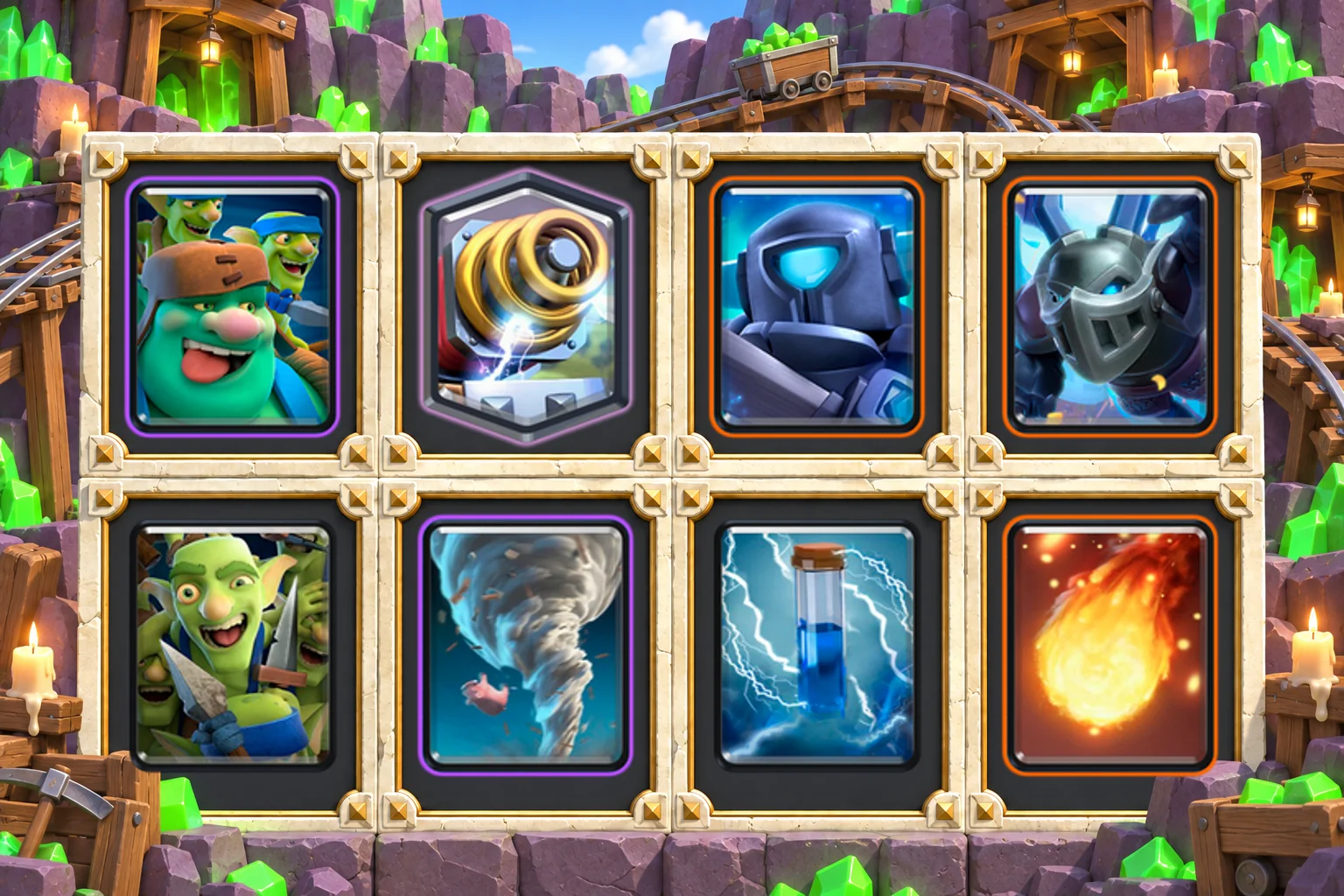
Average elixir: 3.9
Eight cards and their jobs
- Goblin Giant (6 elixir): Building-targeting tank with carried Spear Goblin support; does not replace a full air defense.
- Sparky (6 elixir): Charged heavy ground splash; protect against resets, distractions and air attacks.
- Mini P.E.K.K.A (4 elixir): Concentrated ground damage against a tank or other high-health attacker.
- Mega Minion (3 elixir): Durable single flying attacker for focused air or ground damage.
- Goblin Gang (3 elixir): Mixed melee and spear bodies for surrounds and supplementary air damage; fragile to spells.
- Tornado (3 elixir): Repositions troops and damages an area; placement determines whether the pull helps defense.
- Zap (2 elixir): Small air and ground hit plus brief stun/reset; does not replace heavy damage.
- Fireball (4 elixir): Immediate area damage and knockback; spend for useful defense or support value.
Pull blockers only when a shot can use the group
Sparky supplies charged ground damage while Goblin Giant can protect a useful survivor. Tornado may bring blockers into a valuable shot, but Mini P.E.K.K.A still handles immediate danger while Sparky charges. Mega Minion is the important air reserve, and the absence of a defensive building makes its timing especially consequential.
Opening and double elixir
Wait or split Gang safely rather than opening with the twelve-elixir tank-and-Sparky plan. In double elixir, build around a surviving Sparky and keep Zap for a specific interruption. Tornado should have a follow-up damage source ready instead of becoming an automatic cast whenever several units are visible.
Defensive order and matchups
Against Electro Wizard: Address the reset source with suitable damage or distraction before expecting Sparky to complete its shot. Mini P.E.K.K.A and useful Fireball value can help, depending on position. Pulling targets together while Sparky is repeatedly interrupted may simply create a larger dangerous group without the blast you expected.
Against Balloon: Mega Minion must engage early, with Tornado used for a destination that buys real damaging time. Gang's Spears are a limited backup around removal. No building provides an easy route extension, and neither Sparky nor Mini P.E.K.K.A can replace the missing air damage if the flyer is spent elsewhere.
A decision during the match
Sparky keeps being reset while the enemy counterpush grows. Adding Goblin Giant spends six without restoring the charged shot. Defend with the remaining resources, address the reset if possible and let the stalled attack end rather than using the tank to justify the earlier six-elixir investment.
One-card alternatives and upgrades
- Guards for Goblin Gang: Better shielded ground resilience but less air damage. New average 3.9 elixir.
- Arrows for Tornado: Straight swarm removal without repositioning. New average 3.9 elixir.
Maintain the selected tank plan with Sparky and Mega Minion useful in their separate jobs. Guards strengthen shielded ground distraction but remove Gang's air help. Arrows replaces Tornado with direct swarm removal and loses the positional setup, reducing one conditional combination while changing how blockers are handled.
Golem Night Witch Tornado

Average elixir: 4.3
Eight cards and their jobs
- Golem (8 elixir): Expensive building-targeting tank; commit only with room to defend the opposite lane.
- Night Witch (4 elixir): Ground melee support that produces flying Bats; needs protection from splash.
- Baby Dragon (4 elixir): Durable flying splash support; its damage alone is not a fast tank solution.
- Mega Minion (3 elixir): Durable single flying attacker for focused air or ground damage.
- Lumberjack (4 elixir): Fast ground damage whose dropped Rage can support survivors; death timing matters.
- Lightning (6 elixir): Expensive damage and stun on selected high-health targets; seek building plus support value.
- Tornado (3 elixir): Repositions troops and damages an area; placement determines whether the pull helps defense.
- Barbarian Barrel (2 elixir): Ground-line removal and a Barbarian body; cannot damage air.
Defend the other lane before adding Golem support
Golem buys time for Night Witch and air support while Baby Dragon and Tornado clear useful groups. Keep Lumberjack ready for fast ground pressure, and use Lightning when its targets justify the cost. With no building and several expensive cards, this is a deliberate beatdown choice that must keep a real response to fast pressure in the other lane.
Opening and double elixir
Wait or use Mega Minion reactively, and spend eight on Golem only when the opposite side can still be covered. In double elixir, build one supported lane rather than stacking every troop into the same spell area. Lightning should address meaningful targets, not become an automatic tower-chip purchase behind the tank.
Defensive order and matchups
Against Inferno Tower: Lightning can reset and damage Inferno when a viable push remains to exploit the window. Supporting distractions and targeting still matter after the cast. If Golem and its damage are already nearly gone, preserve the six elixir rather than buying a reset for an attack that cannot use it.
Against Battle Ram: When Golem is already walking, Lumberjack and Barbarian Barrel may need to contain the opposing charge and released troops. Their timing and the enemy support determine whether more help is necessary. Do not abandon that lane simply because Night Witch was the next card in the original offensive plan.
A decision during the match
The opponent commits fast pressure opposite Golem. Paying for defense leaves less immediate elixir for Night Witch and Lightning, but that can be the correct adjustment. Accept a smaller main push instead of turning an eight-elixir commitment into an uncontrolled tower trade just to complete the planned support order.
One-card alternatives and upgrades
- Mini P.E.K.K.A for Lumberjack: Ground damage without Rage support. New average 4.3 elixir.
- Fireball for Lightning: Lower commitment but loses heavy reset. New average 4.0 elixir.
Golem and Night Witch are substantial collection investments, while Mega Minion must remain useful during the return. Mini P.E.K.K.A replaces Lumberjack's damage role without the Rage drop. Fireball lowers Lightning's commitment while losing the heavier reset package, changing which prepared defenses the tank can challenge.
Electro Giant Bowler Tornado

Average elixir: 4.0
Eight cards and their jobs
- Electro Giant (7 elixir): Building-targeting tank with reactive close-range damage; opponents can exploit distance and high damage.
- Bowler (5 elixir): Ground line splash and eligible knockback; cannot shoot air.
- Phoenix (4 elixir): Flying single-target damage with a conditional egg rebirth; protect the egg rather than assume it survives.
- Cannon (3 elixir): Cheap ground-targeting pull; can draw Balloon but cannot shoot it.
- Bomber (2 elixir): Cheap ground splash behind a tank or defensive distraction; cannot shoot air.
- Tornado (3 elixir): Repositions troops and damages an area; placement determines whether the pull helps defense.
- Lightning (6 elixir): Expensive damage and stun on selected high-health targets; seek building plus support value.
- Barbarian Barrel (2 elixir): Ground-line removal and a Barbarian body; cannot damage air.
Do not pull high damage into a tank that cannot survive it
Electro Giant punishes nearby attackers through its reactive damage while Bowler controls ground lines and Phoenix supplies air damage. Tornado can improve defensive or offensive positions, but not every closer target is automatically favorable. A powerful defender brought beside an already weak tank may end the push before the expected return damage matters.
Opening and double elixir
Wait, use Bomber safely or place Cannon for actual pressure before purchasing the seven-elixir tank. In double elixir, support Electro Giant only with cards needed for the current answer. Lightning should include a meaningful defender or building, with enough reserve left to handle the next air approach.
Defensive order and matchups
Against P.E.K.K.A: P.E.K.K.A can deal substantial damage despite the tank's reactive effect. Use support, spacing and a sensible defensive sequence rather than expecting Electro Giant to win the contact automatically. A Tornado that brings her closer must have a worthwhile damage or positioning payoff, not merely satisfy the deck's usual combination.
Against Balloon: Cannon changes Balloon's route and Phoenix supplies the real air damage, with Tornado used to buy a useful firing window. Protect the egg only when its location and remaining defenders permit recovery. Bowler and Bomber cannot replace the flyer against this target even if their ground line is secure.
A decision during the match
Electro Giant is weak and Tornado could pull a high-damage defender beside him. If the tank will fall before the arrangement creates meaningful value, keep Tornado for defense instead. Evaluate the surviving health and follow-up damage rather than treating every close-range interaction as favorable.
One-card alternatives and upgrades
- Mega Minion for Phoenix: Cheaper focused air unit without egg recovery. New average 3.9 elixir.
- Electro Spirit for Bomber: Faster rotation and chain stun but loses ground splash damage. New average 3.9 elixir.
Maintain Electro Giant and Phoenix alongside the control and spell roles you actually use. Mega Minion lowers the air slot's cost and removes conditional egg recovery. Electro Spirit accelerates rotation in Bomber's slot but trades continuing ground splash for brief chain control, creating a different response to repeated small groups.
Lava Balloon Flying Machine

Average elixir: 4.0
Eight cards and their jobs
- Lava Hound (7 elixir): Expensive flying building-targeting tank; weak immediate defense against ground pressure.
- Balloon (5 elixir): Air win condition; threaten only when the air counter or building can be managed.
- Flying Machine (4 elixir): Fragile flying ranged support; place far enough away to use its reach.
- Mega Minion (3 elixir): Durable single flying attacker for focused air or ground damage.
- Guards (3 elixir): Shielded ground surround and distraction; no air targeting.
- Tombstone (3 elixir): Defensive pull with Skeleton distractions; vulnerable to splash.
- Fireball (4 elixir): Immediate area damage and knockback; spend for useful defense or support value.
- Arrows (3 elixir): Wide air and ground swarm removal; no reset effect.
Keep the ground answer before adding the second air threat
Lava Hound absorbs air-targeting fire while Balloon supplies the direct damage, with Flying Machine and Mega Minion covering different ranges. Guards and Tombstone carry much of the ground defense. This is a specialist air collection whose biggest commitment still needs a plan for the lane where none of its main attackers can defend promptly.
Opening and double elixir
Wait or use Tombstone reactively before paying seven for Hound. In double elixir, add Balloon only after checking the remaining air counter and the ground reserve. Space Flying Machine and the flyer so one Fireball does not collect the entire support investment.
Defensive order and matchups
Against P.E.K.K.A: Tombstone and Guards buy time while the ranged damage works, but supporting splash can remove the distractions. Protect or separate those small bodies rather than assuming they indefinitely contain P.E.K.K.A. Finish the dangerous support arrangement before spending five on an extra attacker elsewhere.
Against Inferno Tower: Neither Arrows nor Fireball supplies a dependable Inferno Tower beam reset. Use target timing, pressure and actual support damage to create a better attack, or wait for the building's condition to change. Do not spend both spells reflexively on a prepared defense and assume that is equivalent to Zap.
A decision during the match
A fast ground push appears opposite Hound. Fund Tombstone and Guards before adding Balloon, even if that leaves the air lane less threatening than planned. A smaller supported attempt with a surviving tower is often preferable to completing a twelve-elixir attacker pair while the ground defense is absent.
One-card alternatives and upgrades
- Musketeer for Flying Machine: Ground-based focused range with less flying pressure. New average 4.0 elixir.
- Barbarians for Guards: More ground damage at a much larger commitment. New average 4.3 elixir.
Keep the chosen air threats and Flying Machine useful while maintaining the ground cards that protect their commitment. Musketeer replaces flying range with ground-based focused shooting. Barbarians offer more ground damage than Guards at two extra elixir, making the already expensive offensive window harder to fund.
Lumberjack Balloon Tornado

Average elixir: 3.8
Eight cards and their jobs
- Balloon (5 elixir): Air win condition; threaten only when the air counter or building can be managed.
- Lumberjack (4 elixir): Fast ground damage whose dropped Rage can support survivors; death timing matters.
- Bowler (5 elixir): Ground line splash and eligible knockback; cannot shoot air.
- Baby Dragon (4 elixir): Durable flying splash support; its damage alone is not a fast tank solution.
- Mega Minion (3 elixir): Durable single flying attacker for focused air or ground damage.
- Tornado (3 elixir): Repositions troops and damages an area; placement determines whether the pull helps defense.
- Freeze (4 elixir): Temporary immobilization to exploit an existing attack window; no lasting defender.
- Barbarian Barrel (2 elixir): Ground-line removal and a Barbarian body; cannot damage air.
Create a Freeze window with a defensible board
Bowler and Baby Dragon handle useful groups while Lumberjack supplies ground damage and Mega Minion provides focused air hits. Tornado can improve splash alignment. With no building, this specialist Balloon plan needs careful defensive timing, and Freeze should exploit an already viable connection rather than promise a tower from any blind cast.
Opening and double elixir
Wait or use Mega Minion reactively while retaining the support needed for the first ground threat. In double elixir, Balloon follows useful survivors and Freeze waits until the remaining travel and defender positions create a real window. Keep enough defense after that nine-elixir pair rather than counting the frozen units as permanently removed.
Defensive order and matchups
Against Hog Rider: Lumberjack and Tornado can create a timing-based defense, with the pull directed toward useful damage or a safer position. It is not an automatic building pull or guaranteed activation. Add the appropriate support when the enemy's troops or levels demand it, while preserving the next air damage card.
Against Inferno Dragon: Freeze buys a temporary interruption but does not eliminate Inferno Dragon. Mega Minion must contribute useful damage while the target is controlled. If the Dragon survives and resumes attacking, a second offensive purchase needs to account for that remaining defender rather than assuming the beam problem disappeared.
A decision during the match
Balloon is too far from the tower to use most of the available Freeze time. Save the four elixir or wait for a better moment instead of casting because the defender has appeared. If the attack is already lost, defend what returns rather than rescuing the original plan at any cost.
One-card alternatives and upgrades
- Fireball for Freeze: Immediate support damage and more conventional defense. New average 3.8 elixir.
- Valkyrie for Bowler: Cheaper local ground splash without long knockback line. New average 3.6 elixir.
Balloon and Lumberjack need useful levels, with Mega Minion maintained for the concentrated air role. Fireball trades Freeze's conditional window for immediate support damage and more conventional defense. Valkyrie lowers Bowler's cost but removes his rolling control line, changing how the ground approach is managed.
X-Bow Ice Wizard Tornado

Average elixir: 3.5
Eight cards and their jobs
- X-Bow (6 elixir): Long-range ground siege or defensive building; needs protection and disciplined commitment.
- Tesla (4 elixir): Air and ground defensive building; preserve its useful lifetime for an actual attack.
- Ice Wizard (3 elixir): Ranged air and ground damage with slow; low damage needs a protected partner.
- Knight (3 elixir): Low-cost ground tank that occupies support and protects ranged damage.
- Skeletons (1 elixir): One-elixir ground distraction that buys shots and helps rotate the hand.
- Tornado (3 elixir): Repositions troops and damages an area; placement determines whether the pull helps defense.
- Rocket (6 elixir): Expensive concentrated damage; check current level-specific tower damage before a finish.
- The Log (2 elixir): Ground-line damage and knockback; cannot clear flying units.
Keep Tesla affordable before buying a spell finish
Tesla protects a useful X-Bow position while Knight occupies support, Ice Wizard slows and Tornado buys time when the destination helps. Rocket offers a costly conditional finish. This technical siege deck can use X-Bow defensively; an offensive placement is a decision based on the ready tank and reserve, not a requirement every cycle.
Opening and double elixir
Split Skeletons safely or wait to learn the opposing tank before spending six offensively. In double elixir, stabilize a difficult lane with defensive X-Bow when needed and look for a genuine offensive opening later. Keep the damage and control package available rather than paying Rocket whenever the tower health looks low.
Defensive order and matchups
Against Royal Giant: Royal Giant's ranged building damage can make a ready offensive X-Bow an expensive target. Defend the current approach and evaluate the next cycle instead of buying every support card to protect a lock that cannot develop. Knight should occupy reachable support while Tesla supplies the damage needed locally.
Against Balloon: Tesla and Ice Wizard need early positions, with Tornado buying useful time rather than simply moving the attacker closer. X-Bow cannot shoot air. Preserve the building and shooter before paying for another siege, especially when a removal spell can threaten the slow ranged support.
A decision during the match
Rocket would leave insufficient elixir to deploy Tesla against the known next threat. Wait unless the current damage shown in your game actually ends the match. A speculative finish that does not kill the tower can give the opponent the exact undefended window they need.
One-card alternatives and upgrades
- Archers for Ice Wizard: More split damage but no slow. New average 3.5 elixir.
- Fireball for Rocket: Cheaper responses, loses heavy finishing potential. New average 3.3 elixir.
Maintain X-Bow, Tesla and the useful slow-and-control defense, with Rocket considered through verified level-specific damage. Archers trade slow for more split shooting damage. Fireball lowers the spell commitment and improves response flexibility while removing the heavier finishing potential that shaped the original endgame.
Pull attackers where your defenders can safely damage them
Fisherman-Hunter and Executioner-Tornado solve different positioning problems. A ground hook can put a target where Hunter’s pellets concentrate, provided Hunter is protected. Tornado can improve an axe line only if Executioner is already able to fire into the resulting group.
If Fisherman pulls a high-damage melee defender onto a vulnerable Hunter, the hook may sacrifice the very damage source it was meant to help. Change the angle or withhold it. If Tornado brings support closer to your weak tower without useful splash ready, choose a safer defensive destination rather than chase an impressive-looking cluster.
Neither interaction comes with a guaranteed King activation, exact trade or zero-hit promise here. Supporting units, timing and levels change the outcome. Watch where the attacker will land and which defender remains able to work, then judge whether another offensive card is affordable.
Read Cannon Cart’s current form
Supercell’s Cannon Cart rework combined its old health structure and made it become a building at 50% health. The June follow-up confirms that the old shield was removed. Do not plan around two fresh health bars or a stationary Cart continuing to walk.
In Royal Giant Cannon Cart Lane, a healthy moving Cart can justify Royal Giant ahead of it. Once Cart is stationary deep in your half, its value is local ground defense. The new six-elixir attack must stand on its own or use a different real survivor.
In Graveyard Cannon Cart Counterpush, a Cart close to transforming may be less reliable as the tower tank than a healthy Knight. Graveyard needs useful tower attention during its actual Skeleton window, not a unit that was moving when you first planned the attack.
Keep the defense that makes another attack possible
Royal Giant costs six, Graveyard five and Hog four. Their follow-up packages can be much larger: Royal Giant plus Lightning costs twelve, Graveyard plus Poison nine, and Executioner plus Tornado eight before any offensive Hog. Those totals require different reserves and, in some cases, regeneration beyond a ten-elixir bank.
The heavy specialists also need the other lane covered. Hound plus Balloon costs twelve; a Golem already walking does not make Lumberjack or the air defenders free. Accept a smaller supported push when a real opposite-lane threat consumes the original support budget.
Phoenix rebirth remains conditional on the egg surviving. Mother Witch needs eligible cursed deaths. Freeze needs an attack close enough to use its current shorter window. These are reasons to inspect the living board before buying more support, rather than count every possible payoff as already secured.
Use the current interaction, not an old clip
The October balance update restored a small Crown Tower hit when Goblin Drill appears, so the old zero-chip assumption no longer applies. It also made Skeletons deploy closer together and reduced Royal Ghost’s health. Keep cheap defenders out of ready splash and check whether a damaged Ghost can still support the counterpush. Barbarian Barrel no longer fully counters Wall Breakers by itself, so retain another response when they are shown. The August changes to lone Spirit connections and Bowler/Executioner projectile reach still matter, while the September update shortened Freeze and reduced Fireball’s Crown Tower damage. Check the current in-game damage before buying a spell finish.
Normal card advice also should not inherit a special form’s effect. A standard Hunter is being used for his shots, and the copy links specify the ordinary eight cards. Inspect your owned forms and current in-game damage before applying a different interaction to a match.
Make one role change you can explain
In Royal Giant Fisherman Hunter, Valkyrie replaces Royal Ghost and raises the displayed average from 3.0 to 3.1. You gain tougher local ground splash but lose invisibility and spend one more elixir. Choose that swap when contact with ground groups is the repeated problem.
In Graveyard Ice Wizard Control, Musketeer replaces Ice Wizard and raises the average from 3.4 to 3.5. You gain more focused air damage and lose slow. The change is useful when the existing control repeatedly lacks damage, but it alters how much time the other defenders receive.
Upgrade one selected win condition, the damage card that repeatedly keeps the tower alive and the relevant spell interactions. Do not spread resources over every new Legendary or specialist tank. The cards that make your current defensive sequence reliable deserve priority over an unused alternative.
Questions before Executioner’s Kitchen
Do I need Champions for Arena 15?
No. These are Champion-free standard-card configurations. The selection is based on ordinary collection fit and defensive roles, with no requirement to own a particular special form or unusual early reward.
Does every deck need Tornado now?
No. Tornado is useful when its position change has a purpose. A simpler Cage-Musketeer or Tesla-Musketeer defense may better fit your levels and timing. Without reachable follow-up damage, another control spell can move the problem without solving it.
Can Fisherman protect against Balloon?
His hook cannot pull the flying attacker. Preserve Hunter, Phoenix, Mega Minion or whichever real air damage the chosen list contains. A ground pull elsewhere does not replace that defensive job.
Do the copy links set my Evolution or Hero?
The links select the eight standard cards. Supercell’s March slot rules unlock Evolution at Arena 3, Hero at Arena 5 and Wild at Arena 10, but the forms still require ownership and configuration. Hero forms and Champion rarity are different concepts.
Are these decks ranked by a personal match sample?
No. The ordering is editorial, with three accessible starting plans followed by alternatives and specialists. The explanations give conditional tactics and tradeoffs; the guide does not report measured win rates or guarantee trophy gains.
Should I rebuild the deck at 5,500 trophies?
Keep a useful leveled core while learning what the next unlocks solve. Browse the arena guide library, identify the defense that fails and change one role deliberately. Entering another arena does not make every familiar card obsolete.
Review notes
These recommendations cover Miner’s Mine at 5,000 trophies. Arena identity and ordinary card availability were checked against maintained listings, with official updates used for changed mechanics. Actual ownership, forms and useful levels can differ by account; the in-game collection remains the final check before copying.
Choose the deck whose defensive sequence you can repeat. Decide where the target should land, which unit supplies the damage and what remains for the next attack. Improve that sequence before purchasing a different eight-card plan.
This is an independent fan guide. It is not affiliated with, endorsed by, sponsored by or approved by Supercell. Clash Royale and its game assets belong to Supercell. See the Supercell Fan Content Policy.